


 Cart
Cart
 sales@molnova.com


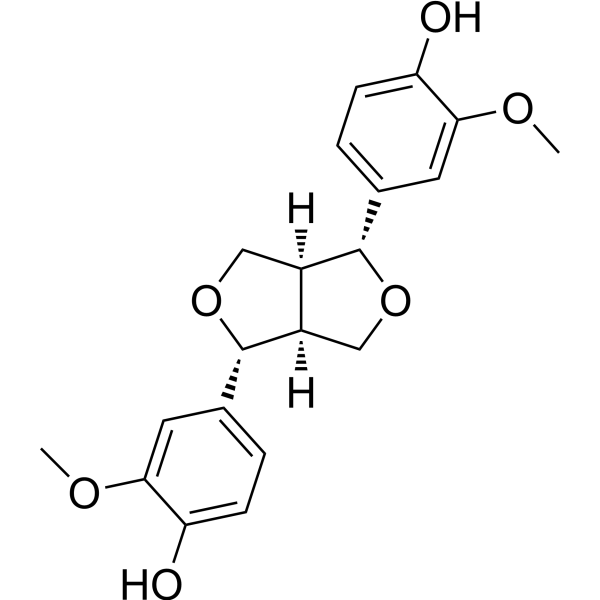
(-)-Pinoresinol
CAS No. 81446-29-9
(-)-Pinoresinol( —— )
Catalog No. M29215 CAS No. 81446-29-9
(-)-Pinoresinol is isolated from the whole plant of Serissa japonica (Thunb.) Thunb.
Purity : >98% (HPLC)
 COA
Datasheet
HNMR
HPLC
MSDS
Handing Instructions
COA
Datasheet
HNMR
HPLC
MSDS
Handing Instructions
| Size | Price / USD | Stock | Quantity |
| 1 mL x 10 mM in DMSO | 339 | In Stock |


|
| 5MG | 337 | In Stock |
|
| 10MG | 472 | In Stock |
|
| 25MG | 735 | In Stock |
|
| 50MG | 918 | In Stock |
|
| 100MG | 1293 | In Stock |
|
| 200MG | Get Quote | In Stock |
|
| 500MG | Get Quote | In Stock |
|
| 1G | Get Quote | In Stock |
|
Biological Information
-
Product Name(-)-Pinoresinol
-
NoteResearch use only, not for human use.
-
Brief Description(-)-Pinoresinol is isolated from the whole plant of Serissa japonica (Thunb.) Thunb.
-
Description(-)-Pinoresinol is isolated from the whole plant of Serissa japonica (Thunb.) Thunb.(In Vitro):(-)-Pinoresinol may serve as potential chemotaxonomic makers for Serissa japonica.
-
In Vitro——
-
In Vivo——
-
Synonyms——
-
PathwayOthers
-
TargetOther Targets
-
Recptor——
-
Research Area——
-
Indication——
Chemical Information
-
CAS Number81446-29-9
-
Formula Weight358.39
-
Molecular FormulaC20H22O6
-
Purity>98% (HPLC)
-
Solubility——
-
SMILESCOc1cc(ccc1O)[C@@H]1OC[C@@H]2[C@H]1CO[C@H]2c1ccc(O)c(OC)c1
-
Chemical Name——
Shipping & Storage Information
-
Storage(-20℃)
-
ShippingWith Ice Pack
-
Stability≥ 2 years
Reference
molnova catalog



related products
-
(E)-3-(Naphth-1-yl)a...
(E)-3-(Naphth-1-yl)acrylic acid (3-(1-Naphthyl)acrylic acid) is a biochemical reagent that can be used to synthesize a variety of compounds and participate in many reactions in the body.
-
TAS-102
TAS-102 is an investigational drug candidate for metastatic colorectal Y. It contains trifluridine (TFT) and Tipiracil hydrochloride (TTP) in a molar ratio of 2:1.
-
4-Demethyl Picropodo...
4'-Demethyl Picropodophyllotoxin
