


 Cart
Cart
 sales@molnova.com


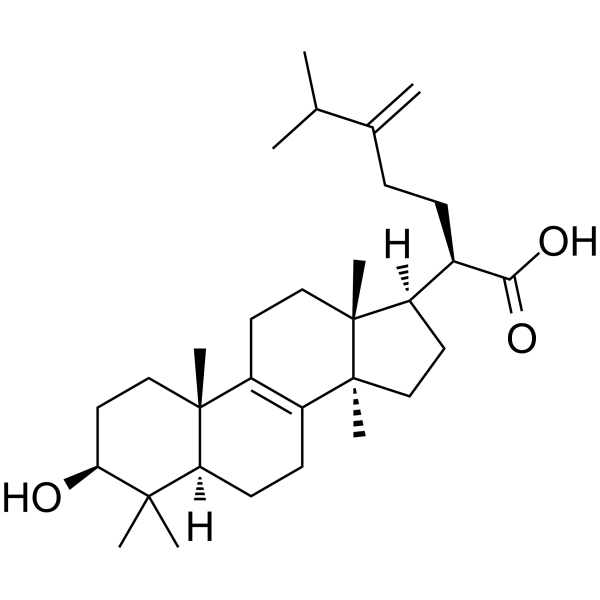
Eburicoic acid
CAS No. 560-66-7
Eburicoic acid( Eburicoicacid | ZINC4655149 | MFCD00238594 )
Catalog No. M29136 CAS No. 560-66-7
Eburicoic acid exhibits anti-inflammatory and antioxidant activity thereby protecting the liver from CCl4-induced hepatic damage and can be used in studies about anti-liver cancer.
Purity : >98% (HPLC)
 COA
Datasheet
HNMR
HPLC
MSDS
Handing Instructions
COA
Datasheet
HNMR
HPLC
MSDS
Handing Instructions
| Size | Price / USD | Stock | Quantity |
| 2MG | 105 | In Stock |


|
| 5MG | 169 | In Stock |
|
| 10MG | 259 | In Stock |
|
| 25MG | 419 | In Stock |
|
| 100MG | Get Quote | In Stock |
|
| 200MG | Get Quote | In Stock |
|
| 500MG | Get Quote | In Stock |
|
| 1G | Get Quote | In Stock |
|
Biological Information
-
Product NameEburicoic acid
-
NoteResearch use only, not for human use.
-
Brief DescriptionEburicoic acid exhibits anti-inflammatory and antioxidant activity thereby protecting the liver from CCl4-induced hepatic damage and can be used in studies about anti-liver cancer.
-
DescriptionEburicoic acid exhibits anti-inflammatory and antioxidant activity thereby protecting the liver from CCl4-induced hepatic damage and can be used in studies about anti-liver cancer.
-
In Vitro——
-
In Vivo——
-
SynonymsEburicoicacid | ZINC4655149 | MFCD00238594
-
PathwayOthers
-
TargetAntioxidant
-
RecptorAntioxidant
-
Research Area——
-
Indication——
Chemical Information
-
CAS Number560-66-7
-
Formula Weight470.738
-
Molecular FormulaC31H50O3
-
Purity>98% (HPLC)
-
Solubility——
-
SMILES[H][C@@]12CCC3=C(CC[C@]4(C)[C@H](CC[C@@]34C)[C@@H](CCC(=C)C(C)C)C(O)=O)[C@@]1(C)CC[C@H](O)C2(C)C
-
Chemical Name——
Shipping & Storage Information
-
Storage(-20℃)
-
ShippingWith Ice Pack
-
Stability≥ 2 years
Reference
molnova catalog



related products
-
Scopoletin acetate
Scopoletin acetate (7-Acetoxy-6-methoxycoumari) is a coumarin analog derived from Artemisia granatensis with antioxidant, antimicrobial, cardioprotective and anticancer activities.
-
3-Aminopropionitrile...
3-Aminopropionitrile fumarate;B-aminopropionitrile.
-
L(+)-Tartaric acid
Tartaric acid occurs naturally in many plants particularly grapes and tamarinds and is one of the main acids found in wine. It is used as an antioxidant. Salts of tartaric acid are known as tartrates.
