


 Cart
Cart
 sales@molnova.com


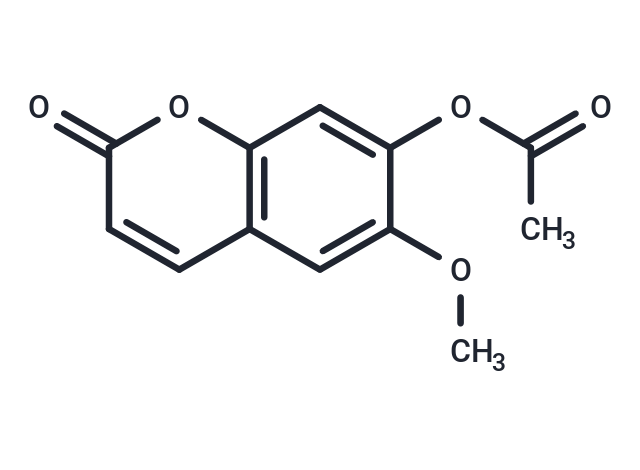
Scopoletin acetate
CAS No. 56795-51-8
Scopoletin acetate( —— )
Catalog No. M37744 CAS No. 56795-51-8
Scopoletin acetate (7-Acetoxy-6-methoxycoumari) is a coumarin analog derived from Artemisia granatensis with antioxidant, antimicrobial, cardioprotective and anticancer activities.
Purity : >98% (HPLC)
 COA
Datasheet
HNMR
HPLC
MSDS
Handing Instructions
COA
Datasheet
HNMR
HPLC
MSDS
Handing Instructions
| Size | Price / USD | Stock | Quantity |
| 1 mL x 10 mM in DMSO | 1651 | In Stock |


|
| 5MG | 1205 | In Stock |
|
| 100MG | Get Quote | In Stock |
|
| 200MG | Get Quote | In Stock |
|
| 500MG | Get Quote | In Stock |
|
| 1G | Get Quote | In Stock |
|
Biological Information
-
Product NameScopoletin acetate
-
NoteResearch use only, not for human use.
-
Brief DescriptionScopoletin acetate (7-Acetoxy-6-methoxycoumari) is a coumarin analog derived from Artemisia granatensis with antioxidant, antimicrobial, cardioprotective and anticancer activities.
-
DescriptionScopoletin acetate is a coumarin isolated from Artemisia granatensis.
-
In Vitro——
-
In Vivo——
-
Synonyms——
-
PathwayOthers
-
TargetAntioxidant
-
RecptorAntioxidant | Antibacterial
-
Research Area——
-
Indication——
Chemical Information
-
CAS Number56795-51-8
-
Formula Weight234.2
-
Molecular FormulaC12H10O5
-
Purity>98% (HPLC)
-
Solubility——
-
SMILESO=C1OC=2C=C(OC(=O)C)C(OC)=CC2C=C1
-
Chemical Name——
Shipping & Storage Information
-
Storage(-20℃)
-
ShippingWith Ice Pack
-
Stability≥ 2 years
Reference
1. Barrero AF, et al. Terpenes and polyacetylenes from cultivated Artemisia granatensis boiss (Royal chamomile) and their defensive properties. Phytochemistry. 2013;94:192-197.?
molnova catalog



related products
-
3-Indolepropionic ac...
3-Indolepropionic acid is shown to be a powerful antioxidant and has potential in the treatment for Alzheimer’s disease.
-
Farrerol
Farrerol modulates TAP and BNBD5 gene expression in mammary gland, enhances bMEC defense against S. aureus infection and could be useful in protection against bovine mastitis.
-
Oleoylestrone
Oleoylestrone (MP-101) is present in plasma and adipose tissue, has potential antioxidant effects, induces loss of body fat in rats, and can be used for weight loss.
