


 Cart
Cart
 sales@molnova.com


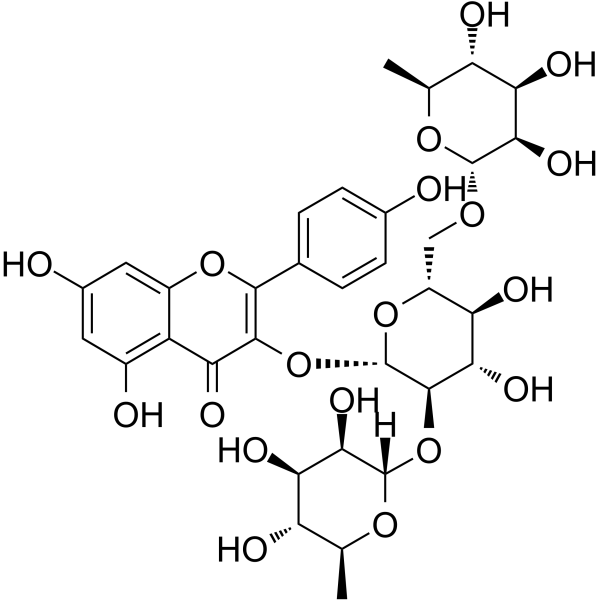
Clitorin
CAS No. 55804-74-5
Clitorin( —— )
Catalog No. M29118 CAS No. 55804-74-5
Clitorin has free radical scavenging property. It shows significant interactions with CD38, it may have anti-hyperglycemic potential.
Purity : >98% (HPLC)
 COA
Datasheet
HNMR
HPLC
MSDS
Handing Instructions
COA
Datasheet
HNMR
HPLC
MSDS
Handing Instructions
| Size | Price / USD | Stock | Quantity |
| 5MG | 140 | In Stock |


|
| 10MG | 230 | In Stock |
|
| 25MG | 377 | In Stock |
|
| 50MG | 555 | In Stock |
|
| 100MG | 790 | In Stock |
|
| 200MG | Get Quote | In Stock |
|
| 500MG | Get Quote | In Stock |
|
| 1G | Get Quote | In Stock |
|
Biological Information
-
Product NameClitorin
-
NoteResearch use only, not for human use.
-
Brief DescriptionClitorin has free radical scavenging property. It shows significant interactions with CD38, it may have anti-hyperglycemic potential.
-
DescriptionClitorin has free radical scavenging property. It shows significant interactions with CD38, it may have anti-hyperglycemic potential.(In Vitro):Antiplasmodial activity of extracts was confirmed and the active fractions in the extract were identified by HPLC-based activity profiling, a gradient HPLC fractionation of a single injection of the extract, followed by offline bioassay of the obtained microfractions. For preparative isolation of compounds, an alkaloidal fraction was obtained via adsorption on cationic ion exchange resin. Active compounds were purified by HPLC-MS and MPLC-ELSD. Structures were established by HR-ESI-MS and NMR spectroscopy. For compounds 5 and 7 absolute configuration was confirmed by comparison of experimental and calculated electronic circular dichroism (ECD) spectroscopy data, and by X-ray crystallography. Compounds were tested for bioactivity in vitro against four parasites (Trypanosoma brucei rhodesiense, Trypanosoma cruzi, Leishmania donovani, and Plasmodium falciparum), and in the Plasmodium berghei mouse model. Profiling indicated flavonoids and alkaloids in the active time windows. A total of nine compounds were isolated. Four were known flavonols--manghaslin, Clitorin, rutin, and nicotiflorin. Five compounds isolated from the alkaloidal fraction were piperidine alkaloids. Compounds 5 and 6 were inactive carpamic acid and methyl carpamate, while three alkaloids 7-9 showed high antiplasmodial activity and low cytotoxicity. When tested in the Plasmodium berghei mouse model, carpaine (7) did not increase the survival time of animals.
-
In Vitro——
-
In Vivo——
-
Synonyms——
-
PathwayAngiogenesis
-
TargetPKC
-
RecptorPKC
-
Research Area——
-
Indication——
Chemical Information
-
CAS Number55804-74-5
-
Formula Weight740.664
-
Molecular FormulaC33H40O19
-
Purity>98% (HPLC)
-
SolubilityIn Vitro:?DMSO : 100 mg/mL (135.01 mM)
-
SMILESC[C@@H]1O[C@@H](OC[C@H]2O[C@@H](Oc3c(oc4cc(O)cc(O)c4c3=O)-c3ccc(O)cc3)[C@H](O[C@@H]3O[C@@H](C)[C@H](O)[C@@H](O)[C@H]3O)[C@@H](O)[C@@H]2O)[C@H](O)[C@H](O)[C@H]1O
-
Chemical Name——
Shipping & Storage Information
-
Storage(-20℃)
-
ShippingWith Ice Pack
-
Stability≥ 2 years
Reference
molnova catalog



related products
-
Miltefosine
Miltefosine is used for the treatment of visceral and cutaneous leishmaniasis, and is undergoing clinical trials for this use in several other countries.
-
PKC412
A potent, selective PKC inhibitor with IC50 of 50 nM.
-
Staurosporine
Staurosporine is a potent PKC inhibitor for PKCα, PKCγ and PKCη.
