


 Cart
Cart
 sales@molnova.com


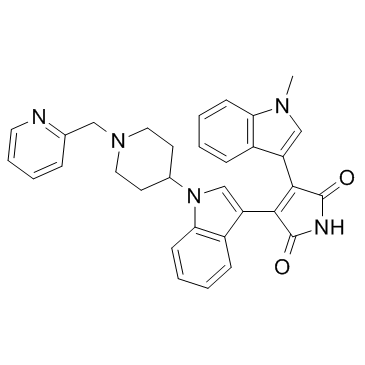
Enzastaurin
CAS No. 170364-57-5
Enzastaurin( LY317615 | LY-317615 | LY 317615 )
Catalog No. M12602 CAS No. 170364-57-5
A potent, selective, ATP-competitive PKCβ inhibitor with IC50 of 6 nM.
Purity : >98% (HPLC)
 COA
Datasheet
HNMR
HPLC
MSDS
Handing Instructions
COA
Datasheet
HNMR
HPLC
MSDS
Handing Instructions
| Size | Price / USD | Stock | Quantity |
| 1 mL x 10 mM in DMSO | 46 | In Stock |


|
| 5MG | 41 | In Stock |
|
| 10MG | 58 | In Stock |
|
| 25MG | 84 | In Stock |
|
| 50MG | 116 | In Stock |
|
| 100MG | 184 | In Stock |
|
| 200MG | Get Quote | In Stock |
|
| 500MG | Get Quote | In Stock |
|
| 1G | Get Quote | In Stock |
|
Biological Information
-
Product NameEnzastaurin
-
NoteResearch use only, not for human use.
-
Brief DescriptionA potent, selective, ATP-competitive PKCβ inhibitor with IC50 of 6 nM.
-
DescriptionA potent, selective, ATP-competitive PKCβ inhibitor with IC50 of 6 nM; weakly inhibits PKCα, PKCγ, and PKCε with IC50 of 39, 83, and 110 nM, respectively; induces apoptosis and suppresses the proliferation of tumor cells, suppresses the phosphorylation of GSK3β Ser9, ribosomal protein S6(S240/244) and AKT(Thr308); suppresses tumor growth through multiple mechanism in vivo; orally active.Blood Cancer Phase 3 Discontinued(In Vitro):Enzastaurin (LY317615) application results in a marked dose-dependent inhibition of growth in all MM cell lines investigated, including MM.1S, MM.1R, RPMI 8226 (RPMI), RPMI-Dox40 (Dox40), NCI-H929, KMS-11, OPM-2, and U266, with IC50 from 0.6-1.6 μM. Enzastaurin direct impacts human tumor cells, inducing apoptosis and suppressing proliferation in cultured tumor cells. Enzastaurin also suppresses the phosphorylation of GSK3βser9, ribosomal protein S6S240/244, and AKTThr308 while having no direct effect on VEGFR phosphorylation.Enzastaurin increases apoptosis in malignant lymphocytes of CTCL. When combined with GSK3 inhibitors, enzastaurin demonstrates an enhancement of cytotoxicity levels. Treatment with a combination of enzastaurin and the GSK3 inhibitor AR-A014418 leads to increased levels of β-catenin total protein and β-catenin-mediated transcription. Blocking of β-catenin-mediated transcription or small hairpin RNA (shRNA) knockdown of β-catenin induces the same cytotoxic effects as that of enzastaurin plus AR-A014418. Additionally, treatment with enzastaurin and AR-A014418 decreases the mRNA levels and surface expression of CD44.(In Vivo):Treatment of xenografts with Enzastaurin and radiation produces greater reductions in density of microvessels than either treatment alone. The decrease in microvessel density corresponds to delayed tumor growth.
-
In VitroEnzastaurin (LY317615) application results in a marked dose-dependent inhibition of growth in all MM cell lines investigated, including MM.1S, MM.1R, RPMI 8226 (RPMI), RPMI-Dox40 (Dox40), NCI-H929, KMS-11, OPM-2, and U266, with IC50 from 0.6-1.6 μM. Enzastaurin direct impacts human tumor cells, inducing apoptosis and suppressing proliferation in cultured tumor cells. Enzastaurin also suppresses the phosphorylation of GSK3βser9, ribosomal protein S6S240/244, and AKTThr308 while having no direct effect on VEGFR phosphorylation.Enzastaurin increases apoptosis in malignant lymphocytes of CTCL. When combined with GSK3 inhibitors, enzastaurin demonstrates an enhancement of cytotoxicity levels. Treatment with a combination of enzastaurin and the GSK3 inhibitor AR-A014418 leads to increased levels of β-catenin total protein and β-catenin-mediated transcription. Blocking of β-catenin-mediated transcription or small hairpin RNA (shRNA) knockdown of β-catenin induces the same cytotoxic effects as that of enzastaurin plus AR-A014418. Additionally, treatment with enzastaurin and AR-A014418 decreases the mRNA levels and surface expression of CD44.
-
In VivoTreatment of xenografts with Enzastaurin and radiation produces greater reductions in density of microvessels than either treatment alone. The decrease in microvessel density corresponds to delayed tumor growth.
-
SynonymsLY317615 | LY-317615 | LY 317615
-
PathwayAngiogenesis
-
TargetPKC
-
RecptorPKCα|PKCβ|PKCγ|PKCε
-
Research AreaCancer
-
IndicationBlood cancer
Chemical Information
-
CAS Number170364-57-5
-
Formula Weight515.605
-
Molecular FormulaC32H29N5O2
-
Purity>98% (HPLC)
-
Solubility10 mM in DMSO
-
SMILESCN1C=C(C2=CC=CC=C12)C1=C(C(=O)NC1=O)C1=CN(C2CCN(CC3=NC=CC=C3)CC2)C2=CC=CC=C12 |c:2,6,30,32,40,t:4,8,12,20,28,38,42|
-
Chemical Name1H-Pyrrole-2,5-dione, 3-(1-methyl-1H-indol-3-yl)-4-[1-[1-(2-pyridinylmethyl)-4-piperidinyl]-1H-indol-3-yl]-
Shipping & Storage Information
-
Storage(-20℃)
-
ShippingWith Ice Pack
-
Stability≥ 2 years
Reference
1. Graff JR, et al. Cancer Res. 2005 Aug 15;65(16):7462-9.
2. Faul MM, et al. Bioorg Med Chem Lett. 2003 Jun 2;13(11):1857-9.
3. Querfeld C, et al. J Invest Dermatol. 2006 Jul;126(7):1641-7.
4. Rizvi MA, et al. Mol Cancer Ther. 2006 Jul;5(7):1783-9.
molnova catalog



related products
-
Pep2m, myristoylated
Cell-permeable, myristoylated form of pep2m. Peptide inhibitor of the interaction between the C-terminus of the GluA2 (AMPA receptor) subunit and N-ethylmaleimide-sensitive fusion protein (NSF), a protein that regulates AMPA receptor function. Reduces postsynaptic currents in CA1 neurons, AMPA-mediated currents in cultured hippocampal neurons and AMPA receptor surface expression.
-
Bisindolylmaleimide ...
Bisindolylmaleimide IV is a protein kinase C (PKC) ?cell permeable inhibitor(?IC50 : 0.10 - 0.55 μM).
-
OSU-2S
A non-immunosuppressive FTY720 analogue, PKCδ activator with higher antiproliferative potency.
