


 Cart
Cart
 sales@molnova.com


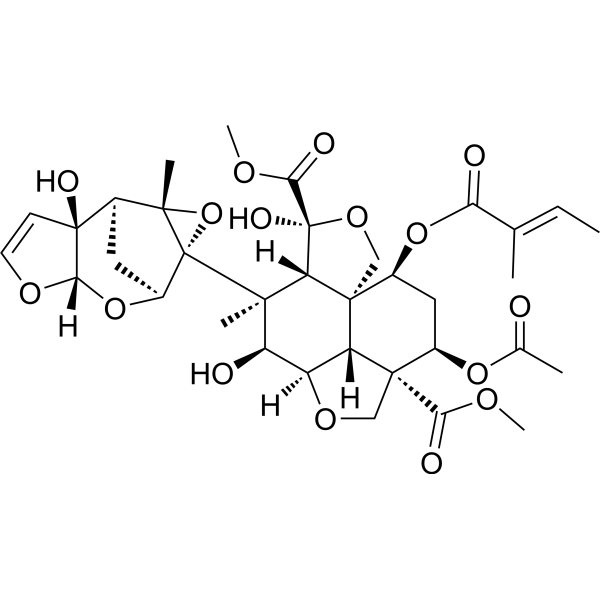
Azadirachtin
CAS No. 11141-17-6
Azadirachtin( —— )
Catalog No. M29096 CAS No. 11141-17-6
Azadirachtin has antifungal activity, used as an insecticide.
Purity : >98% (HPLC)
 COA
Datasheet
HNMR
HPLC
MSDS
Handing Instructions
COA
Datasheet
HNMR
HPLC
MSDS
Handing Instructions
| Size | Price / USD | Stock | Quantity |
| 1 mL x 10 mM in DMSO | 316 | In Stock |


|
| 5MG | 215 | In Stock |
|
| 10MG | 330 | In Stock |
|
| 25MG | 548 | In Stock |
|
| 100MG | Get Quote | In Stock |
|
| 200MG | Get Quote | In Stock |
|
| 500MG | Get Quote | In Stock |
|
| 1G | Get Quote | In Stock |
|
Biological Information
-
Product NameAzadirachtin
-
NoteResearch use only, not for human use.
-
Brief DescriptionAzadirachtin has antifungal activity, used as an insecticide.
-
DescriptionAzadirachtin has antifungal activity, used as an insecticide.
-
In Vitro——
-
In Vivo——
-
Synonyms——
-
PathwayApoptosis
-
TargetApoptosis
-
RecptorApoptosis
-
Research Area——
-
Indication——
Chemical Information
-
CAS Number11141-17-6
-
Formula Weight720.721
-
Molecular FormulaC35H44O16
-
Purity>98% (HPLC)
-
SolubilityIn Vitro:?DMSO : ≥ 100 mg/mL (138.75 mM)
-
SMILES[H][C@@]12OC=C[C@]1(O)[C@@H]1C[C@H](O2)[C@]2(O[C@@]12C)[C@]1(C)[C@H](O)[C@]2([H])OC[C@@]3([C@@H](C[C@H](OC(=O)C(\C)=C\C)[C@@]4(CO[C@](O)(C(=O)OC)[C@@]14[H])[C@@]23[H])OC(C)=O)C(=O)OC
-
Chemical Name——
Shipping & Storage Information
-
Storage(-20℃)
-
ShippingWith Ice Pack
-
Stability≥ 2 years
Reference
molnova catalog



related products
-
Fmoc-D-Cha-OH
Fmoc-D-Cha-OH (FDCO) is an apoptotic DNase γ inhibitor that inhibits the release of HMGB1.
-
Pivanex
Pivanex is an orally active HDAC inhibitor and an antimetastatic and antiangiogenic agent. Pivanex downregulates the Bcr-Abl protein and enhances apoptosis.
-
Polygalacin D
Polygalacin D shows anti- proliferation, anti-inflammary, and hepatoprotective activities.
