


 Cart
Cart
 sales@molnova.com


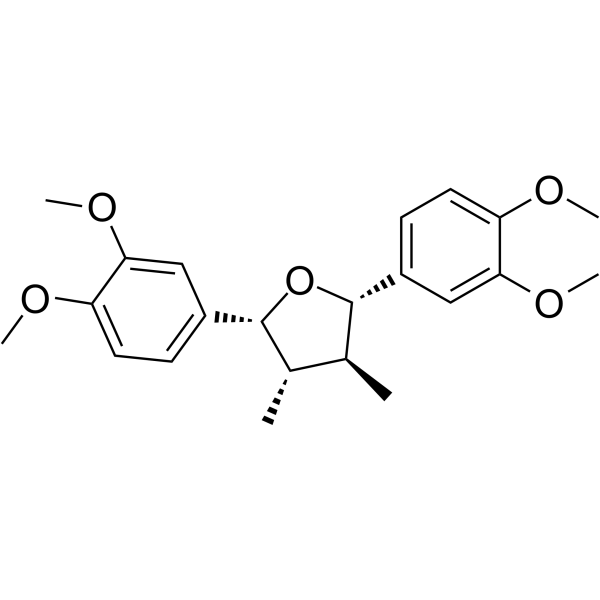
Veraguensin
CAS No. 19950-55-1
Veraguensin( —— )
Catalog No. M29056 CAS No. 19950-55-1
Veraguensin is derived from Magnolia sp.. Veraguensin inhibits bone resorption and shows high antileishmanial activity.
Purity : >98% (HPLC)
 COA
Datasheet
HNMR
HPLC
MSDS
Handing Instructions
COA
Datasheet
HNMR
HPLC
MSDS
Handing Instructions
| Size | Price / USD | Stock | Quantity |
| 5MG | 180 | In Stock |


|
| 10MG | 297 | In Stock |
|
| 25MG | 502 | In Stock |
|
| 50MG | 699 | In Stock |
|
| 100MG | Get Quote | In Stock |
|
| 200MG | Get Quote | In Stock |
|
| 500MG | Get Quote | In Stock |
|
| 1G | Get Quote | In Stock |
|
Biological Information
-
Product NameVeraguensin
-
NoteResearch use only, not for human use.
-
Brief DescriptionVeraguensin is derived from Magnolia sp.. Veraguensin inhibits bone resorption and shows high antileishmanial activity.
-
DescriptionVeraguensin is derived from Magnolia sp.. Veraguensin inhibits bone resorption and shows high antileishmanial activity.(In Vitro):Veraguensin shows activity against trypomastigote T. cruzi.
-
In Vitro——
-
In Vivo——
-
Synonyms——
-
PathwayMAPK/ERK Signaling
-
Targetp38 MAPK
-
Recptorp38 MAPK
-
Research Area——
-
Indication——
Chemical Information
-
CAS Number19950-55-1
-
Formula Weight372.461
-
Molecular FormulaC22H28O5
-
Purity>98% (HPLC)
-
SolubilityIn Vitro:?DMSO : 25 mg/mL (67.12 mM)
-
SMILESCOc1ccc(cc1OC)[C@H]1O[C@H]([C@@H](C)[C@@H]1C)c1ccc(OC)c(OC)c1
-
Chemical Name——
Shipping & Storage Information
-
Storage(-20℃)
-
ShippingWith Ice Pack
-
Stability≥ 2 years
Reference
molnova catalog



related products
-
Forsythin
Extracted from Forsythia suspensa;Suitability:The mixed solvent of chloroform and methanol,DMSO;Store the product in sealed,cool and dry condition.
-
Licochalcone D
Licochalcone D may be a potential drug for human melanoma treatment by inhibiting proliferation, inducing apoptosis via the mitochondrial pathway and blocking cell migration and invasion.
-
SB 239063
A potent, selective, orally available p38 MAPK inhibitor with IC50 of 44 nM for both p38α and p38β.
