


 Cart
Cart
 sales@molnova.com


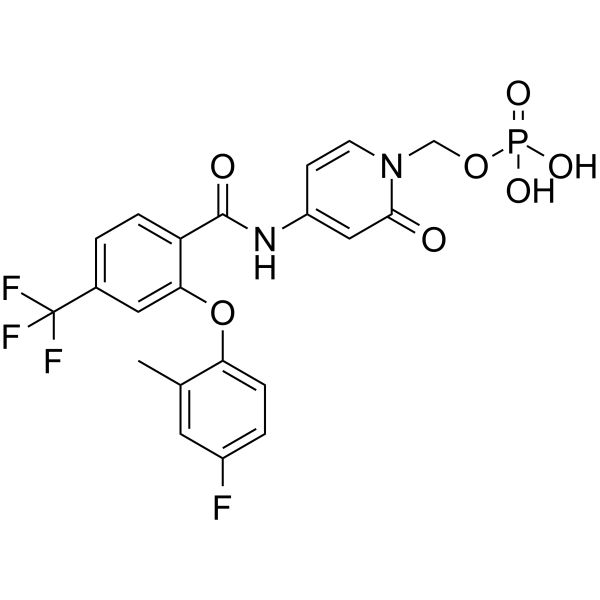
VX-150
CAS No. 1793080-72-4
VX-150( —— )
Catalog No. M28830 CAS No. 1793080-72-4
VX-150 is a highly selective NaV1.8 inhibitor relative to the other sodium channel subtypes (>400-fold).
Purity : >98% (HPLC)
 COA
Datasheet
HNMR
HPLC
MSDS
Handing Instructions
COA
Datasheet
HNMR
HPLC
MSDS
Handing Instructions
| Size | Price / USD | Stock | Quantity |
| 1 mL x 10 mM in DMSO | 159 | In Stock |


|
| 5MG | 140 | In Stock |
|
| 10MG | 235 | In Stock |
|
| 25MG | 471 | In Stock |
|
| 50MG | 739 | In Stock |
|
| 100MG | 1181 | In Stock |
|
| 200MG | Get Quote | In Stock |
|
| 500MG | Get Quote | In Stock |
|
| 1G | Get Quote | In Stock |
|
Biological Information
-
Product NameVX-150
-
NoteResearch use only, not for human use.
-
Brief DescriptionVX-150 is a highly selective NaV1.8 inhibitor relative to the other sodium channel subtypes (>400-fold).
-
DescriptionVX-150 is a highly selective NaV1.8 inhibitor relative to the other sodium channel subtypes (>400-fold).
-
In Vitro——
-
In Vivo——
-
Synonyms——
-
PathwayMembrane Transporter/Ion Channel
-
TargetSodium Channel
-
RecptorFatty Acid Synthase (FASN)
-
Research Area——
-
Indication——
Chemical Information
-
CAS Number1793080-72-4
-
Formula Weight516.34
-
Molecular FormulaC21H17F4N2O7P
-
Purity>98% (HPLC)
-
SolubilityIn Vitro:?DMSO : 125 mg/mL (242.09 mM)
-
SMILESCc(cc(cc1)F)c1Oc(cc(C(F)(F)F)cc1)c1C(NC(C=CN1COP(O)(O)=O)=CC1=O)=O
-
Chemical Name——
Shipping & Storage Information
-
Storage(-20℃)
-
ShippingWith Ice Pack
-
Stability≥ 2 years
Reference
1.Rae C, et al. Inhibition of Fatty Acid Synthase Sensitizes Prostate Cancer Cells to Radiotherapy. Radiat Res. 2015 Nov;184(5):482-93.
molnova catalog



related products
-
GX 201
GX 201 is a selective NaV1.7 inhibitor, IC50 of < 3.2 nM for hNaV1.7.
-
Tocainide
Tocainide is a blocker of the sodium channel and used for the treatment of tinnitus.
-
L(-)-sorbose
L(-)-sorbose is a ketose belonging to the group of sugars known as monosaccharides.
