


 Cart
Cart
 sales@molnova.com


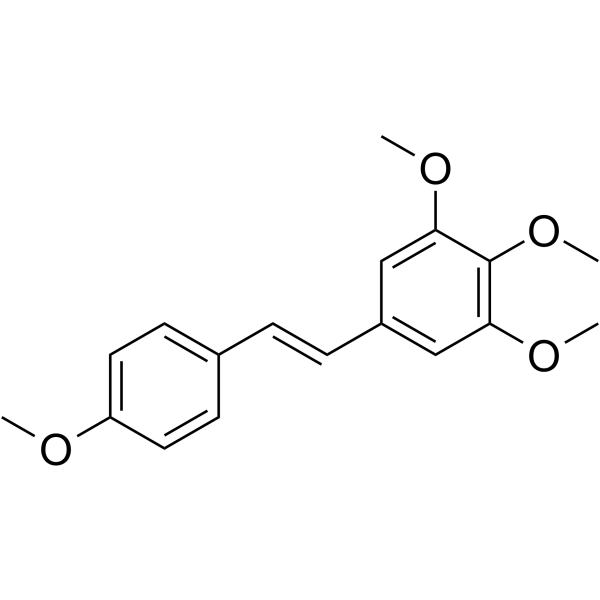
DMU-212
CAS No. 134029-62-2
DMU-212( —— )
Catalog No. M28078 CAS No. 134029-62-2
DMU-212, a methylated form of Resveratrol, shows antimitotic, antiproliferative, and antioxidant activities. DMU-212 induces mitotic arrest through the activation of ERK1/2 protein and the promotion of apoptosis.
Purity : >98% (HPLC)
 COA
Datasheet
HNMR
HPLC
MSDS
Handing Instructions
COA
Datasheet
HNMR
HPLC
MSDS
Handing Instructions
| Size | Price / USD | Stock | Quantity |
| 1 mL x 10 mM in DMSO | 51 | In Stock |


|
| 2MG | 29 | In Stock |
|
| 5MG | 46 | In Stock |
|
| 10MG | 76 | In Stock |
|
| 25MG | 155 | In Stock |
|
| 50MG | 268 | In Stock |
|
| 100MG | 398 | In Stock |
|
| 200MG | Get Quote | In Stock |
|
| 500MG | 901 | In Stock |
|
| 1G | Get Quote | In Stock |
|
Biological Information
-
Product NameDMU-212
-
NoteResearch use only, not for human use.
-
Brief DescriptionDMU-212, a methylated form of Resveratrol, shows antimitotic, antiproliferative, and antioxidant activities. DMU-212 induces mitotic arrest through the activation of ERK1/2 protein and the promotion of apoptosis.
-
DescriptionDMU-212, a methylated form of Resveratrol, shows antimitotic, antiproliferative, and antioxidant activities. DMU-212 induces mitotic arrest through the activation of ERK1/2 protein and the promotion of apoptosis.(In Vitro):DMU-212 (0.3125-40 μM) inhibited the cellular proliferation of human melanoma cells at submicromolar or micromolar concentrations (IC50=0.5 μM, 0.5 μM, 1.25 μM, and 1.25 μM for A375, Bro, MeWo, and M5 human melanoma cells, respectively.).(In Vivo):In SCID female mice, DMU-212 (50 mg/kg; i.g.) inhibited tumor growth and lowered tumor burden.
-
In VitroCell Proliferation Assay Cell Line:A375 cells, MeWo cells, M5 cells, Bro cells Concentration:0.3125 μM, 0,625 μM, 1.25 μM, 2.5 μM, 5 μM, 10 μM, 20 μM, 40 μM Incubation Time:96 hours Result:Inhibited the cellular proliferation of human melanoma cells at submicromolar or micromolar concentrations (IC50=0.5 μM for A375 and Bro and IC50= 1.25 μM for MeWo and M5 cells).Cell Cycle Analysis Cell Line:A375 cells Concentration:20 μM, 30 μM, 50 μM Incubation Time:24 hoursResult:Caused a marked increase in the levels of p21, p53 and cyclin B1 proteins with a concomitant decrease in the levels of cyclin A2.Western Blot Analysis Cell Line:A375 cells Concentration:20 μM, 30 μM, 50 μM Incubation Time:24 hours Result:Significant upregulated Bax, caspase 3 and caspase 9 protein levels, while decreased the levels of the anti-apoptotic protein Bcl-2.Apoptosis Analysis Cell Line:A375 cells Concentration:10 μM, 20 μM Incubation Time:24 hours, 36 hoursResult:Induced apoptosis.
-
In VivoAnimal Model:6-weeks-old SCID female mice (20-24 g), with ovarian cancer xenografts Dosage:50 mg/kg Administration:Oral gavage, three times a week, for 14 days Result:Lowered tumor burden.
-
Synonyms——
-
PathwayApoptosis
-
TargetApoptosis
-
RecptorTubulin polymerization
-
Research Area——
-
Indication——
Chemical Information
-
CAS Number134029-62-2
-
Formula Weight300.35
-
Molecular FormulaC18H20O4
-
Purity>98% (HPLC)
-
SolubilityIn Vitro:?DMSO : 20 mg/mL (66.59 mM)
-
SMILESCOC1=CC=C(/C=C/C2=CC(OC)=C(OC)C(OC)=C2)C=C1
-
Chemical Name——
Shipping & Storage Information
-
Storage(-20℃)
-
ShippingWith Ice Pack
-
Stability≥ 2 years
Reference
1.Schneider Y, et al. Resveratrol analog (Z)-3,5,4'-trimethoxystilbene is a potent anti-mitotic drug inhibiting tubulin polymerization. Int J Cancer. 2003 Nov 1;107(2):189-96.
molnova catalog



related products
-
CSRM617 hydrochlorid...
CSRM617 hydrochloride is a selective small-molecule inhibitor of the transcription factor ONECUT2 (OC2, a master regulator of androgen receptor), with a Kd of 7.43 μM in SPR assays, directly binding to the OC2-HOX domain.
-
GUT-70
GUT-70 is a tricyclic coumarin derived from Calophyllum brasiliense, markedly reduces cell proliferation.
-
SCFSkp2-IN-2
SCFSkp2-IN-2, a Skp2 inhibitor, exhibits a dissociation constant (K_D) of 28.77 μM. It demonstrates antitumor activities by inducing apoptosis in non-small cell lung cancer (NSCLC) cells.
