


 Cart
Cart
 sales@molnova.com


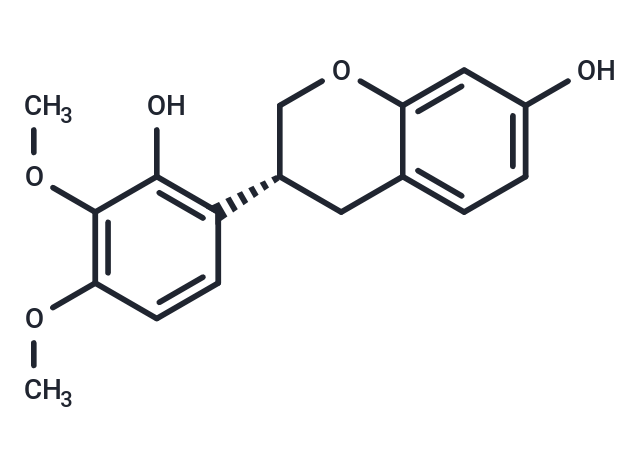
(R)-Isomucronulatol
CAS No. 64474-51-7
(R)-Isomucronulatol( —— )
Catalog No. M37802 CAS No. 64474-51-7
(R)-Isomucronulatol (2H-1-Benzopyran-7-ol), a flavonoid that can be extracted from the leaves of Astragalus membranaceus, Sophora japonica, Sclerotium tigrinum, and Glycyrrhiza glabra, inhibits the proliferation and apoptosis of BMSCs in the TNF-α microenvironment.
Purity : >98% (HPLC)
 COA
Datasheet
HNMR
HPLC
MSDS
Handing Instructions
COA
Datasheet
HNMR
HPLC
MSDS
Handing Instructions
| Size | Price / USD | Stock | Quantity |
| 1 mL x 10 mM in DMSO | 204 | In Stock |


|
| 5MG | 187 | In Stock |
|
| 10MG | 306 | In Stock |
|
| 25MG | 512 | In Stock |
|
| 100MG | Get Quote | In Stock |
|
| 200MG | Get Quote | In Stock |
|
| 500MG | Get Quote | In Stock |
|
| 1G | Get Quote | In Stock |
|
Biological Information
-
Product Name(R)-Isomucronulatol
-
NoteResearch use only, not for human use.
-
Brief Description(R)-Isomucronulatol (2H-1-Benzopyran-7-ol), a flavonoid that can be extracted from the leaves of Astragalus membranaceus, Sophora japonica, Sclerotium tigrinum, and Glycyrrhiza glabra, inhibits the proliferation and apoptosis of BMSCs in the TNF-α microenvironment.
-
Description(R)-Isomucronulatol is a natural flavonoid that could be isolated from the seeds of sphaerophysa salsula.
-
In Vitro——
-
In Vivo——
-
Synonyms——
-
PathwayApoptosis
-
TargetApoptosis
-
RecptorApoptosis
-
Research Area——
-
Indication——
Chemical Information
-
CAS Number64474-51-7
-
Formula Weight302.32
-
Molecular FormulaC17H18O5
-
Purity>98% (HPLC)
-
Solubility——
-
SMILESOC1=C([C@H]2CC=3C(OC2)=CC(O)=CC3)C=CC(OC)=C1OC
-
Chemical Name——
Shipping & Storage Information
-
Storage(-20℃)
-
ShippingWith Ice Pack
-
Stability≥ 2 years
Reference
1. Zhongjun Ma, et al. Flavonoids from the seeds of Sphaerophysa salsula. J Asian Nat Prod Res. 2004 Mar;6(1):69-73.?
molnova catalog



related products
-
PBOX 6
PBOX 6 is a pyrrolo-1,5-benzoxazepine (PBOX) compound exhibiting anticancer and antitumor activity by inhibiting breast cancer cell growth in vitro and selectively inducing apoptosis in leukemia cells through c-Jun NH2 terminal kinase-dependent phosphorylation and inactivation of Bcl-2 and Bcl-XL.
-
9-dihydro-13-acetylb...
9-Dihydro-13-acetylbaccatin III is an apoptosis inducer. It shows cytotoxicity against the MCF7 cell line and drug-resistant cell line MCF7-ADR.
-
Pitstop 2
Pitstop 2 is a inhibitor of clathrin, and inhibits clathrin-mediated endocytosis (CME) by associating with the terminal domain of clathrin. It has the potential for anti-cancer research.
