


 Cart
Cart
 sales@molnova.com


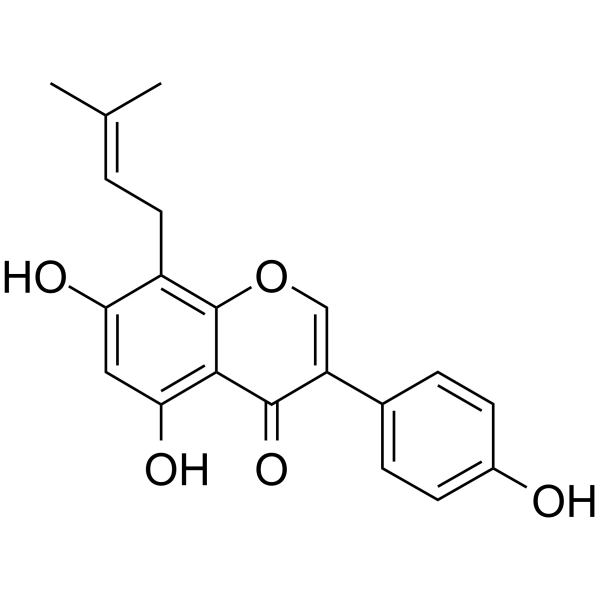
Lupiwighteone
CAS No. 104691-86-3
Lupiwighteone( —— )
Catalog No. M29187 CAS No. 104691-86-3
Lupiwighteone has anti-angiogenesis potential, it also has anticancer and cancer preventive effects on SH-SY5Y cells.
Purity : >98% (HPLC)
 COA
Datasheet
HNMR
HPLC
MSDS
Handing Instructions
COA
Datasheet
HNMR
HPLC
MSDS
Handing Instructions
| Size | Price / USD | Stock | Quantity |
| 1 mL x 10 mM in DMSO | 542 | In Stock |


|
| 5MG | 377 | In Stock |
|
| 10MG | 560 | In Stock |
|
| 25MG | 898 | In Stock |
|
| 50MG | 1190 | In Stock |
|
| 100MG | Get Quote | In Stock |
|
| 200MG | Get Quote | In Stock |
|
| 500MG | Get Quote | In Stock |
|
| 1G | Get Quote | In Stock |
|
Biological Information
-
Product NameLupiwighteone
-
NoteResearch use only, not for human use.
-
Brief DescriptionLupiwighteone has anti-angiogenesis potential, it also has anticancer and cancer preventive effects on SH-SY5Y cells.
-
DescriptionLupiwighteone has anti-angiogenesis potential, it also has anticancer and cancer preventive effects on SH-SY5Y cells.(In Vitro):This study aimed to examine the antitumor activity of Lupiwighteone, explore its antitumor mechanism in a human prostate carcinoma cell line (DU-145), and evaluate its antiangiogenetic activity in the human umbilical vein endothelial cell line (HUVEC). The results showed that Lupiwighteone could inhibit the growth of DU-145 and HUVEC cells in a concentration-dependent and time-dependent manner by a 3-(4,5-dimethylthiazol-2-yl)-2,5-diphenyl tetrazolium bromide assay. Flow cytometry analysis indicated that Lupiwighteone could induce cell cycle arrest, cells apoptosis, mitochondrial membrane potential loss, and an increase in intracellular reactive oxygen species of DU-145 cells. Upregulation of Bax, cytochrome c, caspase-3, and PARP-1 protein expressions and downregulation of Bcl-2, procaspase-9, and p-Akt protein expressions were observed by western blot after the treatment of Lupiwighteone. Furthermore, the effects of Lupiwighteone on the cellular behavior of HUVECs were also investigated.
-
In VitroLupiwighteone (2-100 μM; 72 hours) shows cytotoxicity towards various cell lines, especially on DU-145 cells and SGC-7901 cells with IC50s of 23.7 μM and 21 μM, respectively.Lupiwighteone (20-60 μM; 48 hours) induces (cell cycle arrest in DU-145 cells.Lupiwighteone (20-60 μM; 48 hours) induces cells apoptosis.Lupiwighteone (20-60 μM; 48 hours) decreases the cell cycle-related protein expressions in a dose-dependent manner in DU-145 cells.Lupiwighteone (20-60 μM; 48 hours) induces a dose-dependent increase in ROS production.Lupiwighteone up-regulates of cytochrome c and caspase-3, and subsequent cleavage of PARP-1 and down-regulates of the p-Akt/Akt ratio and VEGF expression, suggests the activation of mitochondria-based intrinsic apoptosis in DU-145 cells. Cell Viability Assay Cell Line:DU-145 cells, C4-2 cells, SGC-7901 cells, Hela cells, HUVEC, MCF-7 cells, CNE cells, Vero Concentration:2 μM, 5 μM, 25 μM, 50 μM, 100 μM Incubation Time:72 hours Result:Had inhibition on the survival of many cancer cell lines and HUVEC.Cell Cycle Analysis Cell Line:DU-145 cells Concentration:20 μM, 40 μM, 60 μM Incubation Time:48 hours Result:Induced cell cycle arrest.Apoptosis Analysis Cell Line:DU-145 cells Concentration:20 μM, 40 μM, 60 μM Incubation Time:48 hours Result:Induced apoptosis.Western Blot Analysis Cell Line:DU-145 cells Concentration:20 μM, 40 μM, 60 μM Incubation Time:48 hours Result:Decreased CDK1, 2, 4, 6, cyclinD1, and cyclinB1 protein expression in a dose-dependent manner.
-
In Vivo——
-
Synonyms——
-
PathwayApoptosis
-
TargetApoptosis
-
RecptorApoptosis
-
Research Area——
-
Indication——
Chemical Information
-
CAS Number104691-86-3
-
Formula Weight338.359
-
Molecular FormulaC20H18O5
-
Purity>98% (HPLC)
-
SolubilityIn Vitro:?DMSO : 100 mg/mL (295.55 mM)
-
SMILESCC(C)=CCc1c(O)cc(O)c2c1occ(-c1ccc(O)cc1)c2=O
-
Chemical Name——
Shipping & Storage Information
-
Storage(-20℃)
-
ShippingWith Ice Pack
-
Stability≥ 2 years
Reference
molnova catalog



related products
-
DB2313
DB2313 is a potent transcription factor PU.1 inhibitor, IC50=14 nM. DB2313 disrupts the interaction of PU.1 with target gene promoters. DB2313 induces apoptosis of acute myeloid leukemia (AML) cells, and has anticancer effects
-
Epibrassinolide
Epibrassinolide (EBR) is a biologically active compound of the brassinosteroids is a natural brassinosteroid (BR) derivative is a plant regulator with a similar structure to mammalian steroids.
-
Dihydrorotenone
Dihydrorotenone is a potent mitochondrial inhibitor and probably induces Parkinsonian syndrome.
