


 Cart
Cart
 sales@molnova.com


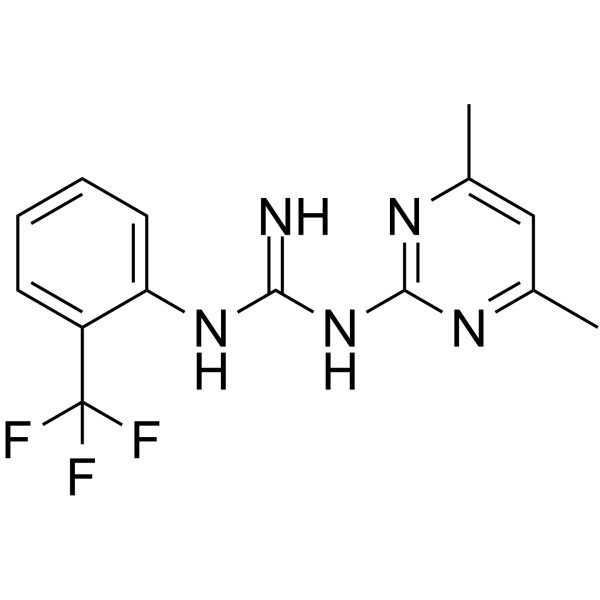
ZINC69391
CAS No. 303094-67-9
ZINC69391( ZINC-69391 | N'-(4,6-dimethylpyrimidin-2-yl)-N-[2-(trifluoromethyl)phenyl]guanidine )
Catalog No. M27796 CAS No. 303094-67-9
ZINC69391 is a selective inhibitor of Rac1 with antiproliferative and antimetastatic effects. ZINC69391 interferes with the interaction of Rac1 with Dock180, reduces Rac1-GTP levels and induces apoptosis.
Purity : >98% (HPLC)
 COA
Datasheet
HNMR
HPLC
MSDS
Handing Instructions
COA
Datasheet
HNMR
HPLC
MSDS
Handing Instructions
| Size | Price / USD | Stock | Quantity |
| 1 mL x 10 mM in DMSO | 79 | In Stock |


|
| 5MG | 71 | In Stock |
|
| 10MG | 115 | In Stock |
|
| 25MG | 208 | In Stock |
|
| 50MG | 285 | In Stock |
|
| 100MG | 384 | In Stock |
|
| 200MG | 510 | In Stock |
|
| 500MG | Get Quote | In Stock |
|
| 1G | Get Quote | In Stock |
|
Biological Information
-
Product NameZINC69391
-
NoteResearch use only, not for human use.
-
Brief DescriptionZINC69391 is a selective inhibitor of Rac1 with antiproliferative and antimetastatic effects. ZINC69391 interferes with the interaction of Rac1 with Dock180, reduces Rac1-GTP levels and induces apoptosis.
-
DescriptionZINC69391 is a selective inhibitor of Rac1 with antiproliferative and antimetastatic effects. ZINC69391 interferes with the interaction of Rac1 with Dock180, reduces Rac1-GTP levels and induces apoptosis.(In Vitro):In U-87 MG and LN229 cells, ZINC69391 (0-125 μM) reduces cell proliferation of human glioma cells. ZINC69391 (50-100 μM) triggers cell cycle arrest. ZINC69391 inhibits the growth of U937, HL-60, KG1A, and Jurkat cells (IC50s = 41-54 μM). In HL-60, U937, and KG1A cell lines, ZINC69391 (50 μM) triggers an increase in apoptotic cells. In LN229 cells, ZINC69391 (50 and 100 μM) augments the enzymatic activity of caspase 3 and increases the percentage of cells in the sub-G0/G1 phase in a concentration-dependent manner.(In Vivo):In specific pathogen-free female BALB/c inbred mice (bearing F3II cells), ZINC69391 (25 mg/kg; i.p) impairs metastatic lung colonization and reduces by about 60% the formation of total metastatic lung colonies.
-
In VitroZINC69391 inhibits growth of U937, HL-60, KG1A and Jurkat cells with IC50s ranging from 41 to 54 μM.ZINC69391 (50-100 μM; 24 hours) augments the enzymatic activity of caspase 3 in a concentration dependent manner.ZINC69391 (0-125 μM; 72h) reduces cell proliferation of human glioma cells.ZINC69391 (50-100 μM; 48 hours) triggers cell cycle arrest.ZINC69391 (50 μM; 24 hours) triggers apoptosis on human acute leukemic cells. Cell Proliferation Assay Cell Line:U-87 MG, LN229 cells Concentration:0-125μM Incubation Time:72 hours Result:Reduced cell proliferation in a concentration-dependent manner.Cell Cycle Analysis Cell Line:LN229 cells Concentration:50, 100 μM Incubation Time:48 hours Result:Resulted in a significant increased percentage of cells in the sub-G0/G1 phase in a concentration dependent manner.Apoptosis Analysis Cell Line:HL-60, U937 and KG1A cell lines Concentration:50 μM Incubation Time:24 hours Result:Led to a significant increase in apoptotic cells.
-
In VivoZINC69391 (25 mg/kg; i.p; daily for 21 days) impairs metastatic lung colonization in a syngeneic animal model. Animal Model:Specific pathogen-free female BALB/c inbred mice (bearing F3II cells)Dosage:25 mg/kg body weight Administration:I.p; daily for 21 days Result:Significantly reduced by about 60% the formation of total metastatic lung colonies.
-
SynonymsZINC-69391 | N'-(4,6-dimethylpyrimidin-2-yl)-N-[2-(trifluoromethyl)phenyl]guanidine
-
PathwayApoptosis
-
TargetApoptosis
-
RecptorEGFR|EGFR (L858R)|EGFR (L858R/T790M)|EGFR (L858R/T790M/C797S)
-
Research Area——
-
Indication——
Chemical Information
-
CAS Number303094-67-9
-
Formula Weight309.296
-
Molecular FormulaC14H14F3N5
-
Purity>98% (HPLC)
-
SolubilityIn Vitro:?DMSO : 25 mg/mL (80.83 mM)
-
SMILESCc1cc(C)nc(NC(=N)Nc2ccccc2C(F)(F)F)n1
-
Chemical Name——
Shipping & Storage Information
-
Storage(-20℃)
-
ShippingWith Ice Pack
-
Stability≥ 2 years
Reference
1.Zhang H, et al. Discovery of 2,4,6-trisubstitued pyrido[3,4-d]pyrimidine derivatives as new EGFR-TKIs. Eur J Med Chem. 2018 Mar 25;148:221-237.
molnova catalog



related products
-
Methyl pyropheophorb...
Methyl pyropheophorbide-a (MPPa) is a chlorine photosensitizer and a derivative of chlorophyll a. It is photodynamically active, induces apoptosis and inhibits tumor growth, and can be used in photodynamic therapy (PDT) of cancer.
-
BiP inducer X
BiP inducer X is a selective inducer of immunoglobulin heavy chain binding protein (BiP)/GRP78 and an ER chaperone inducer. BiP inducer X prevents cell death in neurons and retinal cell lines.
-
Adarotene
Adarotene is an effective apoptosis inducer. It surprisingly produces DNA damage and exhibits a potent antiproliferative activity on a large panel of human tumor cells.
