


 Cart
Cart
 sales@molnova.com


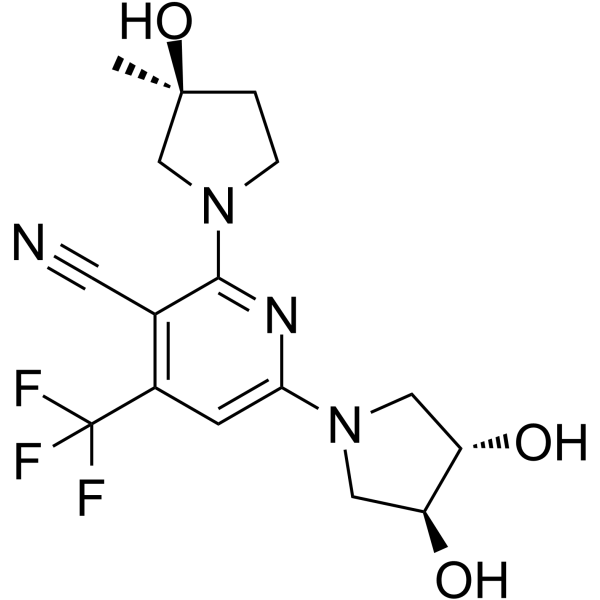
KHK-IN-2
CAS No. 2135304-43-5
KHK-IN-2( —— )
Catalog No. M26269 CAS No. 2135304-43-5
KHK-IN-2 is a selective and potent ketohexokinase (KHK) inhibitor with an IC50 of 0.45 μM.
Purity : >98% (HPLC)
 COA
Datasheet
HNMR
HPLC
MSDS
Handing Instructions
COA
Datasheet
HNMR
HPLC
MSDS
Handing Instructions
| Size | Price / USD | Stock | Quantity |
| 1 mL x 10 mM in DMSO | 29 | In Stock |


|
| 5MG | 29 | In Stock |
|
| 10MG | 50 | In Stock |
|
| 25MG | 107 | In Stock |
|
| 100MG | Get Quote | In Stock |
|
| 200MG | Get Quote | In Stock |
|
| 500MG | Get Quote | In Stock |
|
| 1G | Get Quote | In Stock |
|
Biological Information
-
Product NameKHK-IN-2
-
NoteResearch use only, not for human use.
-
Brief DescriptionKHK-IN-2 is a selective and potent ketohexokinase (KHK) inhibitor with an IC50 of 0.45 μM.
-
DescriptionKHK-IN-2 is a selective and potent ketohexokinase (KHK) inhibitor with an IC50 of 0.45 μM.
-
In Vitro——
-
In Vivo——
-
Synonyms——
-
PathwayChromatin/Epigenetic
-
TargetHistone Demethylase
-
Recptor——
-
Research Area——
-
Indication——
Chemical Information
-
CAS Number2135304-43-5
-
Formula Weight372.348
-
Molecular FormulaC16H19F3N4O3
-
Purity>98% (HPLC)
-
SolubilityIn Vitro:?DMSO : 250 mg/mL (671.43 mM)
-
SMILESC[C@]1(O)CCN(C1)c1nc(cc(c1C#N)C(F)(F)F)N1C[C@H](O)[C@@H](O)C1
-
Chemical Name——
Shipping & Storage Information
-
Storage(-20℃)
-
ShippingWith Ice Pack
-
Stability≥ 2 years
Reference
1.Ai CB, et al. Salvianolic Acids D and E: Two New Depsides from Salvia miltiorrhiza. Planta Med. 1992 Apr;58(2):197-9.
molnova catalog



related products
-
MS049 2HCl
MS049 is a potent and selective inhibitor of PRMT4 (IC50 = 34 nM) and PRMT6 (IC50 = 43 nM).
-
PFI-90
PFI-90 is a selective inhibitor of histone demethylase (KDM3B) that inhibits PAX3-FOXO1 action.PFI-90 has the potential for the antitumor activity.
-
T-448
T-448 (T448) is a specific inhibitor of LSD1 enzyme activity, enhances H3K4 methylation in primary cultured rat neurons but has little impact on LSD1-GFI1B complex in human TF-1a erythroblasts.
