


 Cart
Cart
 sales@molnova.com


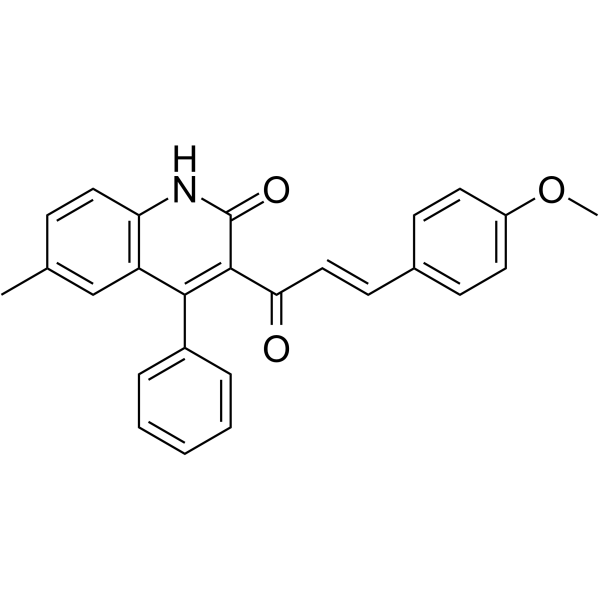
Ceranib1
CAS No. 328076-61-5
Ceranib1( —— )
Catalog No. M26103 CAS No. 328076-61-5
Ceranib1 is an inhibitor of ceramidase. It inhibits the proliferation of ovarian cancer cells.
Purity : >98% (HPLC)
 COA
Datasheet
HNMR
HPLC
MSDS
Handing Instructions
COA
Datasheet
HNMR
HPLC
MSDS
Handing Instructions
| Size | Price / USD | Stock | Quantity |
| 2MG | 55 | In Stock |


|
| 5MG | 83 | In Stock |
|
| 10MG | 101 | In Stock |
|
| 25MG | 223 | In Stock |
|
| 50MG | 326 | In Stock |
|
| 100MG | 458 | In Stock |
|
| 200MG | Get Quote | In Stock |
|
| 500MG | 918 | In Stock |
|
| 1G | Get Quote | In Stock |
|
Biological Information
-
Product NameCeranib1
-
NoteResearch use only, not for human use.
-
Brief DescriptionCeranib1 is an inhibitor of ceramidase. It inhibits the proliferation of ovarian cancer cells.
-
DescriptionCeranib1 is an inhibitor of ceramidase. It inhibits the proliferation of ovarian cancer cells. Ceranib1 inhibits ceramidase activity toward an exogenous ceramide analog, induces the accumulation of multiple ceramide species, decreases levels of S1P and sphingosine.(In Vitro):Ceranib1 produces a dose-dependent decrease in ceramidase activity, with 50% inhibition at 55 and 28 μM in SKOV3 cells. Ceranib1 prevents the hydrolysis of endogenous ceramide species and reduces intracellular sphingosine and S1P. Ceranib1 (10 nM-10 μM; 72 hours) exhibits antiproliferative activity for SKOV3 cells. Ceranib1 (24 hours) does not cause significant acute cytotoxicity at concentrations up to at least those used in the ceramidase assay in SKOV3 cells.
-
In VitroCeranib1 produces a dose-dependent decrease in ceramidase activity, with 50% inhibition at 55 and 28 μM in SKOV3 cells.Ceranib1 (24 hours) does not cause significant acute cytotoxicity at concentrations up to at least those used in the ceramidase assay in SKOV3 cells.Ceranib1 prevents the hydrolysis of endogenous ceramide species and reduces intracellular sphingosine and S1P.Ceranib1 (10 nM-10 μM; 72 hours) exhibits antiproliferative activity for SKOV3 cells. Cell Proliferation Assay Cell Line:SKOV3 cellsConcentration:10 nM-10 μM (varying concentrations)Incubation Time:72 hours Result:Inhibited cell proliferation with IC50 values of 3.9 ± 0.3 μM.
-
In Vivo——
-
Synonyms——
-
PathwayOthers
-
TargetOther Targets
-
RecptorPROTAC Linker
-
Research Area——
-
Indication——
Chemical Information
-
CAS Number328076-61-5
-
Formula Weight395.458
-
Molecular FormulaC26H21NO3
-
Purity>98% (HPLC)
-
Solubility——
-
SMILESCOc1ccc(\C=C\C(=O)c2c(-c3ccccc3)c3cc(C)ccc3[nH]c2=O)cc1
-
Chemical Name——
Shipping & Storage Information
-
Storage(-20℃)
-
ShippingWith Ice Pack
-
Stability≥ 2 years
Reference
1.Khan S, et al. A selective BCL-XL PROTAC degrader achieves safe and potent antitumor activity. Nat Med. 2019 Dec;25(12):1938-1947.
molnova catalog



related products
-
EGA
EGA inhibits the intoxication of lethal toxins and prevents the entry of a variety of other acid-dependent bacterial toxins and viruses into mammalian cells.EGA is a powerful tool for the study of membrane trafficking and can be used to treat infectious diseases.
-
Amodiaquine
Amodiaquine is a synthetic aminoquinoline used to treat malaria.
-
L-Phenylalanine beta...
L-Phenylalanine betaine
