


 Cart
Cart
 sales@molnova.com


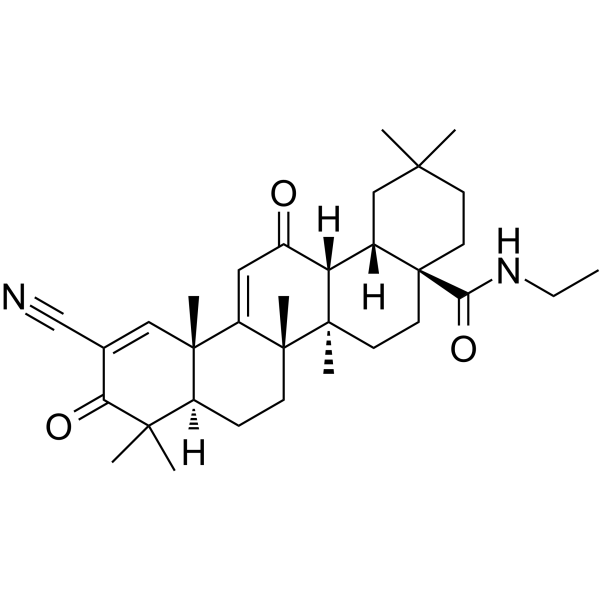
CDDO-EA
CAS No. 932730-51-3
CDDO-EA( CDDO ethyl amide | TP319 | RTA 405 )
Catalog No. M26099 CAS No. 932730-51-3
CDDO-EA is an activator of the Nrf2/antioxidant response element.
Purity : >98% (HPLC)
 COA
Datasheet
HNMR
HPLC
MSDS
Handing Instructions
COA
Datasheet
HNMR
HPLC
MSDS
Handing Instructions
| Size | Price / USD | Stock | Quantity |
| 1 mL x 10 mM in DMSO | 187 | In Stock |


|
| 5MG | 163 | In Stock |
|
| 10MG | 297 | In Stock |
|
| 25MG | 511 | In Stock |
|
| 50MG | 716 | In Stock |
|
| 100MG | 923 | In Stock |
|
| 200MG | 1237 | In Stock |
|
| 500MG | Get Quote | In Stock |
|
| 1G | Get Quote | In Stock |
|
Biological Information
-
Product NameCDDO-EA
-
NoteResearch use only, not for human use.
-
Brief DescriptionCDDO-EA is an activator of the Nrf2/antioxidant response element.
-
DescriptionCDDO-EA is an activator of the Nrf2/antioxidant response element.(In Vitro):In a cell culture model of ALS, CDDO-EA potently activates Nrf2/ARE . CDDO-EA induces apoptosis in A549 lung cancer cells and induces heme oxygenase-1. CDDO-EA is 7-fold more potent than CDDO as a suppressor of the ability of IFN-γ to induce iNOS in RAW264.7 macrophage-like cells.(In Vivo):CDDO-EA-treated G93A mice live significantly longer than the control. CDDO-EA increases the life-span from 124.05 days to 144.72 days (16.6%). In CDDO-EA-treated G93A mice, the age of death is 141.4 days and the duration from the age of onset to the age of death is 57.6 days. The age of death from the onset is prolonged by 17.5 days (43%) .
-
In VitroCDDO-EA potently activates Nrf2/ARE in a cell culture model of ALS and in the G93A SOD1 mouse model of ALS. CDDO-EA is a potent inducer of apoptosis in A549 lung cancer cells, as shown both by PARP cleavage and Annexin staining. CDDO-EA is more potent than CDDO itself as inducers of heme oxygenase-1 (HO-1). In RAW264.7 macrophage-like cells, CDDO-EA is 7-fold more potent than CDDO as suppressors of the ability of IFN-γ to induce iNOS.
-
In VivoThe survival analysis shows that G93A mice treated with CDDO-EA, compared to G93A littermate controls, lives significantly longer. CDDO-EA treatment increases the life-span by 20.6 days from 124.05±3.7 days to 144.72±8.1 days (16.6%) (p<0.001). In CDDO-EA-treated G93A mice, the age of death is 141.4±5.2 days and the duration from the age of onset to the age of death is 57.6±7.6 days, which means that the age of death from onset is prolonged by 17.5 days (43%).
-
SynonymsCDDO ethyl amide | TP319 | RTA 405
-
PathwayNuclear Receptor/Transcription Factor
-
TargetKeap1-Nrf2
-
RecptorE3 Ligase Ligand-Linker Conjugate
-
Research Area——
-
Indication——
Chemical Information
-
CAS Number932730-51-3
-
Formula Weight518.73
-
Molecular FormulaC33H46N2O3
-
Purity>98% (HPLC)
-
SolubilityIn Vitro:?DMSO : 16.67 mg/mL (32.14 mM)
-
SMILESC(NCC)(=O)[C@]12[C@]([C@@]3([C@@](C)(CC1)[C@@]4(C)C(=CC3=O)[C@]5(C)[C@@](CC4)(C(C)(C)C(=O)C(C#N)=C5)[H])[H])(CC(C)(C)CC2)[H]
-
Chemical Name——
Shipping & Storage Information
-
Storage(-20℃)
-
ShippingWith Ice Pack
-
Stability≥ 2 years
Reference
1.Guangrong Zheng, et al. Compounds that induce degradation of anti-apoptotic bcl-2 family proteins and the uses thereof. WO2017184995A1.
molnova catalog



related products
-
KI696 isomer
KI696 isomer is an isomer of KI696, a low affinity probe for the study of immune and metabolic diseases.
-
2-tert-Butyl-1,4-ben...
2-tert-Butyl-1,4-benzoquinone (TBQ), an electrophilic metabolite of butylated hydroxyanisole (BHA), causes activation of Nrf2 together with S-arylation of its negative regulator Keap1 in RAW264.7 cells.
-
CPUY192018
CPUY192018 is an inhibitor of Keap1-Nrf2 protein-protein interactions and shows cytoprotective effects in NCM460 colon cells.CPUY192018 inhibits glycolysis, enhances resistance to oxidative stress, and can be used to study mitochondrial autophagy.
