


 Cart
Cart
 sales@molnova.com


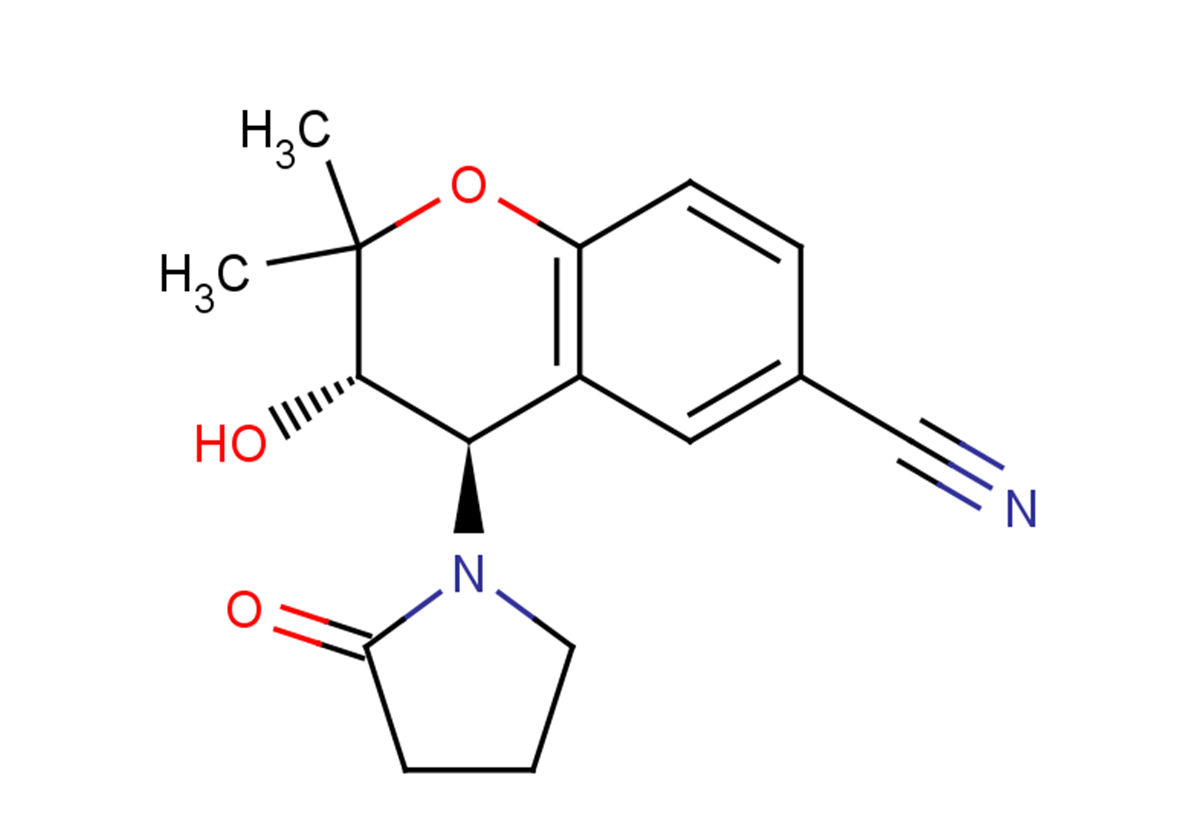
Levcromakalim
CAS No. 94535-50-9
Levcromakalim( (-)-Cromakalim | BRL 38227 )
Catalog No. M24993 CAS No. 94535-50-9
Levcromakalim is an activator of the ATP-sensitive K+ channel.
Purity : >98% (HPLC)
 COA
Datasheet
HNMR
HPLC
MSDS
Handing Instructions
COA
Datasheet
HNMR
HPLC
MSDS
Handing Instructions
| Size | Price / USD | Stock | Quantity |
| 1 mL x 10 mM in DMSO | 106 | In Stock |


|
| 2MG | 67 | In Stock |
|
| 5MG | 96 | In Stock |
|
| 10MG | 145 | In Stock |
|
| 25MG | 335 | In Stock |
|
| 50MG | 488 | In Stock |
|
| 100MG | 706 | In Stock |
|
| 200MG | Get Quote | In Stock |
|
| 500MG | Get Quote | In Stock |
|
| 1G | Get Quote | In Stock |
|
Biological Information
-
Product NameLevcromakalim
-
NoteResearch use only, not for human use.
-
Brief DescriptionLevcromakalim is an activator of the ATP-sensitive K+ channel.
-
DescriptionLevcromakalim is an activator of the ATP-sensitive K+ channel.
-
In Vitro——
-
In Vivo——
-
Synonyms(-)-Cromakalim | BRL 38227
-
PathwayCell Cycle/DNA Damage
-
TargetPotassium Channel
-
RecptorATP-sensitive potassium (KATP) channels
-
Research Area——
-
Indication——
Chemical Information
-
CAS Number94535-50-9
-
Formula Weight286.33
-
Molecular FormulaC16H18N2O3
-
Purity>98% (HPLC)
-
SolubilityDMSO:50 mg/mL (174.62 mM);Water:Insoluble
-
SMILESCC(O1)(C)[C@@H](O)[C@H](N2CCCC2=O)C3=C1C=CC(C#N)=C3
-
Chemical Name——
Shipping & Storage Information
-
Storage(-20℃)
-
ShippingWith Ice Pack
-
Stability≥ 2 years
Reference
1.Matsumoto T, et al. Tunicamycin-Induced Alterations in the Vasorelaxant Response in Organ-Cultured Superior Mesenteric Arteries of Rats. Biol Pharm Bull. 2016;39(9):1475-81.
molnova catalog



related products
-
TKIM
TKIM is a TWIK-related potassium channel 1 (TREK-1) inhibitor, binding to the pocket of the intermediate (IM) state of TREK-1.TKIM binds to the pocket of the IM state of TREK-1, which differs from the binding of common inhibitors, which bind to channels in the inactive state.?
-
Atpenin A5
Atpenin A5 is a potent and highly specific?complex II?inhibitor (IC50?~10 nM). Atpenin A5 is also an effective?mKATP?channel?agonist and cardioprotective agent.
-
Cromakalim
Cromakalim (BRL 34915) is an ATP-dependent K(+) channel opener and a smooth muscle relaxant.
