


 Cart
Cart
 sales@molnova.com


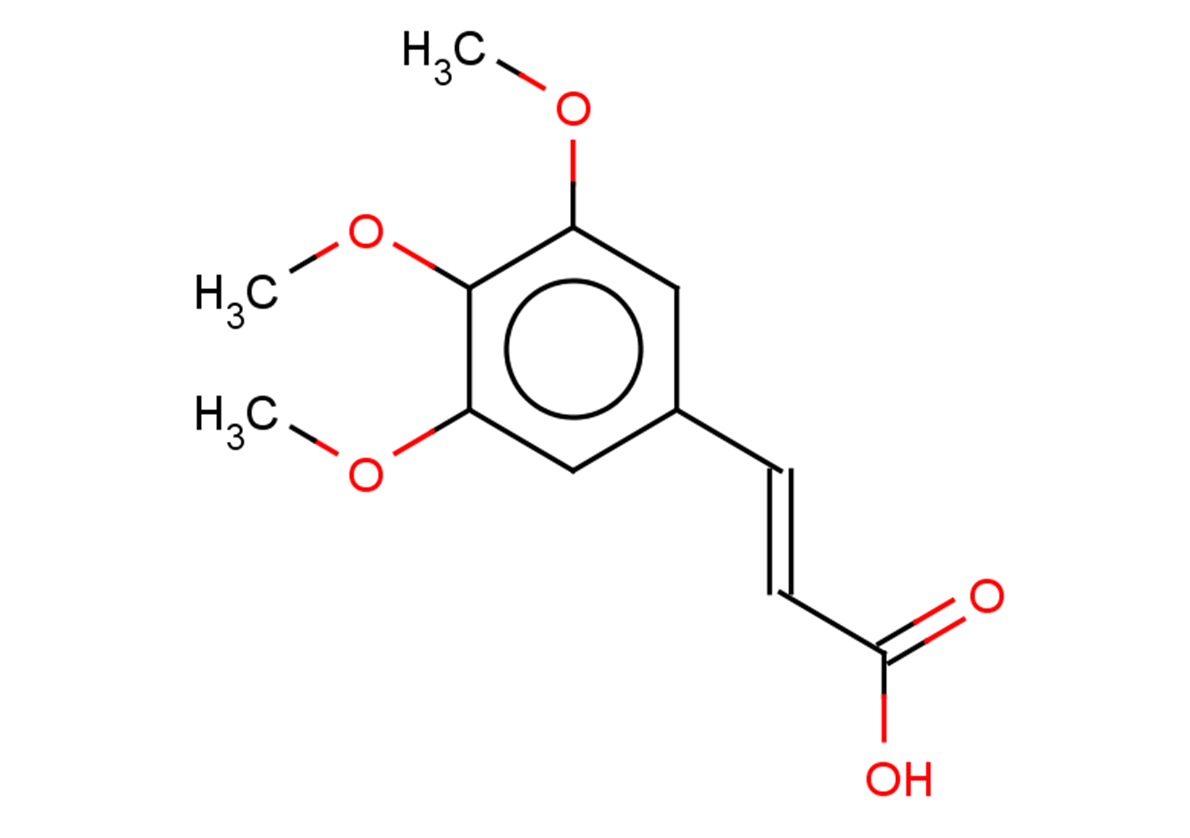
3,4,5-Trimethoxy-trans-cinnamic acid
CAS No. 20329-98-0
3,4,5-Trimethoxy-trans-cinnamic acid( O-Methylsinapic acid | 3,4,5-Trimethoxyphenylacrylic acid )
Catalog No. M23909 CAS No. 20329-98-0
3,4,5-Trimethoxy-trans-cinnamic acid is a natural product from the roots and rhizomes of Notopterygium incisum.
Purity : >98% (HPLC)
 COA
Datasheet
HNMR
HPLC
MSDS
Handing Instructions
COA
Datasheet
HNMR
HPLC
MSDS
Handing Instructions
| Size | Price / USD | Stock | Quantity |
| 1 mL x 10 mM in DMSO | 29 | In Stock |


|
| 100MG | 37 | In Stock |
|
| 200MG | Get Quote | In Stock |
|
| 500MG | 86 | In Stock |
|
| 1G | 126 | In Stock |
|
Biological Information
-
Product Name3,4,5-Trimethoxy-trans-cinnamic acid
-
NoteResearch use only, not for human use.
-
Brief Description3,4,5-Trimethoxy-trans-cinnamic acid is a natural product from the roots and rhizomes of Notopterygium incisum.
-
Description3,4,5-Trimethoxy-trans-cinnamic acid is a natural product from the roots and rhizomes of Notopterygium incisum.
-
In Vitro(E)-3,4,5-Trimethoxycinnamic acid (10 μg/mL, 1 h) increases the expressions of GAD65 and γ-subunit of GABAA receptors in the cerebellar granule cells.(E)-3,4,5-Trimethoxycinnamic acid (0-10 μg/mL, 1 h) shows a significant increase in Cl- influx. Western Blot Analysis Cell Line:Primary cultured cerebellar granule cells Concentration:10 μg/mL Incubation Time:1 h Result:Increased expression of GAD65 (glutamic acid decarboxylase) and γ-subunit of GABAA receptors, but did not influence the amounts of a-, b-subunits in the GABAA receptors.Cell Viability Assay Cell Line:Primary cultured cerebellar granule cellsConcentration:1, 3, 5, 10 μg/mL Incubation Time:1 h Result:Produced a significant increase in Cl- influx.
-
In Vivo(E)-3,4,5-Trimethoxycinnamic acid (0-20 mg/kg, IP, once) shows anti-seizure effects.(E)-3,4,5-Trimethoxycinnamic acid (0-10 mg/kg, Orally, once) enhances hypnotic effects in pentobarbital-treated mice. Animal Model:Ault male KunMing-strain mice (18-20 g, maximal electroshock (MES) and pentylenetetrazol (PTZ) models)Dosage:5, 10 and 20 mg/kg; 10 mL/kg Administration:IP, once Result:Significantly decreased the incidence of MES-induced THE (tonic hindlimb extension) to 50% and 20% of the value of the vehicle controls at 10 and 20 mg/kg. Decreased the incidence of MES-induced THE to only 80% at 5 mg/kg. Significantly delayed the onset of myoclonic jerks (MJ), and decreased the seizure severity and mortality compared with the vehicle-treated animals in PTZ seizure model. The incidence of generalized clonic convulsions (stage 4) disappeared at doses of both 10 and 20 mg/kg.Animal Model:ICR male mice (25-28 g, 10-12 in each group)Dosage:2, 5 and 10 mg/kg Administration:Orally (p.o.), once, 15 min and 1 h prior to pentobarbital injection Result:Significantly decreased locomotor activity at 10 mg/kg. Increased NREM and total sleep, but decreased wakefulness.
-
SynonymsO-Methylsinapic acid | 3,4,5-Trimethoxyphenylacrylic acid
-
PathwayOthers
-
TargetOther Targets
-
RecptorOthers
-
Research Area——
-
Indication——
Chemical Information
-
CAS Number20329-98-0
-
Formula Weight238.24
-
Molecular FormulaC12H14O5
-
Purity>98% (HPLC)
-
SolubilityIn Vitro:?DMSO : 100 mg/mL (419.74 mM)
-
SMILESCOc1cc(/C=C/C(O)=O)cc(OC)c1OC
-
Chemical Name——
Shipping & Storage Information
-
Storage(-20℃)
-
ShippingWith Ice Pack
-
Stability≥ 2 years
Reference
1.Joseph S S , Lynham J A , Molenaar P , et al. Intrinsic sympathomimetic activity of (-)-pindolol mediated through a (-)-propranolol-resistant site of the β1-adrenoceptor in human atrium and recombinant receptors[J]. Naunyn-Schmiedeberg's Archives of Pharmacology, 2003, 368(6):496-503.
molnova catalog



related products
-
Bradykinin (2-7)
Bradykinin (2-7)
-
Myricetin 3-rutinosi...
Myricetin-3-O-rutinoside (Compound 3) is a natural product that can be isolated from Picea abies.
-
Cathepsin S substrat...
Ac-KQKLR-AMC (Cathepsin S substrate) is a biological active peptide. (Cathepsins are a class of globular lysosomal proteases, playing a vital role in mammalian cellular turnover. They degrade polypeptides and are distinguished by their substrate specificities. Cathepsin S is a cysteine proteinase involved in the pathogenesis of autoimmune diseases, atherosclerosis, cancer, obesity and related diseases.This peptide is a cathepsin S substrate fluorescently labeled with AMC (Ex/Em=354 nm/442 nm). It can be used to measure cathepsin S activity.)
