


 Cart
Cart
 sales@molnova.com


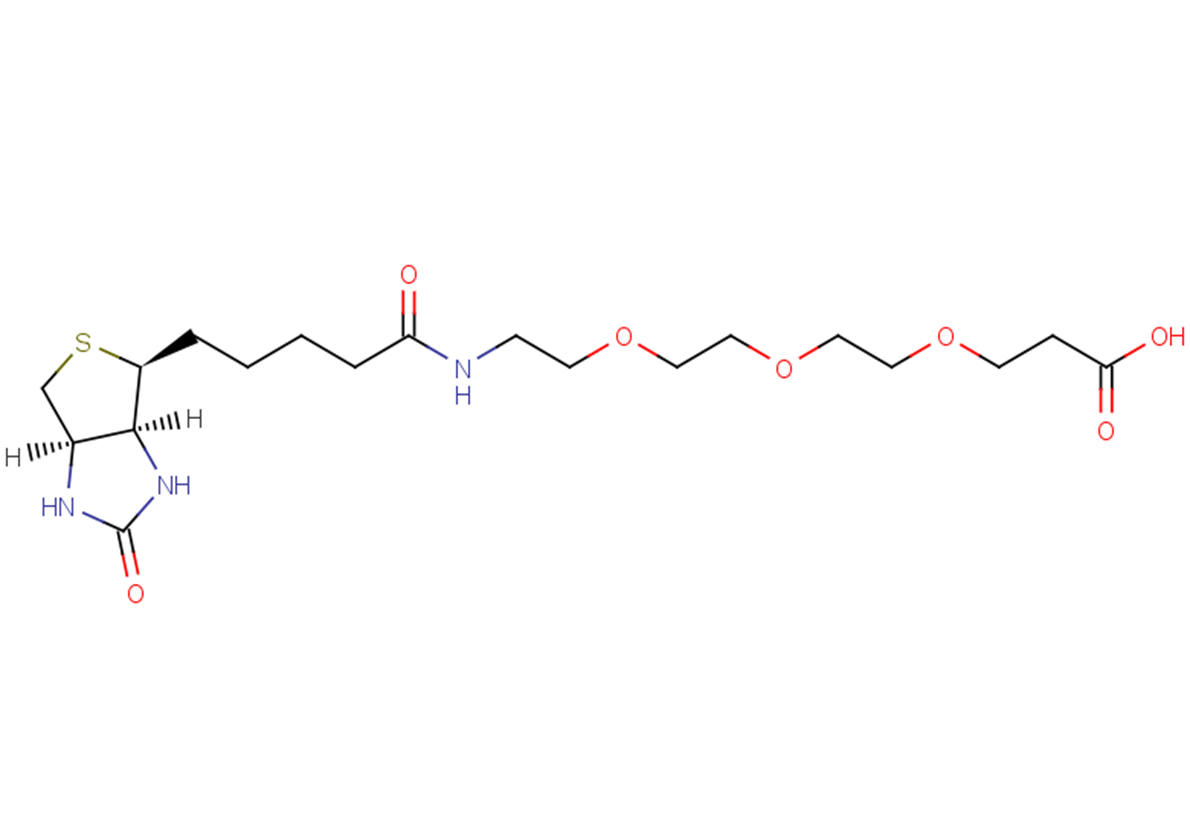
Biotin-PEG3-acid
CAS No. 252881-76-8
Biotin-PEG3-acid( —— )
Catalog No. M22921 CAS No. 252881-76-8
Biotin-PEG3-acid is a biotin-labeled, PEG-based PROTAC linker that can be used in the synthesis of PROTACs.Biotin-PEG3-acid is a heterobiofunctional biotin PEG derivative containing a carboxylic acid group. The hydrophilic PEG spacer arm imparts water solubility that is transferred to the biotinylated molecule.
Purity : >98% (HPLC)
 COA
Datasheet
HNMR
HPLC
MSDS
Handing Instructions
COA
Datasheet
HNMR
HPLC
MSDS
Handing Instructions
| Size | Price / USD | Stock | Quantity |
| 25MG | 28 | In Stock |


|
| 100MG | Get Quote | In Stock |
|
| 200MG | Get Quote | In Stock |
|
| 500MG | Get Quote | In Stock |
|
| 1G | Get Quote | In Stock |
|
Biological Information
-
Product NameBiotin-PEG3-acid
-
NoteResearch use only, not for human use.
-
Brief DescriptionBiotin-PEG3-acid is a biotin-labeled, PEG-based PROTAC linker that can be used in the synthesis of PROTACs.Biotin-PEG3-acid is a heterobiofunctional biotin PEG derivative containing a carboxylic acid group. The hydrophilic PEG spacer arm imparts water solubility that is transferred to the biotinylated molecule.
-
DescriptionBiotin-PEG3-acid is a biotin-labeled, PEG-based PROTAC linker that can be used in the synthesis of PROTACs.Biotin-PEG3-acid is a heterobiofunctional biotin PEG derivative containing a carboxylic acid group. The hydrophilic PEG spacer arm imparts water solubility that is transferred to the biotinylated molecule. PEG Linkers may be useful in the development of antibody drug conjugates and drug delivery methods. PROTACs contain two different ligands connected by a linker; one is a ligand for an E3 ubiquitin ligase and the other is for the target protein. PROTACs exploit the intracellular ubiquitin-proteasome system to selectively degrade target proteins.
-
In VitroPROTACs contain two different ligands connected by a linker; one is a ligand for an E3 ubiquitin ligase and the other is for the target protein. PROTACs exploit the intracellular ubiquitin-proteasome system to selectively degrade target proteins.
-
In Vivo——
-
Synonyms——
-
PathwayPROTACs
-
TargetPROTAC
-
RecptorPEGs
-
Research Area——
-
Indication——
Chemical Information
-
CAS Number252881-76-8
-
Formula Weight447.55
-
Molecular FormulaC19H33N3O7S
-
Purity>98% (HPLC)
-
SolubilityIn Vitro:?DMSO : 100 mg/mL (223.44 mM)
-
SMILESO=C1N[C@]2(CS[C@H]([C@]2(N1)[H])CCCCC(NCCOCCOCCOCCC(O)=O)=O)[H]
-
Chemical Name——
Shipping & Storage Information
-
Storage(-20℃)
-
ShippingWith Ice Pack
-
Stability≥ 2 years
Reference
1. Gadd MS, et al. Structural basis of PROTAC cooperative recognition for selective protein degradation. Nat Chem Biol. 2017 May;13(5):514-521.
molnova catalog



related products
-
FKBP12 PROTAC dTAG-1...
FKBP12 PROTAC dTAG-13 (dTAG-13) is an in vivo-active heterobifunctional adation tag (dTAG) small molecule that engage FKBP12F36V and CRBN.
-
dBET23
dBET23 is a BRD4 heterobifunctional small-molecule ligand (PROTAC), exhibits significant and selective degradation of BRD4 BD1 (DC50/5h=50 nM) in cellular degradation assays.
-
MZ1
MZ1 is a?PROTAC that tethers JQ1 to a ligand for the E3 ubiquitin ligase VHL, triggers, induces degradation of the BET bromodomain BRD4.
