


 Cart
Cart
 sales@molnova.com


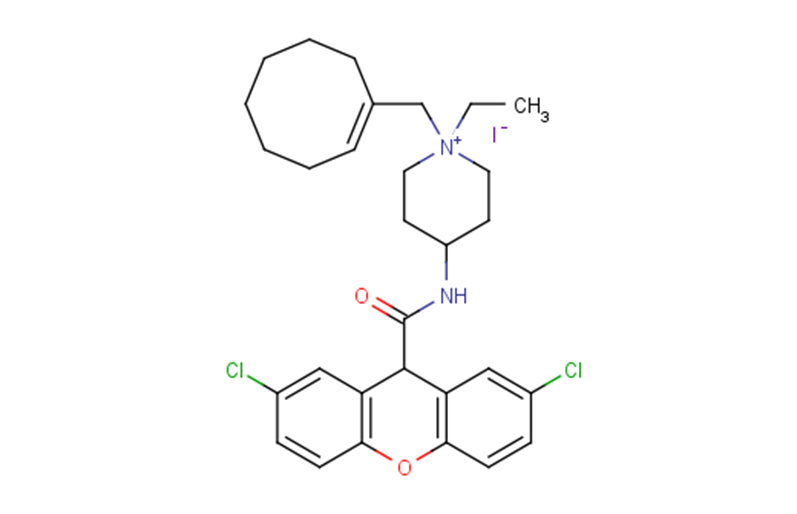
J-113863
CAS No. 353791-85-2
J-113863( —— )
Catalog No. M22691 CAS No. 353791-85-2
J-113863 is also a potent antagonist of the human CCR3 (IC50 of 0.58 nM) , but a weak antagonist of the mouse CCR3 (IC50 of 460 nM). J-113863 is inactive against CCR2, CCR4 and CCR5, as well as the LTB4 or TNF-α receptors. Anti-inflammatory effect. J-113863 is a potent and selective CCR1 (CD18) antagonist with IC50 values of 0.9 nM and 5.8 nM for human and mouse CCR1 receptors, respectively.
Purity : >98% (HPLC)
 COA
Datasheet
HNMR
HPLC
MSDS
Handing Instructions
COA
Datasheet
HNMR
HPLC
MSDS
Handing Instructions
| Size | Price / USD | Stock | Quantity |
| 2MG | 71 | In Stock |


|
| 5MG | 115 | In Stock |
|
| 10MG | 155 | In Stock |
|
| 25MG | 287 | In Stock |
|
| 50MG | 500 | In Stock |
|
| 100MG | 718 | In Stock |
|
| 200MG | Get Quote | In Stock |
|
| 500MG | Get Quote | In Stock |
|
| 1G | Get Quote | In Stock |
|
Biological Information
-
Product NameJ-113863
-
NoteResearch use only, not for human use.
-
Brief DescriptionJ-113863 is also a potent antagonist of the human CCR3 (IC50 of 0.58 nM) , but a weak antagonist of the mouse CCR3 (IC50 of 460 nM). J-113863 is inactive against CCR2, CCR4 and CCR5, as well as the LTB4 or TNF-α receptors. Anti-inflammatory effect. J-113863 is a potent and selective CCR1 (CD18) antagonist with IC50 values of 0.9 nM and 5.8 nM for human and mouse CCR1 receptors, respectively.
-
DescriptionJ-113863 is also a potent antagonist of the human CCR3 (IC50 of 0.58 nM) , but a weak antagonist of the mouse CCR3 (IC50 of 460 nM). J-113863 is inactive against CCR2, CCR4 and CCR5, as well as the LTB4 or TNF-α receptors. Anti-inflammatory effect. J-113863 is a potent and selective CCR1 (CD18) antagonist with IC50 values of 0.9 nM and 5.8 nM for human and mouse CCR1 receptors, respectively. The chemotaxis of the following cells were inhibited by J-113863. Modified Vaccinia virus Ankara (MVA) but not MVA and vaccinia virus (VACV) infected MH-S cells increase the expression of the CXCR2 acting chemokine CXCL2. MH-S cells constitutively produce CCL2 and CCR1 acting chemokines CCL3, CCL5 and CCL9. Consequently, supernatants of mock treated and virus infected MH-S cells induce chemotaxis of murine promyelocyte MPRO cells and human monocytic THP-1 cells at the same level. However, supernatants of MVA infected MH-S cells significantly increase chemotaxis of the CCR2 deficient human monocytic cell line U-937. J-113863 treatment improves paw inflammation and joint damage, and dramatically decreases cell infiltration into joints in arthritic mice.
-
In Vitro——
-
In VivoAnimal Model:DBA-1 male mice (10-12 weeks) induced with Collagen Dosage:3 mg/kg, 10 mg/kg Administration:Intraperitoneal injection; once daily; for 11 days Result:Improved paw inflammation and joint damage, and dramatically decreased cell infiltration into joints.
-
Synonyms——
-
PathwayAutophagy
-
TargetCCR
-
RecptorCCR1|CCR3
-
Research Area——
-
Indication——
Chemical Information
-
CAS Number353791-85-2
-
Formula Weight655.44
-
Molecular FormulaC30H37Cl2IN2O2
-
Purity>98% (HPLC)
-
SolubilityIn Vitro:?DMSO : 50 mg/mL (76.28 mM)
-
SMILES[I-].CC[N+]1(C\C2=C\CCCCCC2)CCC(CC1)NC(=O)C1c2cc(Cl)ccc2Oc2ccc(Cl)cc12
-
Chemical Name——
Shipping & Storage Information
-
Storage(-20℃)
-
ShippingWith Ice Pack
-
Stability≥ 2 years
Reference
1. Lehmann MH, et al. Modified Vaccinia virus Ankara but not vaccinia virus induces chemokine expression in cells of the monocyte/macrophage lineage. Virol J. 2015 Feb 12;12:21.
molnova catalog



related products
-
Leronlimab
Leronlimab (PRO 140) is a humanized IgG4 anti-CCR5 monoclonal antibody with both anti-HIV and anti-tumor activity, inhibiting CCR-mediated HIV-1 virus and cancer cell metastasis in mouse tumor models. Leronlimab can be used to study HIV, non-alcoholic steatohepatitis (NASH), and breast cancer.
-
Arteether
Arteether, a new antimalarial drug.
-
Manninotriose
Manninotriose has the pharmacological activities, such as promoting the proliferation of hematopoietic cells, improving immunity, lowering blood glucose and anti-tumor.
