


 Cart
Cart
 sales@molnova.com


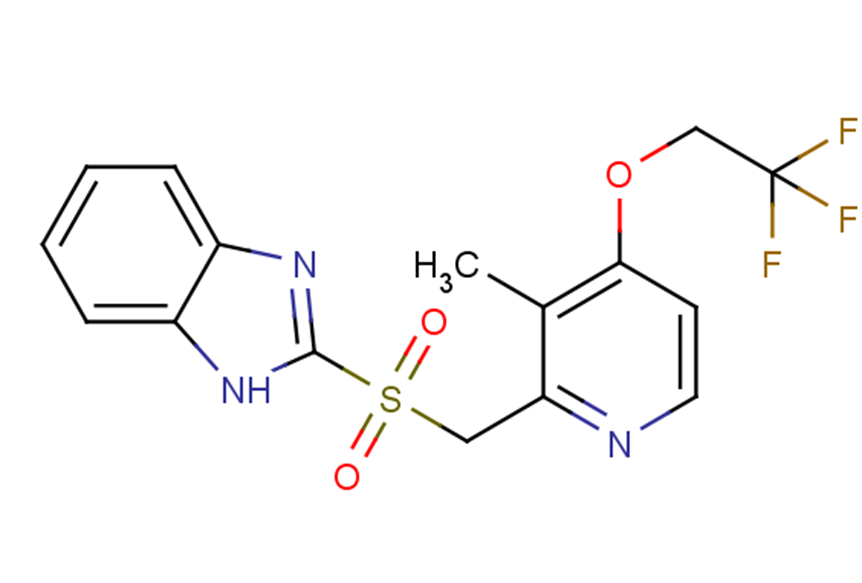
Lansoprazole sulfone
CAS No. 131926-99-3
Lansoprazole sulfone( —— )
Catalog No. M22591 CAS No. 131926-99-3
Lansoprazole sulfone is a metabolite of the gastric pump inhibitor Lansoprazole.
Purity : >98% (HPLC)
 COA
Datasheet
HNMR
HPLC
MSDS
Handing Instructions
COA
Datasheet
HNMR
HPLC
MSDS
Handing Instructions
| Size | Price / USD | Stock | Quantity |
| 1 mL x 10 mM in DMSO | 37 | In Stock |


|
| 5MG | 107 | In Stock |
|
| 10MG | 174 | In Stock |
|
| 25MG | 296 | In Stock |
|
| 50MG | 436 | In Stock |
|
| 100MG | 641 | In Stock |
|
| 200MG | 905 | In Stock |
|
| 500MG | Get Quote | In Stock |
|
| 1G | Get Quote | In Stock |
|
Biological Information
-
Product NameLansoprazole sulfone
-
NoteResearch use only, not for human use.
-
Brief DescriptionLansoprazole sulfone is a metabolite of the gastric pump inhibitor Lansoprazole.
-
DescriptionLansoprazole sulfone is a metabolite of the gastric pump inhibitor Lansoprazole.
-
In Vitro——
-
In Vivo——
-
Synonyms——
-
PathwayOthers
-
TargetOther Targets
-
RecptorOthers
-
Research Area——
-
Indication——
Chemical Information
-
CAS Number131926-99-3
-
Formula Weight385.36
-
Molecular FormulaC16H14F3N3O3S
-
Purity>98% (HPLC)
-
SolubilityIn Vitro:?DMSO : 250 mg/mL (648.74 mM)
-
SMILESCc1c(OCC(F)(F)F)ccnc1CS(=O)(=O)c1nc2ccccc2[nH]1
-
Chemical Name——
Shipping & Storage Information
-
Storage(-20℃)
-
ShippingWith Ice Pack
-
Stability≥ 2 years
Reference
1. Zhang D , Yang M , Liu M , et al. Pharmacokinetics of lansoprazole and its main metabolites after single intravenous doses in healthy Chinese subjects[J]. Xenobiotica, 2012.
molnova catalog



related products
-
Ellagic acid 4-O-alp...
The roots of Diplopanax stachyanthus.
-
H-Leu-Gln-Val-Gln-Le...
H-Leu-Gln-Val-Gln-Leu-Ser-Ile-Arg-OH
-
Bak - BH3
Bak - BH3
