


 Cart
Cart
 sales@molnova.com


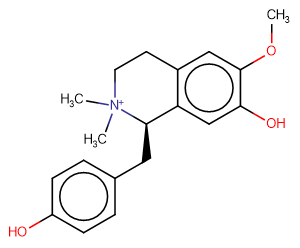
Magnocurarine
CAS No. 6801-40-7
Magnocurarine( —— )
Catalog No. M21688 CAS No. 6801-40-7
Magnocurarine is a natural product from Magnolia officinalis.
Purity : >98% (HPLC)
 COA
Datasheet
HNMR
HPLC
MSDS
Handing Instructions
COA
Datasheet
HNMR
HPLC
MSDS
Handing Instructions
| Size | Price / USD | Stock | Quantity |
| 1 mL x 10 mM in DMSO | 620 | In Stock |


|
| 5MG | 595 | In Stock |
|
| 10MG | 844 | In Stock |
|
| 25MG | 1264 | In Stock |
|
| 50MG | 1665 | In Stock |
|
| 100MG | Get Quote | In Stock |
|
| 200MG | Get Quote | In Stock |
|
| 500MG | Get Quote | In Stock |
|
| 1G | Get Quote | In Stock |
|
Biological Information
-
Product NameMagnocurarine
-
NoteResearch use only, not for human use.
-
Brief DescriptionMagnocurarine is a natural product from Magnolia officinalis.
-
DescriptionMagnocurarine is a natural product from Magnolia officinalis.
-
In Vitro——
-
In Vivo——
-
Synonyms——
-
PathwayOthers
-
TargetOther Targets
-
RecptorOthers
-
Research Area——
-
Indication——
Chemical Information
-
CAS Number6801-40-7
-
Formula Weight314.4
-
Molecular FormulaC19H24NO3
-
Purity>98% (HPLC)
-
Solubility——
-
SMILESC[N+](C)(CCc1c2)[C@H](Cc(cc3)ccc3O)c1cc(O)c2OC
-
Chemical Name——
Shipping & Storage Information
-
Storage(-20℃)
-
ShippingWith Ice Pack
-
Stability≥ 2 years
Reference
1.Effect of Chemical Profiling Change of Processed Magnolia officinalis on the Pharmacokinetic Profiling of Honokiol and Magnolol in Rats.J Chromatogr Sci. 2016 Aug;54(7):1201-12.
molnova catalog



related products
-
Rubropunctamine
Rubropunctamine is a red azaphilone pigment isolated from the extracts of Monascus pilosus-fermented rice (red-mold rice). Rubropunctamine has anti-inflammation activities.
-
Sclareol glycol
Sclareol glycol is the precursor of ambroxide.
-
H-Gly-Pro-Arg-Pro-NH...
H-Gly-Pro-Arg-Pro-NH2 is a peptide that mimics the N-terminal Gly-Pro-Arg region in the a chain of fibrin protein. H-Gly-Pro-Arg-Pro-NH2 prevents fibrin polymerization.
