


 Cart
Cart
 sales@molnova.com


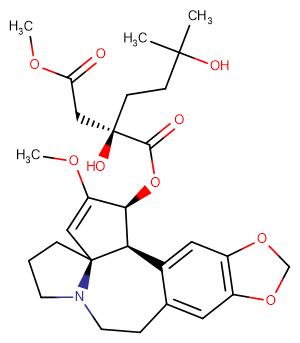
Harringtonine
CAS No. 26833-85-2
Harringtonine( —— )
Catalog No. M21497 CAS No. 26833-85-2
Harringtonine a natural Cephalotaxus alkaloid inhibits protein synthesis.
Purity : >98% (HPLC)
 COA
Datasheet
HNMR
HPLC
MSDS
Handing Instructions
COA
Datasheet
HNMR
HPLC
MSDS
Handing Instructions
| Size | Price / USD | Stock | Quantity |
| 1 mL x 10 mM in DMSO | 87 | In Stock |


|
| 5MG | 75 | In Stock |
|
| 10MG | 113 | In Stock |
|
| 25MG | 188 | In Stock |
|
| 50MG | 275 | In Stock |
|
| 100MG | Get Quote | In Stock |
|
| 200MG | Get Quote | In Stock |
|
| 500MG | Get Quote | In Stock |
|
| 1G | Get Quote | In Stock |
|
Biological Information
-
Product NameHarringtonine
-
NoteResearch use only, not for human use.
-
Brief DescriptionHarringtonine a natural Cephalotaxus alkaloid inhibits protein synthesis.
-
DescriptionHarringtonine a natural Cephalotaxus alkaloid inhibits protein synthesis.(In Vitro):Harringtonine inhibits the elongation phase of translation by preventing substrate binding to the acceptor site on the 60-S ribosome subunit and therefore block aminoacyl-tRNA binding and peptide bond formation. Harringtonine displays potent inhibition of Chikungunya virus infection with an EC50 of 0.24 μM. Harringtonine could inhibit other alphaviruses. Harringtonine inhibits the growth of human myeloid leukemia cells in vitro at low concentrations. The mechanism of the antitumor action of harringtonine is considered to be an effect on protein synthesis and is characterized by breakdown of polysomes to monosomes.
-
In VitroHarringtonine inhibits the elongation phase of translation by preventing substrate binding to the acceptor site on the 60-S ribosome subunit and therefore block aminoacyl-tRNA binding and peptide bond formation. Harringtonine displays potent inhibition of Chikungunya virus infection with an EC50 of 0.24 μM. Harringtonine could inhibit other alphaviruses. Harringtonine inhibits the growth of human myeloid leukemia cells in vitro at low concentrations. The mechanism of the antitumor action of harringtonine is considered to be an effect on protein synthesis and is characterized by breakdown of polysomes to monosomes.
-
In Vivo——
-
Synonyms——
-
PathwayOthers
-
TargetOther Targets
-
RecptorOthers
-
Research Areacancer
-
IndicationLeukemia
Chemical Information
-
CAS Number26833-85-2
-
Formula Weight531.59
-
Molecular FormulaC28H37NO9
-
Purity>98% (HPLC)
-
SolubilityDMSO:1 mg/mL (188.11 mM)
-
SMILESCC(C)(CC[C@@](CC(=O)OC)(C(=O)O[C@H]1[C@H]2C3=CC4=C(C=C3CCN5[C@@]2(CCC5)C=C1OC)OCO4)O)O
-
Chemical Name1-((1S3aR14bS)-2-methoxy-1568914b-hexahydro-4H-[13]dioxolo[4'5':45]benzo[12-d]cyclopenta[b]pyrrolo[12-a]azepin-1-yl) 4-methyl (R)-2-hydroxy-2-(3-hydroxy-3-methylbutyl)succinate
Shipping & Storage Information
-
Storage(-20℃)
-
ShippingWith Ice Pack
-
Stability≥ 2 years
Reference
1.Fresno M et al. Inhibition of translation in eukaryotic systems by harringtonine. Eur J Biochem. 1977 Jan;72(2):323-30.
molnova catalog



related products
-
4-Azido-L-phenylalan...
4-Azido-L-phenylalanine (p-Azido-L-phenylalanine) is an amino acid derivative that acts as a photoaffinity marker and can be used to detect localized protein environments.
-
Fenchlonine
4-Chloro-DL-phenylalanine is a pharmaceutical intermediate.
-
Tecovirimat
Tecovirimat (ST-246, Tpoxx) is a potent, orally bioavailable, first-in-class inhibitor of orthopoxvirus egress with EC50 of 0.01-0.6 uM against a panel of Orthopoxvirusesu.
