


 Cart
Cart
 sales@molnova.com


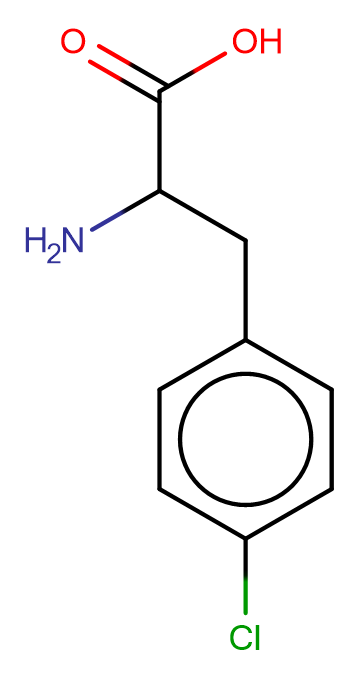
Fenchlonine
CAS No. 7424-00-2
Fenchlonine( PCPA )
Catalog No. M15837 CAS No. 7424-00-2
4-Chloro-DL-phenylalanine is a pharmaceutical intermediate.
Purity : >98% (HPLC)
 COA
Datasheet
HNMR
HPLC
MSDS
Handing Instructions
COA
Datasheet
HNMR
HPLC
MSDS
Handing Instructions
| Size | Price / USD | Stock | Quantity |
| 100MG | Get Quote | In Stock |


|
| 200MG | 28 | In Stock |
|
| 500MG | 39 | In Stock |
|
| 1G | 49 | In Stock |
|
Biological Information
-
Product NameFenchlonine
-
NoteResearch use only, not for human use.
-
Brief Description4-Chloro-DL-phenylalanine is a pharmaceutical intermediate.
-
Description4-Chloro-DL-phenylalanine is a pharmaceutical intermediate.
-
In Vitro——
-
In VivoFenclonine (intraperitoneal injection; 100 mg/kg; once daily; 3 d) treatment can inhibit Morphine-induced anti-nociceptive activity.Fenclonine (intraperitoneal injection; 300 mg/kg; once daily; 3 d) pretreatment completely abolishes the effects of a 50mg/kg dose of Paracetamol. Animal Model:Wistar albino rats of either sex and weighing between 80 and 100 g Dosage:100 mg/kg Administration:Intraperitoneal injection; 100 mg/kg; once daily; 3 days Result:Inhibited the antinociceptive activity of Morphine by 41.5%.Animal Model:Male Swiss mice (22–25 g)Dosage:300 mg/kg Administration:Intraperitoneal injection; 300 mg/kg; once daily; 3 days Result:Inhibited the effects of Paracetamol in depression-like and compulsion-like behavior.
-
SynonymsPCPA
-
PathwayOthers
-
TargetOther Targets
-
RecptorHydroxylases
-
Research AreaOther Indications
-
Indication——
Chemical Information
-
CAS Number7424-00-2
-
Formula Weight199.63
-
Molecular FormulaC9H10CINO2
-
Purity>98% (HPLC)
-
SolubilityWater: 10 mM
-
SMILESC(C(=O)O)(Cc1ccc(cc1)Cl)N
-
Chemical NameAlanine, 3-(4-chlorophenyl)-, DL-
Shipping & Storage Information
-
Storage(-20℃)
-
ShippingWith Ice Pack
-
Stability≥ 2 years
Reference
1.Bai Y, et al. Int J Mol Med. 2014 Feb;33(2):373-82.
molnova catalog



related products
-
AK-778-XXMU
AK-778-XXMU is an ID2 antagonist with a KD value of 129 nM.AK-778-XXMU has potential antitumor and anticancer activity and can be used for the study of gliomas.
-
6-Thio-dG
6-thio-dG is a nucleoside analog and telomerase substrate.
-
2-Isobutoxyaniline
2-Isobutoxyaniline is a marine derived natural products found in Brevibacterium sp.
