


 Cart
 sales@molnova.com


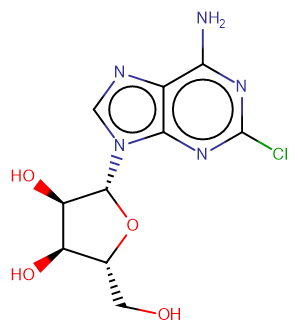
2-Chloroadenosine
CAS No. 146-77-0
2-Chloroadenosine( —— )
Catalog No. M20922 CAS No. 146-77-0
2-Chloroadenosine (CADO) is a metabolically stable analog of adenosine that binds to adenosine A1 A2A and A3 receptors( Ki:300 80 and 1900 nM respectively).
Purity : >98% (HPLC)
 COA
Datasheet
HNMR
HPLC
MSDS
Handing Instructions
| Size | Price / USD | Stock | Quantity |
| 1 mL x 10 mM in DMSO | 29 | In Stock |


|
| 10MG | 41 | In Stock |
|
| 25MG | 61 | In Stock |
|
| 50MG | 73 | In Stock |
|
| 100MG | 124 | In Stock |
|
| 200MG | Get Quote | In Stock |
|
| 500MG | 312 | In Stock |
|
| 1G | Get Quote | In Stock |
|
Biological Information
-
Product Name2-Chloroadenosine
-
NoteResearch use only, not for human use.
-
Brief Description2-Chloroadenosine (CADO) is a metabolically stable analog of adenosine that binds to adenosine A1 A2A and A3 receptors( Ki:300 80 and 1900 nM respectively).
-
Description2-Chloroadenosine (CADO) is a metabolically stable analog of adenosine that binds to adenosine A1 A2A and A3 receptors( Ki:300 80 and 1900 nM respectively).
-
In Vitro——
-
In Vivo——
-
Synonyms——
-
PathwayEndocrinology/Hormones
-
TargetAChR
-
RecptorAdenosine receptor
-
Research Area——
-
Indication——
Chemical Information
-
CAS Number146-77-0
-
Formula Weight301.69
-
Molecular FormulaC10H12ClN5O4
-
Purity>98% (HPLC)
-
SolubilityIn Vitro:?DMSO : 100 mg/mL (331.47 mM)
-
SMILESNc1nc(Cl)nc2c1ncn2[C@@H]1O[C@H](CO)[C@@H](O)[C@H]1O
-
Chemical Name(2R3R4S5R)-2-(6-amino-2-chloro-9H-purin-9-yl)-5-(hydroxymethyl)tetrahydrofuran-34-diol
Shipping & Storage Information
-
Storage(-20℃)
-
ShippingWith Ice Pack
-
Stability≥ 2 years
Reference
1.Ates N Ilbay G Sahin D . Suppression of generalized seizures activity by intrathalamic 2-chloroadenosine application[J]. Experimental Biology and Medicine 2005 230(7):501-505.
molnova catalog



related products
-
DL-trihexyphenidyl h...
One of the centrally acting muscarinic antagonists used for treatment of parkinsonia disorders and drug-induced extrapyramidal movement disorders and as an antispasmodic.
-
Theophylline
Theophylline is a methylated xanthine derivative; competitive nonselective phosphodiesterase inhibitor and nonselective adenosine receptor antagonist.
-
Platycodin D
Platycodin D may stimulate TNF-α synthesis or inhibit degradation of TNF-α mRNA. Platycodin D (10/30 μM) suppresses prostaglandin E2 production in rat peritoneal macrophages stimulated by the protein kinase C activator 12-O-tetradecanoyl phorbol 13-acetate (TPA).
