


 Cart
Cart
 sales@molnova.com


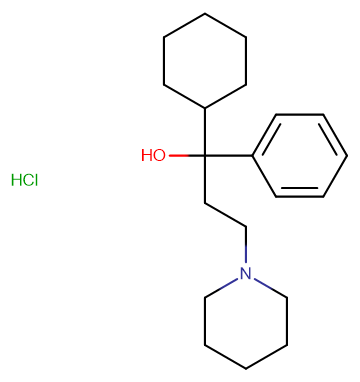
DL-trihexyphenidyl hydrochloride
CAS No. 58947-95-8
DL-trihexyphenidyl hydrochloride( —— )
Catalog No. M15177 CAS No. 58947-95-8
One of the centrally acting muscarinic antagonists used for treatment of parkinsonia disorders and drug-induced extrapyramidal movement disorders and as an antispasmodic.
Purity : >98% (HPLC)
 COA
Datasheet
HNMR
HPLC
MSDS
Handing Instructions
COA
Datasheet
HNMR
HPLC
MSDS
Handing Instructions
| Size | Price / USD | Stock | Quantity |
| 1 mL x 10 mM in DMSO | 28 | In Stock |


|
| 10MG | 29 | In Stock |
|
| 25MG | 39 | In Stock |
|
| 50MG | 60 | In Stock |
|
| 100MG | 80 | In Stock |
|
| 200MG | Get Quote | In Stock |
|
| 500MG | 183 | In Stock |
|
| 1G | Get Quote | In Stock |
|
Biological Information
-
Product NameDL-trihexyphenidyl hydrochloride
-
NoteResearch use only, not for human use.
-
Brief DescriptionOne of the centrally acting muscarinic antagonists used for treatment of parkinsonia disorders and drug-induced extrapyramidal movement disorders and as an antispasmodic.
-
DescriptionOne of the centrally acting muscarinic antagonsistused for treatment of parkinsonian disorders and drug-induced extrapyramidal movement disorders and as an antispasmodic.
-
In Vitro——
-
In Vivo——
-
Synonyms——
-
PathwayEndocrinology/Hormones
-
TargetAChR
-
RecptormAChR
-
Research Area——
-
Indication——
Chemical Information
-
CAS Number58947-95-8
-
Formula Weight337.93
-
Molecular FormulaC20H32ClNO
-
Purity>98% (HPLC)
-
SolubilityDMSO: 10 mM
-
SMILESCl.OC(CCN1CCCCC1)(C1CCCCC1)C1=CC=CC=C1
-
Chemical Name——
Shipping & Storage Information
-
Storage(-20℃)
-
ShippingWith Ice Pack
-
Stability≥ 2 years
Reference
1.Bognar IT, et al. Naunyn Schmiedebergs Arch Pharmacol. 1992 Jun;345(6):611-8.
molnova catalog



related products
-
Atropine sulfate mon...
Atropine sulfate monohydrate is a competitive muscarinic acetylcholine receptor antagonist.
-
2-Chloroadenosine
2-Chloroadenosine (CADO) is a metabolically stable analog of adenosine that binds to adenosine A1 A2A and A3 receptors( Ki:300 80 and 1900 nM respectively).
-
MK-7622
MK-7622 is a modulator of muscarinic M1 receptor positive allosteric.
