


 Cart
Cart
 sales@molnova.com


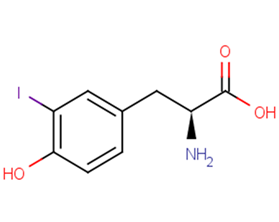
H-Tyr(3-I)-OH
CAS No. 70-78-0
H-Tyr(3-I)-OH( 3-Iodo-L-tyrosine )
Catalog No. M20288 CAS No. 70-78-0
H-Tyr(3-I)-OH is an inhibitor of tyrosine hydroxylase (Ki = 0.39 M) and an intermediate in the synthesis of thyroid hormones.
Purity : >98% (HPLC)
 COA
Datasheet
HNMR
HPLC
MSDS
Handing Instructions
COA
Datasheet
HNMR
HPLC
MSDS
Handing Instructions
| Size | Price / USD | Stock | Quantity |
| 100MG | Get Quote | In Stock |


|
| 200MG | Get Quote | In Stock |
|
| 500MG | Get Quote | In Stock |
|
| 1G | 27 | In Stock |
|
Biological Information
-
Product NameH-Tyr(3-I)-OH
-
NoteResearch use only, not for human use.
-
Brief DescriptionH-Tyr(3-I)-OH is an inhibitor of tyrosine hydroxylase (Ki = 0.39 M) and an intermediate in the synthesis of thyroid hormones.
-
DescriptionH-Tyr(3-I)-OH is an inhibitor of tyrosine hydroxylase (Ki = 0.39 M) and an intermediate in the synthesis of thyroid hormones.
-
In VitroH-Tyr(3-I)-OH (3-iodo-L-tyrosine) is as effective inhibitor of tyrosine hydroxylase. At a concentration of 100μM 3-iodo-L-tyrosine inhibits the enzymatic activity 100% and at a concentration of 10μM it inhibits 60-70%.
-
In Vivo——
-
Synonyms3-Iodo-L-tyrosine
-
PathwayProteasome/Ubiquitin
-
TargetEndogenous Metabolite
-
RecptorHuman Endogenous Metabolite
-
Research Area——
-
Indication——
Chemical Information
-
CAS Number70-78-0
-
Formula Weight307.09
-
Molecular FormulaC9H10INO3
-
Purity>98% (HPLC)
-
SolubilityH2O:6.25 mg/mL (20.35 mM) DMSO:1 mg/mL
-
SMILESN[C@@H](Cc1ccc(O)c(I)c1)C(O)=O
-
Chemical Name——
Shipping & Storage Information
-
Storage(-20℃)
-
ShippingWith Ice Pack
-
Stability≥ 2 years
Reference
1.Fernández-Espejo Emilio Cristian B H . Excess amounts of 3-iodo-L-tyrosine induce Parkinson-like features in experimental approaches of Parkinsonism[J]. NeuroToxicology 2018:S0161813X18301980-.
molnova catalog



related products
-
ADR-925
ADR-925, an active chelated iron metabolite of dexrazoxane, has the ability to protect neonatal rat cardiomyocytes from doxorubicin-induced injury.
-
Magnesium acetate te...
Magnesium acetate tetrahydrate is the hydrated form of the anhydrous magnesium acetate salt.Magnesium acetate tetrahydrate is commonly used to synthesize other compounds, cocoa as an electrolyte supplement or as a reagent in molecular biology experiments.
-
DL-Mandelic acid
It is an isomer of cresotinic acid (2-hydroxy-3-methylbenzoic acid) and oxymethylbenzoic acid (2-methoxybenzoic acid). Derivatives of mandelic acid are formed as a result of metabolism of adrenaline and noradrenaline by monoamine oxidase and catechol-o-methyl transferase.
