


 Cart
Cart
 sales@molnova.com


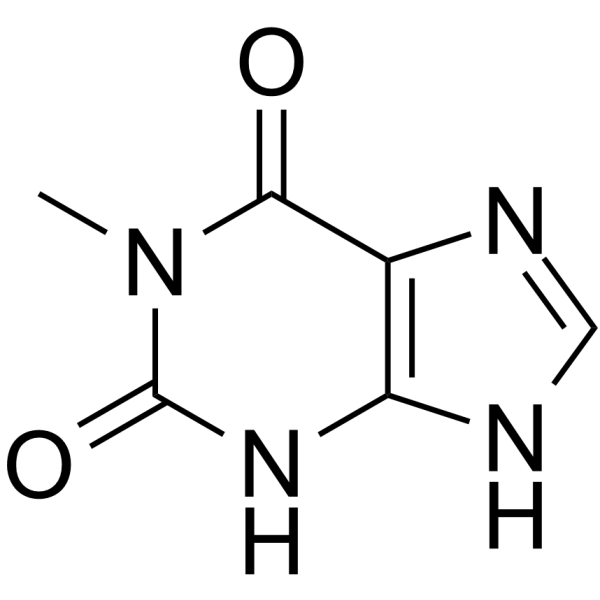
1-Methylxanthine
CAS No. 6136-37-4
1-Methylxanthine( —— )
Catalog No. M26013 CAS No. 6136-37-4
1-Methylxanthine is a caffeine derivative. 1-Methylxanthine is an essential human urinary metabolite of caffeine and theophylline (1,3-dimethylxanthine, TP).
Purity : >98% (HPLC)
 COA
Datasheet
HNMR
HPLC
MSDS
Handing Instructions
COA
Datasheet
HNMR
HPLC
MSDS
Handing Instructions
| Size | Price / USD | Stock | Quantity |
| 1 mL x 10 mM in DMSO | 44 | In Stock |


|
| 25MG | 29 | In Stock |
|
| 50MG | 38 | In Stock |
|
| 100MG | 52 | In Stock |
|
| 200MG | Get Quote | In Stock |
|
| 500MG | Get Quote | In Stock |
|
| 1G | Get Quote | In Stock |
|
Biological Information
-
Product Name1-Methylxanthine
-
NoteResearch use only, not for human use.
-
Brief Description1-Methylxanthine is a caffeine derivative. 1-Methylxanthine is an essential human urinary metabolite of caffeine and theophylline (1,3-dimethylxanthine, TP).
-
Description1-Methylxanthine is a caffeine derivative. 1-Methylxanthine is an essential human urinary metabolite of caffeine and theophylline (1,3-dimethylxanthine, TP). 1-Methylxanthine enhances the radiosensitivity of tumor cells.(In Vitro):1-Methylxanthine exhibits similar activities to other naturally occurring methylxanthines. Unlike caffeine and theobromine, 3-Methylxanthine, and 1-methylxanthine do not occur naturally at high levels in plants. 1-Methylxanthine (3 mM; for 30 min) increases the radiation-induced clonogenic and apoptotic cell (RKO human colorectal cancer cells carrying wild type protein 53 kDa (p53)) death.
-
In Vitro1-Methylxanthine (1-MTX; 3 mM; for 30 min) increases the radiation-induced clonogenic and apoptotic cell (RKO human colorectal cancer cells carrying wild type protein 53 kDa (p53)) death.1-Methylxanthine (1MX) exhibits similar activities to other naturally occurring methylxanthines. Unlike caffeine, TP, and theobromine, 3-Methylxanthine (3MX) and 1-methylxanthine do not occur naturally at high levels in plants.
-
In Vivo——
-
Synonyms——
-
PathwayProteasome/Ubiquitin
-
TargetEndogenous Metabolite
-
Recptor——
-
Research Area——
-
Indication——
Chemical Information
-
CAS Number6136-37-4
-
Formula Weight166.14
-
Molecular FormulaC6H6N4O2
-
Purity>98% (HPLC)
-
SolubilityIn Vitro:?DMSO : 10 mg/mL (60.19 mM)
-
SMILESCn1c(=O)[nH]c2nc[nH]c2c1=O
-
Chemical Name——
Shipping & Storage Information
-
Storage(-20℃)
-
ShippingWith Ice Pack
-
Stability≥ 2 years
Reference



-
H-Leu-Leu-OMe HBr
H-Leu-Leu-OMe HBr (L-Leucyl-L-Leucine methyl ester HBr) is a dipeptide condensation product of L-Leucine methyl ester, a peptide that is toxic to natural killer T-cells and possesses immunosuppressive activity that abrogates all natural killer (NK) cell functions in mixed lymphocyte populations.
-
1-Methylhistamine di...
1-Methylhistamine dihydrochloride is a major metabolite of histamine by histamine N-methyltransferase in the pathway of histidine metabolism.?It has been used as a biomarker of histaminergic system activity in the brains of Alzheimer's disease patients as well as those with hypersomnia and other neurological conditions.
-
L-Methionine sulfoxi...
L-Methionine sulfoxide (H-Met(O)-OH) is a metabolite of Methionine. (H-Met(O)-OH) modulates oxidative stress and purinergic signaling parameters, and induces M1/classical macrophage polarization.
