


 Cart
Cart
 sales@molnova.com


 Home -
Products -
Proteasome/Ubiquitin -
Endogenous Metabolite -
3-(3,4,5-Trimethoxyphenyl)propanoic acid
Home -
Products -
Proteasome/Ubiquitin -
Endogenous Metabolite -
3-(3,4,5-Trimethoxyphenyl)propanoic acid
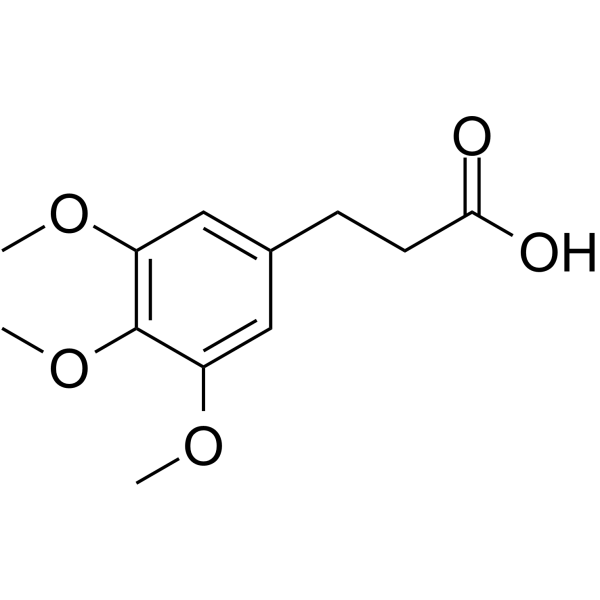
3-(3,4,5-Trimethoxyphenyl)propanoic acid
CAS No. 25173-72-2
3-(3,4,5-Trimethoxyphenyl)propanoic acid( 3-(3,4,5-Trimethoxyphenyl)-propanoic acid )
Catalog No. M27055 CAS No. 25173-72-2
3-(3,4,5-Trimethoxyphenyl)-propanoic acid is a constituent of Piper retrofractum and Piper longum and is found in herbs and spices.
Purity : >98% (HPLC)
 COA
Datasheet
HNMR
HPLC
MSDS
Handing Instructions
COA
Datasheet
HNMR
HPLC
MSDS
Handing Instructions
| Size | Price / USD | Stock | Quantity |
| 1 mL x 10 mM in DMSO | 28 | In Stock |


|
| 100MG | Get Quote | In Stock |
|
| 200MG | Get Quote | In Stock |
|
| 500MG | Get Quote | In Stock |
|
| 1G | 27 | In Stock |
|
Biological Information
-
Product Name3-(3,4,5-Trimethoxyphenyl)propanoic acid
-
NoteResearch use only, not for human use.
-
Brief Description3-(3,4,5-Trimethoxyphenyl)-propanoic acid is a constituent of Piper retrofractum and Piper longum and is found in herbs and spices.
-
Description3-(3,4,5-Trimethoxyphenyl)-propanoic acid is a constituent of Piper retrofractum and Piper longum and is found in herbs and spices.
-
In Vitro——
-
In Vivo——
-
Synonyms3-(3,4,5-Trimethoxyphenyl)-propanoic acid
-
PathwayProteasome/Ubiquitin
-
TargetEndogenous Metabolite
-
RecptorEndogenous Metabolite
-
Research Area——
-
Indication——
Chemical Information
-
CAS Number25173-72-2
-
Formula Weight240.255
-
Molecular FormulaC12H16O5
-
Purity>98% (HPLC)
-
SolubilityIn Vitro:?DMSO : 25 mg/mL (104.06 mM)
-
SMILESCOc1cc(CCC(O)=O)cc(OC)c1OC
-
Chemical Name——
Shipping & Storage Information
-
Storage(-20℃)
-
ShippingWith Ice Pack
-
Stability≥ 2 years
Reference
1.Watanabe K, et al. 3,4,5-Trimethoxyphenylacetaldehyde, an intermediate metabolite of mescaline, is a substrate for microsomal aldehyde oxygenase in the mouse liver. Biol Pharm Bull. 1995 May;18(5):696-9.
molnova catalog



related products
-
Oxoadipic acid
Oxoadipic acid is a key metabolite of the essential amino acids tryptophan and lysine.Important metabolite between the TCA cycle and lysine biosynthesis. Of interest for research on mitochondrial metabolite transporters.
-
Angiotensin III, hum...
Angiotensin III is an agonist of angiotensin 1 (AT1) and AT2 receptor.
-
Alanylphenylalanine
Alanylphenylalanine (Ala-phe) is a compound isolated from the brainstem of calves.
