


 Cart
Cart
 sales@molnova.com


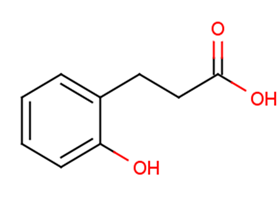
3-(2-Hydroxyphenyl)propionic acid
CAS No. 495-78-3
3-(2-Hydroxyphenyl)propionic acid( —— )
Catalog No. M19688 CAS No. 495-78-3
3-(2-Hydroxyphenyl)propanoic acid also known as melilotic acid or melilotate. Within the cell 3-(2-hydroxyphenyl)propanoic acid is primarily located in the cytoplasm. 3-(2-Hydroxyphenyl)propanoic acid can be biosynthesized from propionic acid.
Purity : >98% (HPLC)
 COA
Datasheet
HNMR
HPLC
MSDS
Handing Instructions
COA
Datasheet
HNMR
HPLC
MSDS
Handing Instructions
| Size | Price / USD | Stock | Quantity |
| 1 mL x 10 mM in DMSO | 28 | In Stock |


|
| 100MG | Get Quote | In Stock |
|
| 200MG | Get Quote | In Stock |
|
| 500MG | 27 | In Stock |
|
| 1G | Get Quote | In Stock |
|
Biological Information
-
Product Name3-(2-Hydroxyphenyl)propionic acid
-
NoteResearch use only, not for human use.
-
Brief Description3-(2-Hydroxyphenyl)propanoic acid also known as melilotic acid or melilotate. Within the cell 3-(2-hydroxyphenyl)propanoic acid is primarily located in the cytoplasm. 3-(2-Hydroxyphenyl)propanoic acid can be biosynthesized from propionic acid.
-
Description3-(2-Hydroxyphenyl)propanoic acid also known as melilotic acid or melilotate. Within the cell 3-(2-hydroxyphenyl)propanoic acid is primarily located in the cytoplasm. 3-(2-Hydroxyphenyl)propanoic acid can be biosynthesized from propionic acid. Outside of the human body 3-(2-hydroxyphenyl)propanoic acid can be found in a number of food items such as herbs and spices red beetroot chinese cinnamon and bilberry. This makes 3-(2-hydroxyphenyl)propanoic acid a potential biomarker for the consumption of these food products.
-
In Vitro——
-
In Vivo——
-
Synonyms——
-
PathwayProteasome/Ubiquitin
-
TargetEndogenous Metabolite
-
RecptorHuman Endogenous Metabolite
-
Research Area——
-
Indication——
Chemical Information
-
CAS Number495-78-3
-
Formula Weight166.17
-
Molecular FormulaC9H10O3
-
Purity>98% (HPLC)
-
SolubilityDMSO:10 mM
-
SMILESOC(=O)CCc1ccccc1O
-
Chemical Name——
Shipping & Storage Information
-
Storage(-20℃)
-
ShippingWith Ice Pack
-
Stability≥ 2 years
Reference
1.Sinha R Ahn J Sampson J N et al. Fecal Microbiota Fecal Metabolome and Colorectal Cancer Interrelations[J]. PLOS ONE 2016 11(3):e0152126.
molnova catalog



related products
-
Aniline
Aniline has been reported to be toxic to the spleen via iron overload and induction of oxidative stress via Heme Oxygenase 1 up-regulation.
-
3-Amino-2-piperidino...
3-Amino-2-piperidinone is a metabolite from all living organisms and can be used as a cyclic ornithine analogue.
-
Guanylin (human)
Endogenous peptide activator of intestinal guanylyl cyclase; secreted mainly by the gastrointestinal mucosa. Regulates water and electrolyte transport in intestinal and renal epithelia.
