


 Cart
Cart
 sales@molnova.com


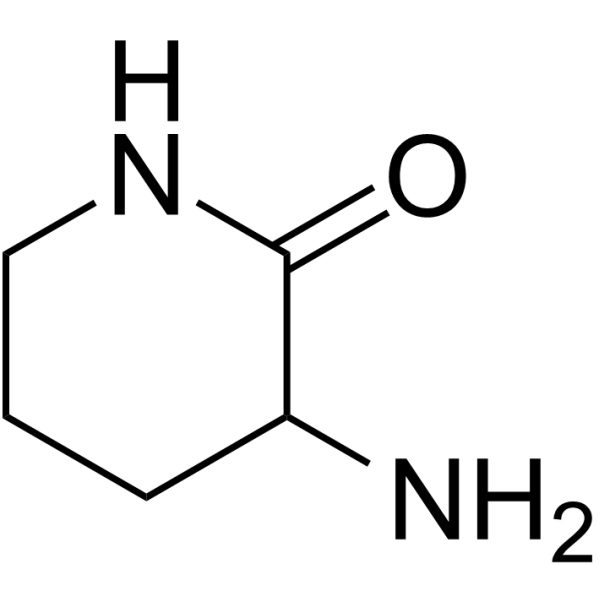
3-Amino-2-piperidinone
CAS No. 1892-22-4
3-Amino-2-piperidinone( Cyclo-ornithine )
Catalog No. M26537 CAS No. 1892-22-4
3-Amino-2-piperidinone is a metabolite from all living organisms and can be used as a cyclic ornithine analogue.
Purity : >98% (HPLC)
 COA
Datasheet
HNMR
HPLC
MSDS
Handing Instructions
COA
Datasheet
HNMR
HPLC
MSDS
Handing Instructions
| Size | Price / USD | Stock | Quantity |
| 1 mL x 10 mM in DMSO | 33 | In Stock |


|
| 100MG | Get Quote | In Stock |
|
| 200MG | Get Quote | In Stock |
|
| 500MG | 27 | In Stock |
|
| 1G | Get Quote | In Stock |
|
Biological Information
-
Product Name3-Amino-2-piperidinone
-
NoteResearch use only, not for human use.
-
Brief Description3-Amino-2-piperidinone is a metabolite from all living organisms and can be used as a cyclic ornithine analogue.
-
Description3-Amino-2-piperidinone is a metabolite from all living organisms and can be used as a cyclic ornithine analogue.
-
In Vitro——
-
In Vivo——
-
SynonymsCyclo-ornithine
-
PathwayProteasome/Ubiquitin
-
TargetEndogenous Metabolite
-
RecptorNF-κB
-
Research Area——
-
Indication——
Chemical Information
-
CAS Number1892-22-4
-
Formula Weight114.148
-
Molecular FormulaC5H10N2O
-
Purity>98% (HPLC)
-
SolubilityIn Vitro:?DMSO : 50 mg/mL (438.02 mM)
-
SMILESNC1CCCNC1=O
-
Chemical Name——
Shipping & Storage Information
-
Storage(-20℃)
-
ShippingWith Ice Pack
-
Stability≥ 2 years
Reference
1.Lagisetty P, et, al. CLEFMA-an anti-proliferative curcuminoid from structure-activity relationship studies on 3,5-bis(benzylidene)-4-piperidones. Bioorg Med Chem. 2010 Aug 15; 18(16):6109-20.
molnova catalog



related products
-
Ochratoxin B
Ochratoxin B is produced by a variety of Aspergillus and Penicillium species and is an analog of the mycotoxin Ochratoxin A, which can contaminate agricultural products.
-
Ethyl nonanoate
Ethyl nonanoate (Ethyl pelargonate) is an abundant ester in spirits, and its presence is usually associated with the aroma of alcoholic beverages.
-
CMP-Sialic acid sodi...
CMP-Sialic acid sodium salt (CMP-Neu5Ac sodium salt) is a variant inhibitor of UDP-GlcNAc 2-epimerase, the activated form of sialic acid, which is widely found in animals and is involved in the metabolism of organisms.
