


 Cart
Cart
 sales@molnova.com


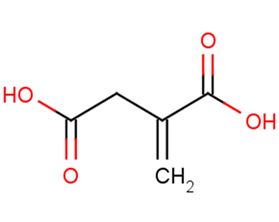
Itaconic acid
CAS No. 97-65-4
Itaconic acid( methylene-butanedioicaci )
Catalog No. M19675 CAS No. 97-65-4
Itaconic acid also known as itaconate belongs to the class of organic compounds known as branched fatty acids. These are fatty acids containing a branched chain. Itaconic acid exists as a solid soluble (in water) and a weakly acidic compound (based on its pKa). Itaconic acid has been detected in multiple biofluids such as sweat and urine.
Purity : >98% (HPLC)
 COA
Datasheet
HNMR
HPLC
MSDS
Handing Instructions
COA
Datasheet
HNMR
HPLC
MSDS
Handing Instructions
| Size | Price / USD | Stock | Quantity |
| 1 mL x 10 mM in DMSO | 43 | In Stock |


|
| 100MG | 50 | In Stock |
|
| 200MG | Get Quote | In Stock |
|
| 500MG | 98 | In Stock |
|
| 1G | 137 | In Stock |
|
Biological Information
-
Product NameItaconic acid
-
NoteResearch use only, not for human use.
-
Brief DescriptionItaconic acid also known as itaconate belongs to the class of organic compounds known as branched fatty acids. These are fatty acids containing a branched chain. Itaconic acid exists as a solid soluble (in water) and a weakly acidic compound (based on its pKa). Itaconic acid has been detected in multiple biofluids such as sweat and urine.
-
DescriptionItaconic acid also known as itaconate belongs to the class of organic compounds known as branched fatty acids. These are fatty acids containing a branched chain. Itaconic acid exists as a solid soluble (in water) and a weakly acidic compound (based on its pKa). Itaconic acid has been detected in multiple biofluids such as sweat and urine. Within the cell itaconic acid is primarily located in the mitochondria cytoplasm and adiposome. Itaconic acid exists in all eukaryotes ranging from yeast to humans. Adenosine triphosphate and itaconic acid can be converted into itaconyl-CoA; which is catalyzed by the enzyme succinyl-CoA ligase. Outside of the human body itaconic acid can be found in a number of food items such as cowpea butternut squash brussel sprouts and nopal. This makes itaconic acid a potential biomarker for the consumption of these food products.
-
In Vitro——
-
In Vivo——
-
Synonymsmethylene-butanedioicaci
-
PathwayProteasome/Ubiquitin
-
TargetEndogenous Metabolite
-
Recptorothers
-
Research Area——
-
Indication——
Chemical Information
-
CAS Number97-65-4
-
Formula Weight130.1
-
Molecular FormulaC5H6O4
-
Purity>98% (HPLC)
-
SolubilityDMSO:10 mM
-
SMILESOC(=O)CC(=C)C(O)=O
-
Chemical Name——
Shipping & Storage Information
-
Storage(-20℃)
-
ShippingWith Ice Pack
-
Stability≥ 2 years
Reference
1.Karada? E Saraydin D Cetinkaya S et al. In vitro swelling studies and preliminary biocompatibility evaluation of acrylamide-based hydrogels.[J]. Biomaterials 1996 17(1):67-70.
molnova catalog



related products
-
3-Methyl-L-histidine
3-Methylhistidine belongs to the class of organic compounds known as histidine and derivatives. Histidine and derivatives are compounds containing cysteine or a derivative thereof resulting from reaction of cysteine at the amino group or the carboxy group or from the replacement of any hydrogen of glycine by a heteroatom.
-
Dimethyl sulfone
Dimethyl sulfone exists in all living organisms, ranging from bacteria to humans.
-
INOSINIC ACID
Inosinic acid is a purine nucleotide which has hypoxanthine as the base and one phosphate group esterified to the sugar moiety.
