


 Cart
Cart
 sales@molnova.com


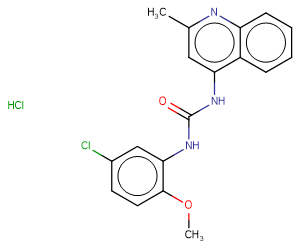
PQ401 hydrochloride
CAS No. ——
PQ401 hydrochloride( —— )
Catalog No. M19402 CAS No. ——
PQ401 inhibits autophosphorylation of IGF-1R domain with IC50 of <1 μM.
Purity : >98% (HPLC)
 COA
Datasheet
HNMR
HPLC
MSDS
Handing Instructions
COA
Datasheet
HNMR
HPLC
MSDS
Handing Instructions
| Size | Price / USD | Stock | Quantity |
| 2MG | 49 | Get Quote |


|
| 5MG | 74 | Get Quote |
|
| 10MG | 104 | Get Quote |
|
| 25MG | 184 | Get Quote |
|
| 50MG | 331 | Get Quote |
|
| 100MG | Get Quote | Get Quote |
|
| 200MG | Get Quote | Get Quote |
|
| 500MG | Get Quote | Get Quote |
|
| 1G | Get Quote | Get Quote |
|
Biological Information
-
Product NamePQ401 hydrochloride
-
NoteResearch use only, not for human use.
-
Brief DescriptionPQ401 inhibits autophosphorylation of IGF-1R domain with IC50 of <1 μM.
-
DescriptionPQ401 inhibits autophosphorylation of IGF-1R domain with IC50 of <1 μM.
-
In Vitro——
-
In Vivo——
-
Synonyms——
-
PathwayAngiogenesis
-
TargetIGF-1R
-
RecptorIGF-1R
-
Research AreaCancer
-
IndicationCancer
Chemical Information
-
CAS Number——
-
Formula Weight378.25
-
Molecular FormulaC18H17Cl2N3O2
-
Purity>98% (HPLC)
-
SolubilityDMSO:10 mM
-
SMILESCl.COc1ccc(Cl)cc1NC(=O)Nc1cc(C)nc2ccccc12
-
Chemical Name——
Shipping & Storage Information
-
Storage(-20℃)
-
ShippingWith Ice Pack
-
Stability≥ 2 years
Reference
1.Gable KLetal Diarylureas are small-molecule inhibitors of insulin-like growth factor I receptor signaling and breast cancer cell growth. Mol Cancer Ther. 2006 Apr;5(4):1079-86.
molnova catalog



related products
-
HNMPA
HNMPA is an inhibitor of insulin receptor tyrosine kinase and inhibits the serine and tyrosine autophosphorylation of human insulin receptor.
-
IGF-I 24-41
IGF-I (24-41) is a 24-41 amino acid fragment of Insulin-like Growth Factor I (IGF-I). IGF-I is partly responsible for systemic GH activities although it possesses a wide number of own properties (anabolic, antioxidant, anti-inflammatory and cytoprotective actions).
-
Tyrphostin AG 538
Tyrphostin AG 538 is a chalcone compound, an IGF-1 receptor kinase inhibitor (IC?0 : for 400 nM) that is potent, cell-permeable, reversible, and competitive.
