


 Cart
Cart
 sales@molnova.com


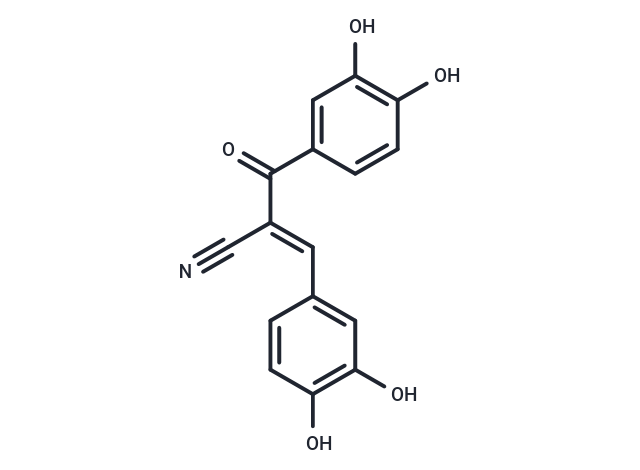
Tyrphostin AG 538
CAS No. 133550-18-2
Tyrphostin AG 538( —— )
Catalog No. M35935 CAS No. 133550-18-2
Tyrphostin AG 538 is a chalcone compound, an IGF-1 receptor kinase inhibitor (IC 0 : for 400 nM) that is potent, cell-permeable, reversible, and competitive.
Purity : >98% (HPLC)
 COA
Datasheet
HNMR
HPLC
MSDS
Handing Instructions
COA
Datasheet
HNMR
HPLC
MSDS
Handing Instructions
| Size | Price / USD | Stock | Quantity |
| 5MG | 193 | In Stock |


|
| 10MG | 292 | In Stock |
|
| 25MG | 513 | In Stock |
|
| 50MG | 686 | In Stock |
|
| 100MG | 909 | In Stock |
|
| 200MG | Get Quote | In Stock |
|
| 500MG | Get Quote | In Stock |
|
| 1G | Get Quote | In Stock |
|
Biological Information
-
Product NameTyrphostin AG 538
-
NoteResearch use only, not for human use.
-
Brief DescriptionTyrphostin AG 538 is a chalcone compound, an IGF-1 receptor kinase inhibitor (IC 0 : for 400 nM) that is potent, cell-permeable, reversible, and competitive.
-
DescriptionAG 538 is a potent, competitive inhibitor of IGF-1 receptor kinase, with an IC50 of 400 nM.
-
In Vitro——
-
In Vivo——
-
Synonyms——
-
PathwayAngiogenesis
-
TargetIGF-1R
-
RecptorIGF-1R
-
Research Area——
-
Indication——
Chemical Information
-
CAS Number133550-18-2
-
Formula Weight297.26
-
Molecular FormulaC16H11NO5
-
Purity>98% (HPLC)
-
Solubility——
-
SMILESC(/C(=C/C1=CC(O)=C(O)C=C1)/C#N)(=O)C2=CC(O)=C(O)C=C2
-
Chemical Name——
Shipping & Storage Information
-
Storage(-20℃)
-
ShippingWith Ice Pack
-
Stability≥ 2 years
Reference
1. G Blum, et al. Substrate Competitive Inhibitors of IGF-1 Receptor Kinase. Biochemistry. 2000 Dec 26;39(51):15705-12.?
molnova catalog



related products
-
NBI-31772
NBI-31772 is the potent inhibitor of insulin-like growth factor-1 binding protein (IGFBP, Ki = 47 nM). NBI-31772 can be used in research on IGF-responsive diseases.
-
AZ7550 trimesylate s...
AZ7550 trimesylate salt (AZ7550 Mesylate) is the active metabolite of ositinib, AZ7550 trimesylate salt inhibits IGF1R activity and can be used in the study of non-small cell lung cancer.
-
Esculentoside H
Phytolaccaceae has anti-tumor activity, the mechanism may be related to the capacity of Esculentoside H for TNF release.
