


 Cart
Cart
 sales@molnova.com


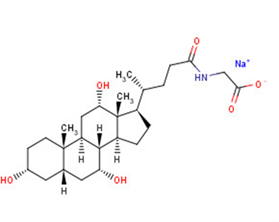
Glycocholic Acid Sodium Salt
CAS No. 863-57-0
Glycocholic Acid Sodium Salt( Glycocholate sodium | Glycocholic acid sodium salt )
Catalog No. M19188 CAS No. 863-57-0
Glycocholic Acid Sodium Salt is a conjugated bile salt and ionic biologic detergent. It is involved in the emulsification of fats.
Purity : >98% (HPLC)
 COA
Datasheet
HNMR
HPLC
MSDS
Handing Instructions
COA
Datasheet
HNMR
HPLC
MSDS
Handing Instructions
| Size | Price / USD | Stock | Quantity |
| 1 mL x 10 mM in DMSO | 37 | In Stock |


|
| 50MG | 33 | In Stock |
|
| 100MG | 45 | In Stock |
|
| 200MG | Get Quote | In Stock |
|
| 500MG | 60 | In Stock |
|
| 1G | 86 | In Stock |
|
Biological Information
-
Product NameGlycocholic Acid Sodium Salt
-
NoteResearch use only, not for human use.
-
Brief DescriptionGlycocholic Acid Sodium Salt is a conjugated bile salt and ionic biologic detergent. It is involved in the emulsification of fats.
-
DescriptionGlycocholate sodium is a conjugated bile salt and ionic biologic detergent. It is involved in the emulsification of fats.
-
In VitroGlycocholic acid (GC) increases the cytotoxicity of epirubicin, significantly increases the intracellular accumulation of epirubicin in Caco-2 cells and the absorption of epirubicin in rat small intestine, and intensified epirubicin-induced apoptosis. Glycocholic acid and epirubicin significantly reduce mRNA expression levels of human intestinal MDR1, MDR-associated protein (MRP)1, and MRP2; downregulate the MDR1 promoter region; suppress the mRNA expression of Bcl-2; induce the mRNA expression of Bax; and significantly increase the Bax-to-Bcl-2 ratio and the mRNA levels of p53, caspase-9 and -3. A combination of anticancer drugs with Glycocholic acid can control MDR via a mechanism that involves modulating P-gp and MRPs as well as regulating apoptosis-related pathways.
-
In Vivo——
-
SynonymsGlycocholate sodium | Glycocholic acid sodium salt
-
PathwayOthers
-
TargetOther Targets
-
RecptorOthers
-
Research Area——
-
Indication——
Chemical Information
-
CAS Number863-57-0
-
Formula Weight487.61
-
Molecular FormulaC26H42NNaO6
-
Purity>98% (HPLC)
-
SolubilityIn Vitro:?DMSO : ≥ 100 mg/mL (205.09 mM)
-
SMILES[Na+].[O-]C(=O)CNC(=O)CC[C@@H](C)[C@H]1CC[C@H]2[C@@H]3[C@H](O)C[C@@H]4C[C@H](O)CC[C@]4(C)[C@H]3C[C@H](O)[C@]12C
-
Chemical NameSodium 2-[[(4R)-4-[(3R,7R,10S,12S,13R,17R)-3,7,12-trihydroxy-10,13-dimethyl-2,3,4,5,6,7,8,9,11,12,14,15,16,17-tetradecahydro-1H-cyclopenta[a]phenanthren-17-yl]pentanoyl]amino]acetate
Shipping & Storage Information
-
Storage(-20℃)
-
ShippingWith Ice Pack
-
Stability≥ 2 years
Reference
1. Mohapatra M, Mishra A K. Effect of submicellar concentrations of conjugated and unconjugated bile salts on the lipid bilayer membrane.[J]. Langmuir, 2011, 27(22):13461-13467.
molnova catalog



related products
-
MCH-Gene-Overprinted...
MCH-Gene-Overprinted-Polypeptide-14 (rat)
-
Nirmatrelvir
PF-07321332 is a potent and orally active inhibitor of SARS-CoV 3C-like protease (3CLPRO) .
-
6-O-Acetyldaidzin
6"-O-Acetyldaidzin is an isoflavone glycoside isolated from soybeans. 6"-O-Acetyldaidzin significantly inhibits lipid peroxidation in rat liver microsome with an IC50 of 8.2 μM.
