


 Cart
Cart
 sales@molnova.com


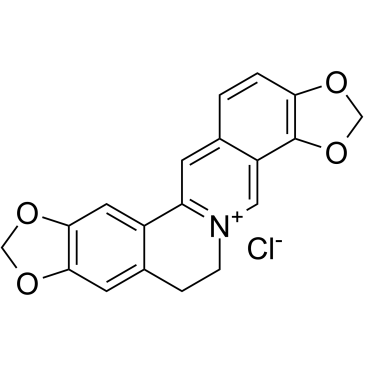
Coptisine chloride
CAS No. 6020-18-4
Coptisine chloride( —— )
Catalog No. M18873 CAS No. 6020-18-4
Coptisine chloride can be absorbed across intestinal epithelial cells, and completely absorbed compounds.
Purity : >98% (HPLC)
 COA
Datasheet
HNMR
HPLC
MSDS
Handing Instructions
COA
Datasheet
HNMR
HPLC
MSDS
Handing Instructions
| Size | Price / USD | Stock | Quantity |
| 1 mL x 10 mM in DMSO | 63 | In Stock |


|
| 5MG | 56 | In Stock |
|
| 10MG | 90 | In Stock |
|
| 25MG | 187 | In Stock |
|
| 50MG | 272 | In Stock |
|
| 100MG | 406 | In Stock |
|
| 200MG | Get Quote | In Stock |
|
| 500MG | 913 | In Stock |
|
| 1G | Get Quote | In Stock |
|
Biological Information
-
Product NameCoptisine chloride
-
NoteResearch use only, not for human use.
-
Brief DescriptionCoptisine chloride can be absorbed across intestinal epithelial cells, and completely absorbed compounds.
-
DescriptionCoptisine chloride can be absorbed across intestinal epithelial cells, and completely absorbed compounds.
-
In VitroCoptisine chloride is an efficient uncompetitive IDO inhibitor with a Ki value of 5.8 μM and an IC50 value of 6.3 μM. Coptisine (0.1-100 μM) inhibits the proliferation of A549, H460, H2170, MDA-MB-231 and HT-29 cells, with IC50s of 18.09, 29.50, 21.60, 20.15 and 26.60?μM, respectively. Coptisine (12.5, 25, 50 μM) upregulates the expression of pH2AX and p21, reduces expression of cyclin B1, cdc2, and cdc25C, and induces G2/M arrest and apoptosis of A549 cells in a concentration-dependent manner. Coptisine (12.5, 25, 50 μM) also induces mitochondrial dysfunction and activates caspases activities in A549 cells. Furthermore, Coptisine (50 μM) increases ROS levels in a time-dependent manner (0.5, 1, 2, 4, 12, and 24?h).
-
In VivoCoptisine shows increased toxicity in mice in a concentration dependent manner, with LD50 value of 880.18 mg/kg. Coptisine (154 mg/kg/day, 90 days) shows no toxicity on SD rats. Coptisine (23.35, 46.7, 70.05 mg/kg, p.o.) dose-dependently decreases the levels of TC, TG, and LDL-c and increases HDL-c content in serum of hamsters to different degree, slows down weight gain induced by the HFHC diet, and raises the level of cholesterol and TBA in feces dose-dependently in hamsters. Coptisine (70.05 mg/kg, p.o.) suppresses HMGCR protein expression level and induces the protein expression of SREBP-2, LDLR, and CYP7A1 involved in cholesterol metabolism.
-
Synonyms——
-
PathwayAngiogenesis
-
TargetPKC
-
RecptorOthers
-
Research AreaOthers-Field
-
Indication——
Chemical Information
-
CAS Number6020-18-4
-
Formula Weight355.77
-
Molecular FormulaC19H14ClNO4
-
Purity>98% (HPLC)
-
SolubilityDMSO : 10.75 mg/mL 30.22 mM
-
SMILESC1C[N+]2=C(C=C3C=CC4=C(C3=C2)OCO4)C5=CC6=C(C=C51)OCO6.[Cl-]
-
Chemical Name——
Shipping & Storage Information
-
Storage(-20℃)
-
ShippingWith Ice Pack
-
Stability≥ 2 years
Reference
molnova catalog



related products
-
Hispidin
Hispidin is a polyphenol originally including antioxidant anti-inflammatory and cytoprotective properties.
-
CA-074 methyl ester
CA-074 methyl ester is a specific inhibitor of Cathepsin B with neuroprotective, anti-cancer, and anti-inflammatory effects.
-
Bisindolylmaleimide ...
Bisindolylmaleimide VIII (Ro-31-7549) is a selective and potent protein kinase C (PKC) inhibitor with good inhibition of PKC-α, PKC-β I, PKC-β II, PKC-γ, and PKC-ε.
