


 Cart
Cart
 sales@molnova.com


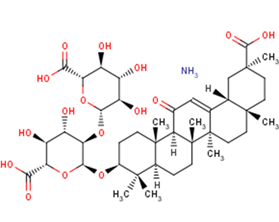
Monoammonium glycyrrhizinate
CAS No. 53956-04-0
Monoammonium glycyrrhizinate( —— )
Catalog No. M18766 CAS No. 53956-04-0
Monoammonium glycyrrhizinate is extracted from Such sweet licorice root.
Purity : >98% (HPLC)
 COA
Datasheet
HNMR
HPLC
MSDS
Handing Instructions
COA
Datasheet
HNMR
HPLC
MSDS
Handing Instructions
| Size | Price / USD | Stock | Quantity |
| 500MG | 37 | Get Quote |


|
| 1G | Get Quote | Get Quote |
|
Biological Information
-
Product NameMonoammonium glycyrrhizinate
-
NoteResearch use only, not for human use.
-
Brief DescriptionMonoammonium glycyrrhizinate is extracted from Such sweet licorice root.
-
DescriptionAmmonium glycyrrhizate is a commercial flavorant and emulsifer found in Glycyrrhiza. It inhibits 11β-HSD and is used to treat herpes virus infection. It inhibits viral entry to host cells, prevents glial inflammation and kaninic acid-induced neuronal death, and suppresses DMH-induced carcinogenesis.(In Vivo):The increase of the lung W/D weight ratios is significantly reduced by high and medium dose of MAG (10 and 30mg/kg) administration. Pretreatment with MAG (10 and 30mg/kg) efficiently reduces the production of TNF- and IL-1 . MAG (10, 30mg/kg) significantly decreases NF- B p65 protein expression, compared with LPS. On the contrary, LPS significantly reduces I B- protein expression compared with the control group, whereas MAG (10 and 30mg/kg) significantly increased I B- expression, compared with the LPS group.Low- and high-dose MAG treatment significantly reduces the AST, ALT, TBIL, and TBA levels at 14 and 21 d time points when compared with that of the RIF and INH group, suggesting the protective effect of MAG on RIF- and INH-induced liver injury. MAG treatment groups elevate the hepatic GSH level at 7, 14, and 21 d time points and markedly reduce the MDA level at 14 and 21 d time points in RIF- and INH-treated rats, suggesting the protective effect of MAG in RIF- and INH induced liver injuries.
-
In Vitro——
-
In VivoThe increase of the lung W/D weight ratios is significantly reduced by high and medium dose of MAG (10 and 30 mg/kg) administration. Pretreatment with MAG (10 and 30 mg/kg) efficiently reduces the production of TNF-α and IL-1β. MAG (10, 30 mg/kg) significantly decreases NF-κB p65 protein expression, compared with LPS. On the contrary, LPS significantly reduces IκB-α protein expression compared with the control group, whereas MAG (10 and 30 mg/kg) significantly increased I??B-?? expression, compared with the LPS group.Low- and high-dose MAG treatment significantly reduces the AST, ALT, TBIL, and TBA levels at 14 and 21 d time points when compared with that of the RIF and INH group, suggesting the protective effect of MAG on RIF- and INH-induced liver injury. MAG treatment groups elevate the hepatic GSH level at 7, 14, and 21 d time points and markedly reduce the MDA level at 14 and 21 d time points in RIF- and INH-treated rats, suggesting the protective effect of MAG in RIF- and INH induced liver injuries.
-
Synonyms——
-
PathwayCytoskeleton/Cell Adhesion Molecules
-
TargetAkt
-
RecptorOthers
-
Research AreaOthers-Field
-
Indication——
Chemical Information
-
CAS Number53956-04-0
-
Formula Weight839.97
-
Molecular FormulaC42H62O16·H3N
-
Purity>98% (HPLC)
-
SolubilityIn Vitro:?DMSO : 100 mg/mL (119.05 mM)
-
SMILES[C@@H]1([C@H]([C@H]([C@@H]([C@H](O1)O[C@H]1[C@H](O[C@@H]([C@H]([C@@H]1O)O)C(=O)O)O[C@@H]1CC[C@@]2([C@@H](C1(C)C)CC[C@@]1([C@@]3(CC[C@@]4(CC[C@@](C[C@@H]4C3=CC(=O)[C@@H]21)(C)C(=O)O)C)C)C)C)O)O)O)C(=O)O.N
-
Chemical Name(2S,3S,4S,5R,6R)-6-(((2S,3R,4S,5S,6S)-6-carboxy-2-(((3R,4aR,6aR,6bS,8aS,11R,12aR,14aR,14bS)-11-carboxy-4,4,6a,6b,8a,11,14b-heptamethyl-14-oxo-1,2,3,4,4a,5,6,6a,6b,7,8,8a,9,10,11,12,12a,14,14a,14b-icosahydropicen-3-yl)oxy)-4,5-dihydroxytetrahydro-2H-pyran-3-yl)oxy)-3,4,5-trihydroxytetrahydro-2H-pyran-2-carboxylic acid, ammonia salt
Shipping & Storage Information
-
Storage(-20℃)
-
ShippingWith Ice Pack
-
Stability≥ 2 years
Reference
1. Shi JR, et al. Int Immunopharmacol. 2010 Oct;10(10):1235-41.
molnova catalog



related products
-
ZINC00640089
ZINC00640089 is a selective lipid carrier protein-2 (LCN2) inhibitor. ZINC00640089 inhibited cell proliferation and cell viability, and reduced AKT phosphorylation in SUM149 cells. ZINC00640089 can be used to study inflammatory breast cancer (IBC).
-
Guggulsterone E&Z
Guggulsterone E&Z?is a 3-hydroxy steroid. It has a role as an androgen.
-
PHT-427
PHT-427 is a small-molecule Akt inhibitor that binds selectively to the PH domain of AKT with Ki of 2.4 uM.
