


 Cart
Cart
 sales@molnova.com


PHT-427
CAS No. 1191951-57-1
PHT-427( PHT 427 | PHT427 )
Catalog No. M10660 CAS No. 1191951-57-1
PHT-427 is a small-molecule Akt inhibitor that binds selectively to the PH domain of AKT with Ki of 2.4 uM.
Purity : >98% (HPLC)
 COA
Datasheet
HNMR
HPLC
MSDS
Handing Instructions
COA
Datasheet
HNMR
HPLC
MSDS
Handing Instructions
| Size | Price / USD | Stock | Quantity |
| 10MG | 35 | In Stock |


|
| 25MG | 71 | In Stock |
|
| 50MG | 140 | In Stock |
|
| 100MG | 237 | In Stock |
|
| 200MG | 407 | In Stock |
|
| 500MG | Get Quote | In Stock |
|
| 1G | Get Quote | In Stock |
|
Biological Information
-
Product NamePHT-427
-
NoteResearch use only, not for human use.
-
Brief DescriptionPHT-427 is a small-molecule Akt inhibitor that binds selectively to the PH domain of AKT with Ki of 2.4 uM.
-
DescriptionPHT-427 is a small-molecule Akt inhibitor that binds selectively to the PH domain of AKT with Ki of 2.4 uM, inhibits phospho-Ser473-AKT in Panc-1 cells with IC50 of 6.3 uM; decreases AKT activation and causes apoptosis at low micromolar concentrations in Panc-1 and MiaPaCa-2 pancreatic cancer cell lines; inhibits AKT and its downstream targets in cells, exhibits good antitumor activity in pancreatic cancer cell xenografts in immunocompromised mice.
-
In VitroThe effects of PHT-427 on cell signaling are investigated by RPPA using a panel of 86 antibodies to phospho- and non-phosphorylated signaling protein related to PtdIns-3-K/PDPK1/Akt signaling in PC-3 prostate cells where PtdIns-3-K/PDPK1/Akt signaling is activated because of homozygous PTEN mutation. After 16 hours, a reduction is observed in phospho-Ser241-PDPK1 phospho-Thr308-Akt by both 10 μM PH-427 and 0.1 μM Wortmannin. Finally, phospho-Ser657-protein kinase C (PKC) and total SGK1 are decreased by treatment with both PHT-427 and Wortmannin. These results suggest that at 10 μM PHT-427 inhibits both Akt and PDKP1. The BxPC-3 and MiaPaCa-2 pancreatic cancer cell lines are probed by Western blotting following up to 24 hr exposure to 10 μM PHT-427, which is below the IC50 for cell growth inhibition of around 30 μM, to determine the effects of PHT-427 on of the PtdIns-3-K/PDPK1/Akt signaling pathway components.
-
In VivoMice with BxPC-3 pancreatic, MCF-7 breast or A-549 NSCL cancer xenografts are administered PHT-427, or its analogs with a C-4, C-6 or C-8 alkyl chain by oral gavage twice a day for 10 days. The results show that PHT-427 has the greatest antitumor activity with the C-8 chain analog having less activity, and analogs with a C-4 or C-6 chain very little activity. All further antitumor studies are conducted using compound PHT-427. Plasma levels of PHT-427 following oral administration to mice of a dose of 200 mg/kg show rapid absorption, without a lag phase, Cmax is 8.2 μg/mL 1 hr following dosing, and the elimination half-life is 1.4 hr with a terminal PHT-427 concentration of 0.1 μg/mL 10 hr after dosing. The plasma concentration of PH-427 is above the level which gave inhibition of Akt and PDPK1 signaling in cells of 10 μM (4 μg/mL) for at least 3 hr.
-
SynonymsPHT 427 | PHT427
-
PathwayCytoskeleton/Cell Adhesion Molecules
-
TargetAkt
-
RecptorAkt|PDK1
-
Research AreaCancer
-
Indication——
Chemical Information
-
CAS Number1191951-57-1
-
Formula Weight409.609
-
Molecular FormulaC20H31N3O2S2
-
Purity>98% (HPLC)
-
Solubility10 mM in DMSO
-
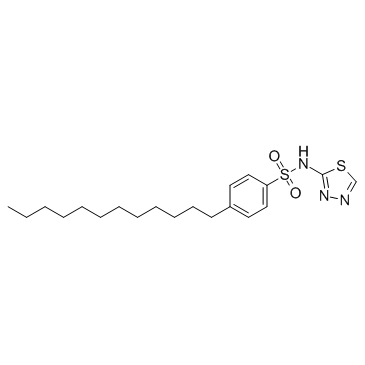
SMILESO=S(C1=CC=C(CCCCCCCCCCCC)C=C1)(NC2=NN=CS2)=O
-
Chemical NameBenzenesulfonamide, 4-dodecyl-N-1,3,4-thiadiazol-2-yl-
Shipping & Storage Information
-
Storage(-20℃)
-
ShippingWith Ice Pack
-
Stability≥ 2 years
Reference
1. Moses SA, et al. Cancer Res. 2009 Jun 15;69(12):5073-81.
2. Meuillet EJ, et al. Mol Cancer Ther. 2010 Mar;9(3):706-17.
3. Dickinson SE, et al. Cancer Prev Res (Phila). 2016 Mar;9(3):215-24.
4. Kobes JE, et al. Pancreas. 2016 Sep;45(8):1158-66.
molnova catalog



related products
-
K-80003
K-80003(TX-803) is a potent retinol-like X-receptor-alpha regulator that inhibits TRxrα-dependent Akt activation and tumor cell growth.
-
Actein
Actein has a stimulatory effect on osteoblastic bone formation or has potential activity against osteoporosis, it also can prevent oxidative damage to osteoblasts in osteoporotic patients.
-
AG 126
The tyrphostin AG-126 selectively inhibits the phosphorylation of ERK1 (p44) and ERK2 (p42) at 25-50 μM.
