


 Cart
Cart
 sales@molnova.com


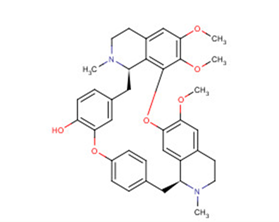
Berbamine
CAS No. 478-61-5
Berbamine( —— )
Catalog No. M18601 CAS No. 478-61-5
Berbamine and its derivatives are promising agents to suppress liver cancer growth by targeting CAMKII.
Purity : >98% (HPLC)
 COA
Datasheet
HNMR
HPLC
MSDS
Handing Instructions
COA
Datasheet
HNMR
HPLC
MSDS
Handing Instructions
| Size | Price / USD | Stock | Quantity |
| 1 mL x 10 mM in DMSO | 56 | In Stock |


|
| 2MG | 29 | In Stock |
|
| 5MG | 41 | In Stock |
|
| 10MG | 67 | In Stock |
|
| 25MG | 128 | In Stock |
|
| 50MG | 193 | In Stock |
|
| 100MG | 276 | In Stock |
|
| 200MG | Get Quote | In Stock |
|
| 500MG | Get Quote | In Stock |
|
| 1G | Get Quote | In Stock |
|
Biological Information
-
Product NameBerbamine
-
NoteResearch use only, not for human use.
-
Brief DescriptionBerbamine and its derivatives are promising agents to suppress liver cancer growth by targeting CAMKII.
-
DescriptionBerbamine has high binding affinity toward the (GGA);G-quadruplex. Berbamine and its derivatives are promising agents to suppress liver cancer growth by targeting CAMKII. Berbamine may be the first ATP-competitive inhibitor of CaMKII γ, could be as a new type of molecular targeted agent through inhibition of the CaMKII γ activity for treatment of leukemia. 4. Berbamine can enhance the antitumor activity of gemcitabine by inhibiting cell growth and inducing apoptosis, possibly through the regulation of the expression of apoptosis-related proteins and the activation of TGF-β/Smad signaling pathway. Berbamine confers cardioprotection against I/R injury by attenuating [Ca(2+)inf(i) overloading and preventing calpain activation through the activation of the PI3K-Akt-GSK3β pathway and, subsequently, opening of the mitoK(ATP) channel.
-
In VitroCell Viability Assay Cell Line:KM3 cell Concentration:1?32 μg/mL Incubation Time:24, 48, or 72 h Result:Inhibited the growth of KM3 cells in a dose- and time-dependent manner.Apoptosis Analysis Cell Line:KM3 cell Concentration:4 μg/mLIncubation Time:6, 12, or 24 h Result:Induced apoptosis in a time-dependent manner treated at 8 μg/mL.Western Blot Analysis Cell Line:KM3 cell Concentration:8 μg/mL Incubation Time:0, 6, 12, or 24 h Result:Inhibited p65 nuclear translocation and expression of IKKα.
-
In VivoAnimal Model:Huh7 xenograft NOD/SCID mice modelDosage:100mg/kg Administration:Oral gavage (p.o.), twice a day for 5 consecutive days Result:Suppressed tumor growth and reduced tumor weight by 70%.
-
Synonyms——
-
PathwayMembrane Transporter/Ion Channel
-
TargetTRP/TRPV Channel
-
RecptorCAMKIIγ
-
Research AreaCancer
-
Indication——
Chemical Information
-
CAS Number478-61-5
-
Formula Weight608.73
-
Molecular FormulaC37H40N2O6
-
Purity>98% (HPLC)
-
SolubilityIn Vitro:?DMSO : 100 mg/mL (164.28 mM)
-
SMILESCN1CCC2=CC(=C3C=C2C1CC4=CC=C(C=C4)OC5=C(C=CC(=C5)CC6C7=C(O3)C(=C(C=C7CCN6C)OC)OC)O)OC
-
Chemical Name——
Shipping & Storage Information
-
Storage(-20℃)
-
ShippingWith Ice Pack
-
Stability≥ 2 years
Reference
molnova catalog



related products
-
Palvanil
Palvanil is a fast desensitizing agonist of TRPV1. it may be promising agents in the therapy of IBS since it modulates intestinal motility and reduces visceral pain.
-
HC067047 Hydrochlori...
HC-067047 hydrochloride is a potent and selective TRPV4 antagonist.
-
RN-1747
RN-1747 is a selective transient receptor potential cation channel subfamily V member 4 agonists (EC50: hTRPV4 of 0.77 μM, mTRPV4 of 4.0 μM, and rTRPV4 of 4.1 μM). RN-1747 also antagonizes TRPM8 (IC50: 4 μM).
