


 Cart
Cart
 sales@molnova.com


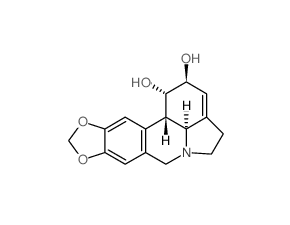
Lycorine
CAS No. 476-28-8
Lycorine( Lycorine | Galanthidine | NSC-401360 | NSC401360 )
Catalog No. M18593 CAS No. 476-28-8
Lycorine inhibits protein synthesis and may inhibit ascorbic acid biosynthesis, although studies on the latter are controversial and inconclusive.
Purity : >98% (HPLC)
 COA
Datasheet
HNMR
HPLC
MSDS
Handing Instructions
COA
Datasheet
HNMR
HPLC
MSDS
Handing Instructions
| Size | Price / USD | Stock | Quantity |
| 1 mL x 10 mM in DMSO | 37 | In Stock |


|
| 10MG | 29 | In Stock |
|
| 25MG | 46 | In Stock |
|
| 50MG | 63 | In Stock |
|
| 100MG | 101 | In Stock |
|
| 200MG | Get Quote | In Stock |
|
| 500MG | 245 | In Stock |
|
| 1G | Get Quote | In Stock |
|
Biological Information
-
Product NameLycorine
-
NoteResearch use only, not for human use.
-
Brief DescriptionLycorine inhibits protein synthesis and may inhibit ascorbic acid biosynthesis, although studies on the latter are controversial and inconclusive.
-
DescriptionLycorine is a novel inhibitor of the growth and metastasis of hormone-refractory prostate cancer. It is a natural alkaloid extracted from the Amaryllidaceae plant family.
-
In VitroCell Viability Assay Cell Line:HL-7702/SRE-Luc cells Concentration:16 hours Incubation Time:5 μM; 10 μM; 20 μM; 40 μM Result:Had no cytotoxicity on HL-7702 cells.Western Blot Analysis Cell Line:HL-7702/SRE-Luc cells Concentration:2 hours, 4 hours, 8 hours, 12 hours, 16 hours Incubation Time:10 μM; 20 μM Result:Decreased p-SREBF1, m-SREBF1, p-SREBF2 and p-SREBF1 protein expression.RT-PCR Cell Line:C8161 cells Concentration:0 μM, 1.56 μM, 3.13 μM, 6.25 μM, 12.5 μM, 25 μM Incubation Time:48 hours Result:Markedly suppressed the expression of VE-cadherin in a dose-dependent manner and also slightly diminished the expression of Sema4D in C8161 cells.
-
In VivoAnimal Model:High-fat diet (HFD)-fed C57BL/6J mice Dosage:15 mg/kg, 30 mg/kg Administration:Oral chow; once daily Result:Ameliorated high-fat diet-induced hyperlipidemia, hepatic steatosis, and insulin resistance in mice.
-
SynonymsLycorine | Galanthidine | NSC-401360 | NSC401360
-
PathwayEndocrinology/Hormones
-
TargetATPase
-
RecptorOthers
-
Research AreaOthers-Field
-
Indication——
Chemical Information
-
CAS Number476-28-8
-
Formula Weight287.31
-
Molecular FormulaC16H17NO4
-
Purity>98% (HPLC)
-
SolubilityIn Vitro:?DMSO : 25 mg/mL (87.01 mM)
-
SMILESC1CN2Cc3cc4c(cc3[C@H]3[C@H]2C1=C[C@@H]([C@H]3O)O)OCO4
-
Chemical Name(1S,2S,3a1S,12bS)-2,3a1,4,5,7,12b-hexahydro-1H-[1,3]dioxolo[4,5-j]pyrrolo[3,2,1-de]phenanthridine-1,2-diol
Shipping & Storage Information
-
Storage(-20℃)
-
ShippingWith Ice Pack
-
Stability≥ 2 years
Reference
1. Vrijsen R. Biol. Chem. 1986, 261 (2): 505–7.
molnova catalog



related products
-
Sodium orthovanadate
Sodium orthovanadate is a commonly used general inhibitor for PTP (protein tyrosine phosphatases), alkaline phosphatase (ALP) and ATPase.
-
Goniothalamin
Goniothalamin is a natural product that has been demonstrated to induce apoptosis in various cancer cell lines, can induce cytotoxicity and apoptosis on RT4 cells, induce apoptosis on HepG2 liver cancer cells via induction of caspase-3 with less sensitivity on the cell line of Chang cells.
-
Deslanoside
Deslanoside is a rapidly acting cardiac glycoside used to treat congestive heart failure and supraventricular arrhythmias due to reentry mechanisms. Deslanoside inhibits the Na-K-ATPase membrane pump resulting in an increase in intracellular sodium and calcium concentrations.
