


 Cart
Cart
 sales@molnova.com


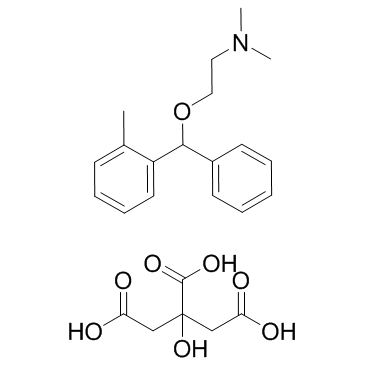
Orphenadrine Citrate
CAS No. 4682-36-4
Orphenadrine Citrate( —— )
Catalog No. M18575 CAS No. 4682-36-4
Orphenadrine Citrate is a skeletal muscle relaxant, it acts in the central nervous system to produce its muscle relaxant effects.
Purity : >98% (HPLC)
 COA
Datasheet
HNMR
HPLC
MSDS
Handing Instructions
COA
Datasheet
HNMR
HPLC
MSDS
Handing Instructions
| Size | Price / USD | Stock | Quantity |
| 100MG | 29 | In Stock |


|
| 200MG | 42 | In Stock |
|
| 500MG | Get Quote | In Stock |
|
| 1G | Get Quote | In Stock |
|
Biological Information
-
Product NameOrphenadrine Citrate
-
NoteResearch use only, not for human use.
-
Brief DescriptionOrphenadrine Citrate is a skeletal muscle relaxant, it acts in the central nervous system to produce its muscle relaxant effects.
-
DescriptionOrphenadrine Citrate is a skeletal muscle relaxant, it acts in the central nervous system to produce its muscle relaxant effects.(In Vitro):Orphenadrine citrate (12 μM; 24.5 h) shows neuroprotective effects on 3-NPA-induced neurotoxicity cerebellar granule cells.(In Vivo):Orphenadrine citrate (10, 20, 30 mg/kg; i.p.; once aday for 3 days) reduces 3-NPA-induced mortality in a dose-dependent manner.Orphenadrine citrate (30 mg/kg; i.p.; once aday for 3 days) shows activity to against 3-NPA-induced neuronal damage in vivo.
-
In VitroOrphenadrine citrate (12 μM; 24.5 h) shows neuroprotective effects on 3-NPA-induced neurotoxicity cerebellar granule cells. Cell Viability AssayCell Line:CGC cells (7-day-old Sprague Dawley rat)Concentration:6, 12, 24, 48 μM Incubation Time:24.5 h Result:Prevented cells from 3-NPA induced cellular aggregation,volume diminution and neurite fragmentation.
-
In VivoOrphenadrine citrate (10, 20, 30 mg/kg; i.p.; once aday for 3 days) reduces 3-NPA-induced mortality in a dose-dependent manner.Orphenadrine citrate (30 mg/kg; i.p.; once aday for 3 days) shows activity to against 3-NPA-induced neuronal damage in vivo. Animal Model:Adult male Sprague Dawley rats (275-300 g; 3-NPA toxicity model).Dosage:10, 20, 30 mg/kg Administration:Intraperitoneal injection; once aday for 3 days (30 min before 3-NPA).Result:Reduced mortality of 3-NPA toxicity rats to 10-40% (3-NPA-treated animals showed general incoordination, drowsiness and general weakness).Recovered 3-NPA-induced body weight loss, and when at 30 mg/kg reduced the level of PBR and expression of HSP27. (PBR and HSP27 are markers of neuronal damage).
-
Synonyms——
-
PathwayAngiogenesis
-
TargetEGFR
-
RecptorAChR
-
Research AreaNeurological Disease
-
Indication——
Chemical Information
-
CAS Number4682-36-4
-
Formula Weight461.5
-
Molecular FormulaC18H23NO·C6H8O7
-
Purity>98% (HPLC)
-
SolubilityDMSO : 100 mg/mL 216.68 mM;H2O : 10 mg/mL 21.67 mM
-
SMILESOC(=O)CC(O)(CC(O)=O)C(O)=O.CN(C)CCOC(C1=CC=CC=C1)C1=CC=CC=C1C
-
Chemical Name——
Shipping & Storage Information
-
Storage(-20℃)
-
ShippingWith Ice Pack
-
Stability≥ 2 years
Reference
1.Cheng MH, et al.Front Neurol. 2015 Jun 9;6:134.
molnova catalog



related products
-
AV-412
AV-412 is an EGFR inhibitor (EGFR, EGFR T790M, EGFR L858R, EGFR L858R/T790M and ErbB2 with IC50s of 0.75, 0.79, 0.5, 2.3, 19 nM).In cells, MP-412 inhibited autophosphorylation of EGFR and ErbB2 with IC(50) of 43 and 282 nM, respectively.?
-
Labuxtinib
Labutinib is a selective inhibitor of the c-kit tyrosine kinase .
-
ICA-105574
ICA-105574 is an activator of hERG that binds to the channel to remove inactivation, thus increasing peak current amplitude and shortening the action potential. It also modulates activation kinetics of the channel.
