


 Cart
Cart
 sales@molnova.com


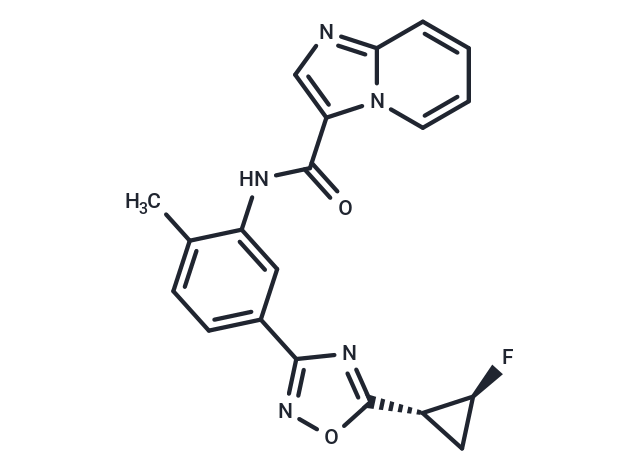
Labuxtinib
CAS No. 1426449-01-5
Labuxtinib( —— )
Catalog No. M37250 CAS No. 1426449-01-5
Labutinib is a selective inhibitor of the c-kit tyrosine kinase .
Purity : >98% (HPLC)
 COA
Datasheet
HNMR
HPLC
MSDS
Handing Instructions
COA
Datasheet
HNMR
HPLC
MSDS
Handing Instructions
| Size | Price / USD | Stock | Quantity |
| 1 mL x 10 mM in DMSO | 373 | In Stock |


|
| 5MG | 337 | In Stock |
|
| 10MG | 541 | In Stock |
|
| 25MG | 1074 | In Stock |
|
| 50MG | 1516 | In Stock |
|
| 100MG | 2037 | In Stock |
|
| 200MG | 2744 | In Stock |
|
| 500MG | Get Quote | In Stock |
|
| 1G | Get Quote | In Stock |
|
Biological Information
-
Product NameLabuxtinib
-
NoteResearch use only, not for human use.
-
Brief DescriptionLabutinib is a selective inhibitor of the c-kit tyrosine kinase .
-
DescriptionLabuxtinib is c-kit tyrosine kinase inhibitor.
-
In Vitro——
-
In Vivo——
-
Synonyms——
-
PathwayAngiogenesis
-
TargetEGFR
-
RecptorEGFR | c-Kit
-
Research Area——
-
Indication——
Chemical Information
-
CAS Number1426449-01-5
-
Formula Weight377.37
-
Molecular FormulaC20H16FN5O2
-
Purity>98% (HPLC)
-
SolubilityIn Vitro:?DMSO : 125 mg/mL (331.24 mM; Ultrasonic )
-
SMILESC(NC1=CC(=CC=C1C)C=2N=C(ON2)[C@@H]3[C@@H](F)C3)(=O)C=4N5C(=NC4)C=CC=C5
-
Chemical Name——
Shipping & Storage Information
-
Storage(-20℃)
-
ShippingWith Ice Pack
-
Stability≥ 2 years
Reference
1. Yeh Vince, et al. Imidazopyridine compounds and compositions as c-kit kinase inhibitors and their preparation. World Intellectual Property Organization, WO2013033070 A1. 2013-03-07.
molnova catalog



related products
-
CO-1686
A potent, highly selective, irreversible inhibitor of mutant EGFR with Ki of 21.5 nM for EGFR L858R/T790M.
-
Anlotinib
Anlotinib (AL-3818) is a novel multi-target tyrosine kinase that primarily inhibit VEGFR2/3, FGFR1-4, PDGFR α/β, c-Kit, and Ret.
-
DBPR112
DBPR112 is an orally active furanopyrimidine-based EGFR inhibitor with IC50s of 15 nM for EGFRWT and 48 nM for EGFRL858R/T790M, capable of occupying the ATP-binding site and demonstrating significant antitumor efficacy.
