


 Cart
Cart
 sales@molnova.com


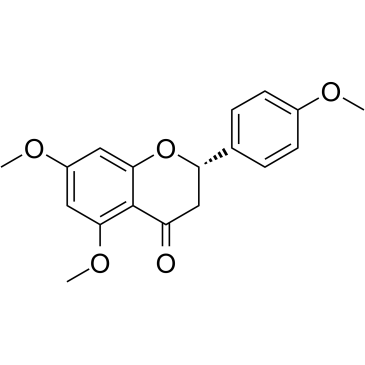
Naringenin trimethyl ether
CAS No. 38302-15-7
Naringenin trimethyl ether( —— )
Catalog No. M18499 CAS No. 38302-15-7
Naringenin trimethyl ether shows significant molluscicidal activity with a median lethal concentration (LC(5)) of 3.9 μg/mL.
Purity : >98% (HPLC)
 COA
Datasheet
HNMR
HPLC
MSDS
Handing Instructions
COA
Datasheet
HNMR
HPLC
MSDS
Handing Instructions
| Size | Price / USD | Stock | Quantity |
| 1 mL x 10 mM in DMSO | 37 | In Stock |


|
| 5MG | 33 | In Stock |
|
| 10MG | 59 | In Stock |
|
| 100MG | Get Quote | In Stock |
|
| 200MG | Get Quote | In Stock |
|
| 500MG | Get Quote | In Stock |
|
| 1G | Get Quote | In Stock |
|
Biological Information
-
Product NameNaringenin trimethyl ether
-
NoteResearch use only, not for human use.
-
Brief DescriptionNaringenin trimethyl ether shows significant molluscicidal activity with a median lethal concentration (LC(5)) of 3.9 μg/mL.
-
DescriptionNaringenin trimethyl ether shows significant molluscicidal activity with a median lethal concentration (LC(5)) of 3.9 μg/mL.
-
In Vitro——
-
In Vivo——
-
Synonyms——
-
PathwayOthers
-
TargetOther Targets
-
RecptorOthers
-
Research AreaOthers-Field
-
Indication——
Chemical Information
-
CAS Number38302-15-7
-
Formula Weight314.33
-
Molecular FormulaC18H18O5
-
Purity>98% (HPLC)
-
Solubility——
-
SMILESCOC1=CC=C(C=C1)C2CC(=O)C3=C(C=C(C=C3O2)OC)OC
-
Chemical Name——
Shipping & Storage Information
-
Storage(-20℃)
-
ShippingWith Ice Pack
-
Stability≥ 2 years
Reference
molnova catalog



related products
-
N4-Acetylcytidine
N4-Acetylcytidine is a modified nucleoside. N4-acetylcytidine is an endogenous urinary nucleoside product of the degradation of transfer ribonucleic acid (tRNA).
-
Substance P (4-11)
Substance P (4-11), the C-terminus fragment of Substance P (Substance P ), is a Substance P agonist that shows highly selective for NK1 receptors.
-
[Gln22] - 25359 - Am...
[Gln22] - 25359 - Amyloid (6 - 40)
