


 Cart
Cart
 sales@molnova.com


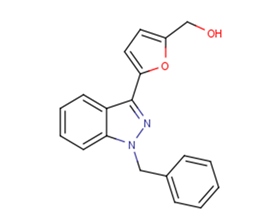
Lificiguat
CAS No. 170632-47-0
Lificiguat( YC1 | YC 1 | YC-1 | Lificiguat )
Catalog No. M18115 CAS No. 170632-47-0
YC-1 is an nitric oxide (NO)-independent activator of soluble guanylyl cyclase(sGC) and an inhibitor of Hypoxia-inducible factor-1alpha (HIF-1alpha).
Purity : >98% (HPLC)
 COA
Datasheet
HNMR
HPLC
MSDS
Handing Instructions
COA
Datasheet
HNMR
HPLC
MSDS
Handing Instructions
| Size | Price / USD | Stock | Quantity |
| 1 mL x 10 mM in DMSO | 46 | In Stock |


|
| 2MG | 29 | In Stock |
|
| 5MG | 42 | In Stock |
|
| 10MG | 59 | In Stock |
|
| 25MG | 130 | In Stock |
|
| 50MG | 235 | In Stock |
|
| 100MG | 405 | In Stock |
|
| 200MG | 719 | In Stock |
|
| 500MG | Get Quote | In Stock |
|
| 1G | Get Quote | In Stock |
|
Biological Information
-
Product NameLificiguat
-
NoteResearch use only, not for human use.
-
Brief DescriptionYC-1 is an nitric oxide (NO)-independent activator of soluble guanylyl cyclase(sGC) and an inhibitor of Hypoxia-inducible factor-1alpha (HIF-1alpha).
-
DescriptionLificiguat, also known as YC-1, is a inhibitor of Hypoxia-inducible factor-1alpha (HIF-1alpha). YC-1 is widely used as a potent inhibitor of HIF-1alpha both in vitro and in vivo, and is also being developed as a novel anticancer drug. YC-1 effectively inhibits tumor invasion and metastasis, and imply that YC-1 is worth while to further develop as a multipurpose anticancer drug.
-
In VitroSoluble guanylate cyclase (sGC) is a heterodimeric heme protein and the primary NO receptor. Lificiguat (YC-1) binds near or directly to the heme-containing domain of the beta subunit. In the absence of CO, Lificiguat (YC-1) binds with Kd=9-21 μM, depending on construct. In the presence of CO, these values decrease to 0.6-1.1 μM. Lificiguat (YC-1) greatly enhanced CO binding to heterodimeric sGC, as expected (Kd=1 μM). Lificiguat (YC-1) stimulates sGC two- to four-fold in the absence of NO but acts synergistically with CO or NO to achieve several hundred fold activation. Binding of Lificiguat(YC-1) can also overcome inhibitory phosphorylation of sGC. Lificiguat (YC-1) is a soluble guanylyl cyclase (sGC) activator. HCC cell lines HepG2, BEL-7402 and HCCLM3 are incubated for 72 h with Sorafenib and/or Lificiguat (YC-1). Sorafenib or Lificiguat (YC-1) alone inhibits HCC cell proliferation in a dose-dependent manner. Moreover, combination of Sorafenib and Lificiguat (YC-1) significantly suppresses proliferation of HCC cells in a dose-dependent manner. In addition, at the ED50 doses for both Sorafenib and Lificiguat (YC-1), combination index values (CI)=0.93 in HepG2, 0.95 in BEL-7402 and 0.72 in HCCLM3 respectively, suggesting that Sorafenib and Lificiguat (YC-1) synergistically inhibit proliferation of HCC cells.
-
In VivoLificiguat (YC-1) (30 or 60 mg/kg, i.p.) inhibits MDA-MB-468 tumor growth in a dose-dependent manner. The effect of the prodrug formulation of Lificiguat (YC-1), YC-1-S, in MDA-MB-468 tumor-bearing mice is also investigated. In vivo pharmacokinetic analysis reveal that YC-1-S is quickly converted into its active form. Mice are administered 20, 40 or 80 mg/kg YC-1-S p.o. YC-1-S also displays dose-dependent inhibition of MDA-MB468 tumor growth. Both Lificiguat (YC-1) and YC-1-S dose-dependently reduce tumor weight. Moreover, the mean body weight of mice is not affected by Lificiguat (YC-1) or YC-1-S compare with vehicle-treated groups. Lificiguat (YC-1) is a potent NO-GC activator reported to improve rodent learning behavior when examined with the Morris water maze (MWM) and avoidance tests. Lificiguat (YC-1) enhances long-term potentiation (LTP) in hippocampal Schafer collateral-CA1 synapse via the NO-cGMP-PKG-dependent pathway and potentiated LTP induction in the amygdala, increases the activation of ERK, and potentiated the expression of brain-derived neurotrophic factor (BDNF) cAMP response element-binding protein (CREB) in response to fear memory test.
-
SynonymsYC1 | YC 1 | YC-1 | Lificiguat
-
PathwayOthers
-
TargetOther Targets
-
RecptorsGC|HIF-1α
-
Research AreaCancer
-
Indication——
Chemical Information
-
CAS Number170632-47-0
-
Formula Weight304.34
-
Molecular FormulaC19H16N2O2
-
Purity>98% (HPLC)
-
SolubilityDMSO : ≥ 51 mg/mL; 167.58 mM
-
SMILESOCC1=CC=C(C2=NN(CC3=CC=CC=C3)C4=C2C=CC=C4)O1
-
Chemical Name5-?[1-?(phenylmethyl)-?1H-?indazol-?3-?yl]-?2-?furanmethanol
Shipping & Storage Information
-
Storage(-20℃)
-
ShippingWith Ice Pack
-
Stability≥ 2 years
Reference
1.Martin E,etal.YC-1 activation of human soluble guanylyl cyclase has both heme-dependent and heme-independent components.Proc Natl Acad Sci U S A. 2001 Nov 6;98(23):12938-42.
molnova catalog



related products
-
Furosemide sodium
Furosemide sodium (Frusemide Sodium) is a potent and orally active inhibitor of Na+/K+/2Cl- (NKCC) cotransporter, NKCC1 and NKCC2.
-
Benzyladenine
6-Benzylaminopurine, benzyl adenine or BAP is a first-generation synthetic cytokinin that elicits plant growth and development responses, setting blossoms and stimulating fruit richness by stimulating cell division.
-
CHIR-090
CHIR-090 is a very potent and selective LpxC inhibitor with antibiotic activity.
