


 Cart
Cart
 sales@molnova.com


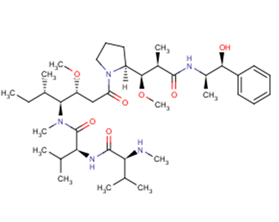
Monomethyl auristatin E
CAS No. 474645-27-7
Monomethyl auristatin E( MMAE | Vedotin | Monomethyl auristatin E )
Catalog No. M17516 CAS No. 474645-27-7
Monomethyl auristatin E (MMAE), an antimitotic agent, inhibits cell division by blocking the polymerization of tubulin and also has inhibition of antibody-drug conjugates (ADCs) activity.
Purity : >98% (HPLC)
 COA
Datasheet
HNMR
HPLC
MSDS
Handing Instructions
COA
Datasheet
HNMR
HPLC
MSDS
Handing Instructions
| Size | Price / USD | Stock | Quantity |
| 10MG | 39 | In Stock |


|
| 25MG | 61 | In Stock |
|
| 50MG | 85 | In Stock |
|
| 100MG | Get Quote | In Stock |
|
| 200MG | Get Quote | In Stock |
|
| 500MG | Get Quote | In Stock |
|
| 1G | Get Quote | In Stock |
|
Biological Information
-
Product NameMonomethyl auristatin E
-
NoteResearch use only, not for human use.
-
Brief DescriptionMonomethyl auristatin E (MMAE), an antimitotic agent, inhibits cell division by blocking the polymerization of tubulin and also has inhibition of antibody-drug conjugates (ADCs) activity.
-
DescriptionMMAE, also known as Monomethyl auristatin E, is a synthetic antineoplastic agent. Because of its toxicity, it cannot be used as a drug itself; instead, it is linked to a monoclonal antibody (MAB) which directs it to the cancer cells. In International Nonproprietary Names for MMAE-MAB-conjugates, the name vedotin refers to MMAE plus its linking structure to the antibody. MMAE is a potent antimitotic drug derived from peptides occurring in marine shell-less mollusc Dolabella auricularia called dolastatins which show potent activity in preclinical studies, both in vitro and in vivo, against a range of lymphomas, leukemia and solid tumors. MMAE show potency of up to 200 times that of vinblastine, another antimitotic drug used for Hodgkin lymphoma as well as other types of cancer.
-
In Vitro——
-
In Vivo——
-
SynonymsMMAE | Vedotin | Monomethyl auristatin E
-
PathwayNeuroscience
-
TargetGamma-secretase
-
Recptormicrotubule
-
Research AreaCancer
-
Indication——
Chemical Information
-
CAS Number474645-27-7
-
Formula Weight717.98
-
Molecular FormulaC39H67N5O7
-
Purity>98% (HPLC)
-
SolubilityDMSO : ≥ 48 mg/mL; 66.85 mM
-
SMILESC(=O)([C@H](C(C)C)NC(=O)[C@H](C(C)C)NC)N(C)[C@H]([C@@H](CC(=O)N1[C@@H](CCC1)[C@@H]([C@H](C(=O)N[C@@H]([C@H](c1ccccc1)O)C)C)OC)OC)[C@H](CC)C
-
Chemical Name(S)-2-(((3R,4S,5S)-1-((S)-2-((1R,2R)-3-(((1S,2R)-1-hydroxy-1-phenylpropan-2-yl)amino)-1-methoxy-2-methyl-3-oxopropyl)pyrrolidin-1-yl)-3-methoxy-5-methyl-1-oxoheptan-4-yl)(methyl)amino)-3-methyl-N-((S)-3-methyl-2-(methylamino)butanoyl)butanamide.
Shipping & Storage Information
-
Storage(-20℃)
-
ShippingWith Ice Pack
-
Stability≥ 2 years
Reference
1. Francisco JA, et al. Blood. 2003, 102(4), 1458-1465.
molnova catalog



related products
-
Demcizumab
Demcizumab (OMP 21M18) is an anti-DLL4 monoclonal antibody and a potent Notch pathway inhibitor, demonstrating efficacy in various cancer models both as a monotherapy and in conjunction with chemotherapy agents.
-
γ-Secretase-IN-1
γ-Secretase-IN-1 is a potent γ-secretase inhibitor that displays partial antiproliferative activity on T-47D cells and inhibits β-amyloid(40), β-amyloid(42), and Notch γ-secretase cleavage.
-
HDAC6-IN-9
HDAC6-IN-9 is an orally active and highly effective γ-secretase modulator that can significantly reduce the level of Aβ42 in mouse brain and can be used to study neurological diseases.
