


 Cart
Cart
 sales@molnova.com


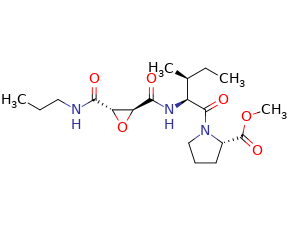
CA-074 methyl ester
CAS No. 147859-80-1
CA-074 methyl ester( LY300046 )
Catalog No. M17318 CAS No. 147859-80-1
CA-074 methyl ester is a specific inhibitor of Cathepsin B with neuroprotective, anti-cancer, and anti-inflammatory effects.
Purity : >98% (HPLC)
 COA
Datasheet
HNMR
HPLC
MSDS
Handing Instructions
COA
Datasheet
HNMR
HPLC
MSDS
Handing Instructions
| Size | Price / USD | Stock | Quantity |
| 1 mL x 10 mM in DMSO | 92 | In Stock |


|
| 2MG | 68 | In Stock |
|
| 5MG | 111 | In Stock |
|
| 10MG | 179 | In Stock |
|
| 25MG | 360 | In Stock |
|
| 50MG | 520 | In Stock |
|
| 100MG | 728 | In Stock |
|
| 200MG | 1004 | In Stock |
|
| 500MG | Get Quote | In Stock |
|
| 1G | Get Quote | In Stock |
|
Biological Information
-
Product NameCA-074 methyl ester
-
NoteResearch use only, not for human use.
-
Brief DescriptionCA-074 methyl ester is a specific inhibitor of Cathepsin B with neuroprotective, anti-cancer, and anti-inflammatory effects.
-
DescriptionCa-074Me is a selective and cell-permeable inhibitor of cathepsin B.(In Vitro):CA-074Me (5 μM and 50 μM) inhibits RANKL-induced osteoclastogenesis in BMM cells derived from C57BL/6J and NOD/ShiLtJ mice. CA-074Me exerts its anti-osteoclastogenic effect within 24 hours post-RANKL stimulation in vitro. CA-074Me does not exert its anti-osteoclastogenic effect via the MAPK-ERK signaling cascade. CA-074Me inhibits c-FOS upregulation and subsequent NFATc1 autoamplification following RANKL stimulation.. CA-074Me reduces apoptosis induced by CVB1. (In Vivo):Hippocampal CA1 neuronal programmed necrosis induced by global cerebral I/R injury is prevented by CA074-me (1 μg, 10 μg) both pre-treatment and post-treatment. The rupture of lysosomal membrane and the leakage of cathepsin-B, and this is strongly inhibited by CA074-me pre-treatment. The overexpression and nuclear translocation of RIP3 and the reduction of NAD+ level after I/R injury are also inhibited, while the upregulation of Hsp70 is strengthened by CA074-me pre-treatment. CA-074Me (30 mg/kg) is capable of inhibiting osteoclastogenesis and bone degradation in vivo. In the CVB+CA-074Me (4 mg/kg/day i.m.) guinea pigs group, the scores of inflammation significantly decrease in comparison with the CVB+None group. In CVB+CA-074Me group, the number of CD8+T cells decrease in comparison with the sham group.
-
In Vitro——
-
In Vivo——
-
SynonymsLY300046
-
PathwayAngiogenesis
-
TargetPKC
-
RecptorCathepsin B
-
Research AreaNeurological Disease
-
Indication——
Chemical Information
-
CAS Number147859-80-1
-
Formula Weight397.5
-
Molecular FormulaC19H31N3O6
-
Purity>98% (HPLC)
-
SolubilityDMSO : ≥ 215 mg/mL. 540.92 mM; H2O : 26.66 mg/mL. 67.07 mM;
-
SMILESCCCNC(=O)[C@@H]1[C@H](O1)C(=O)N[C@@H]([C@@H](C)CC)C(=O)N1CCC[C@@H]1C(=O)OC
-
Chemical NameN-(L-3-trans-Propylcarbonyl-oxirane-2-carbonyl)-L-isoleucyl-L-proline methyl ester
Shipping & Storage Information
-
Storage(-20℃)
-
ShippingWith Ice Pack
-
Stability≥ 2 years
Reference
1.Xu Y, et al. Brain Res Bull. 2016 Jan;120:97-105.
molnova catalog



related products
-
AS2521780
AS2521780 is a?potent, selective, orally bioavailable PKCθ inhibitor that inhibits combinant human PKCθ enzyme with IC50 of 0.48 nM.
-
PKC412
A potent, selective PKC inhibitor with IC50 of 50 nM.
-
[Ala113]-MBP (104-11...
Synthetic peptide analog of bovine myelin basic protein (MBP). Non-competitive inhibitor of PKC (IC50 = 28 - 62 mM).
