


 Cart
Cart
 sales@molnova.com


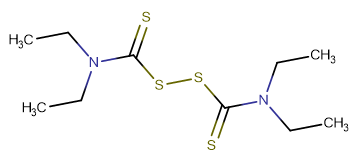
Disulfiram
CAS No. 97-77-8
Disulfiram( NSC 25953 | Tetraethylthiuram disulfide )
Catalog No. M16885 CAS No. 97-77-8
Disulfiram is a specific inhibitor of aldehyde-dehydrogenase (ALDH1), used for the treatment of chronic alcoholism by producing an acute sensitivity to alcohol.
Purity : >98% (HPLC)
 COA
Datasheet
HNMR
HPLC
MSDS
Handing Instructions
COA
Datasheet
HNMR
HPLC
MSDS
Handing Instructions
| Size | Price / USD | Stock | Quantity |
| 1 mL x 10 mM in DMSO | 46 | In Stock |


|
| 100MG | Get Quote | In Stock |
|
| 200MG | Get Quote | In Stock |
|
| 500MG | 33 | In Stock |
|
| 1G | 45 | In Stock |
|
Biological Information
-
Product NameDisulfiram
-
NoteResearch use only, not for human use.
-
Brief DescriptionDisulfiram is a specific inhibitor of aldehyde-dehydrogenase (ALDH1), used for the treatment of chronic alcoholism by producing an acute sensitivity to alcohol.
-
DescriptionDisulfiram is a specific inhibitor of aldehyde-dehydrogenase (ALDH1), used for the treatment of chronic alcoholism by producing an acute sensitivity to alcohol.(In Vitro):Disulfiram-copper complex potently inhibits the proteasomal activity in cultured breast cancer MDA-MB-231 and MCF10DCIS.com cells, but not normal, immortalized MCF-10A cells, before induction of apoptotic cancer cell death. Disulfiram (DS), a clinically used anti-alcoholism drug, strongly inhibits constitutive and 5-FU-induced NF-kappaB activity in a dose-dependent manner. Disulfiram inhibits both NF-kappaB nuclear translocation and DNA binding activity but has no effect on 5-FU-induced IkappaBalpha degradation. Disulfiram significantly enhances the apoptotic effect of 5-FU on DLD-1 and RKO(WT) cell lines and synergistically potentiated the cytotoxicity of 5-FU to both cell lines. Disulfiram also effectively abolishes 5-FU chemoresistance in a 5-FU resistant cell line H630(5-FU) in vitro. Oseltamivir decreases the number of viable cells, and the addition of CuCl2 significantly enhances the DSF-induced cell death to less than 10% of control. Disulfiram given to melanoma cells in combination with Cu2+ or Zn2+ decreases expression of cyclin A and reduces proliferation in vitro at lower concentrations than disulfiram alone.Disulfiram (0.1 nM-10 μM; 72 h) + Cu2+ combination enhances the cytotoxicity on ovarian cancer cell lines. (In Vivo):Disulfiram significantly inhibits the tumor growth (by 74%), associated with in vivo proteasome inhibition (as measured by decreased levels of tumor tissue proteasome activity and accumulation of ubiquitinated proteins and natural proteasome substrates p27 and Bax) and apoptosis induction (as shown by caspase activation and apoptotic nuclei formation) in mice bearing MDA-MB-231 tumor xenografts. Disulfiram blocks the P-glycoprotein extrusion pump, inhibits the transcription factor nuclear factor-kappaB, sensitizes tumors to chemotherapy, reduces angiogenesis, and inhibits tumor growth in mice. Disulfiram inhibits growth and angiogenesis in melanomas transplanted in severe combined immunodeficient mice, and these effects are potentiated by Zn2+ supplementation.
-
In Vitro——
-
In Vivo——
-
SynonymsNSC 25953 | Tetraethylthiuram disulfide
-
PathwayMetabolic Enzyme/Protease
-
TargetDehydrogenase
-
RecptorALDH1| DBH
-
Research AreaMetabolic Disease
-
Indication——
Chemical Information
-
CAS Number97-77-8
-
Formula Weight296.54
-
Molecular FormulaC10H20N2S4
-
Purity>98% (HPLC)
-
SolubilityEthanol: 59 mg/mL (198.96 mM); DMSO: 59 mg/mL (198.96 mM)
-
SMILESS=C(SSC(N(CC)CC)=S)N(CC)CC
-
Chemical NameBis(diethylthiocarbamyl) disulfide
Shipping & Storage Information
-
Storage(-20℃)
-
ShippingWith Ice Pack
-
Stability≥ 2 years
Reference
1.Mackenzie IS, et al. Arterioscler Thromb Vasc Biol. 2005 Sep; 25(9):1891-5.
molnova catalog



related products
-
TC HSD 21
TC HSD 21 is a potent and highly selective inhibitor of 17β-hydroxysteroid dehydrogenase type 3 (IC50 = 14 nM).
-
AGI-5198
AGI-5198 is the first highly potent and selective inhibitor of IDH1 R132H/R132C mutants with IC50 of 0.07 μM/0.16 μM.
-
MF-438
MF-438 is an effective and orally bioavailable stearoyl-CoA desaturase 1 (SCD1) inhibitor (EC50: 2.3 nM for rSCD1). In a mouse model, MF-438 shows an ED50 between 1 and 3 mg/kg.
