


 Cart
Cart
 sales@molnova.com


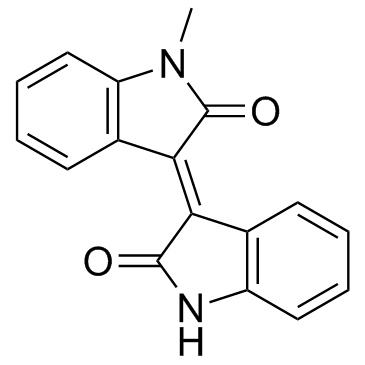
Methylisoindigotin
CAS No. 97207-47-1
Methylisoindigotin( Methylisoindigotin )
Catalog No. M16877 CAS No. 97207-47-1
Meisoindigo(Natura-α; N-Methylisoindigotin; Dian III), a derivative of Indigo naturalis, might induce apoptosis and myeloid differentiation of acute myeloid leukemia (AML).
Purity : >98% (HPLC)
 COA
Datasheet
HNMR
HPLC
MSDS
Handing Instructions
COA
Datasheet
HNMR
HPLC
MSDS
Handing Instructions
| Size | Price / USD | Stock | Quantity |
| 1 mL x 10 mM in DMSO | 67 | In Stock |


|
| 5MG | 61 | In Stock |
|
| 10MG | 85 | In Stock |
|
| 25MG | 169 | In Stock |
|
| 50MG | 253 | In Stock |
|
| 100MG | 398 | In Stock |
|
| 200MG | Get Quote | In Stock |
|
| 500MG | Get Quote | In Stock |
|
| 1G | Get Quote | In Stock |
|
Biological Information
-
Product NameMethylisoindigotin
-
NoteResearch use only, not for human use.
-
Brief DescriptionMeisoindigo(Natura-α; N-Methylisoindigotin; Dian III), a derivative of Indigo naturalis, might induce apoptosis and myeloid differentiation of acute myeloid leukemia (AML).
-
DescriptionMeisoindigo(Natura-α; N-Methylisoindigotin; Dian III), a derivative of Indigo naturalis, might induce apoptosis and myeloid differentiation of acute myeloid leukemia (AML).(In Vitro):Meisoindigo (Dian III; 5-20 μM; for 24 hours) inhibits growth of the AML cell lines.Meisoindigo (10 μM; for 24 hours) induces apoptosis of acute myeloid leukemia.Meisoindigo (5-10 μM; for 24 hours) causes cell-cycle arrest.Meisoindigo (5-10 μM; for 24 hours) increases the cleaved caspase-3 and pro-apoptotic Bak, and decreases Bcl-2 and Bcl-xL levels in HL-60 cells.Meisoindigo (10, 30, 50, 100, 150 μM; 24 hours) interdicts LPS-induced (1 μg/mL) NLRP3 inflammasome activation and M1/M2 polarization through down-regulation of TLR4 pathways after OGD/R in HT-22 and BV2 cells.(In Vivo):Meisoindigo (Dian III; 50-150 mg/kg; IP; daily; for 14 days) has anti-leukemic activity in vivo.Meisoindigo (2, 4, 8, 12 mg/kg; IP; before MCAO and 2 h after reperfusion) significantly reduces infarct volume, ameliorates neurological deficits 3 days after middle cerebral artery occlusion (MCAO) in Wild-type C57BL/6J mice (25-30 g). Meisoindigo reduces edema and lowers AQP4 expression in the brain.
-
In VitroMeisoindigo (Dian III; 5-20 μM; for 24?hours) inhibits growth of the AML cell lines. Meisoindigo (10?μM; for 24?hours) induces apoptosis of acute myeloid leukemia. Meisoindigo (5-10?μM; for 24?hours) causes cell-cycle arrest. Meisoindigo (5-10?μM; for 24?hours) increases the cleaved caspase-3 and pro-apoptotic Bak, and decreases Bcl-2 and Bcl-xL levels in HL-60 cells. Meisoindigo (10, 30, 50, 100, 150 μM; 24 hours) interdicts LPS-induced (1 μg/mL) NLRP3 inflammasome activation and M1/M2 polarization through down-regulation of TLR4 pathways after OGD/R in HT-22 and BV2 cells. Cell Viability Assay Cell Line:HL-60, NB4, U937 leukemic cell lines Concentration:5, 10, 15, 20 μM Incubation Time:For 24?hours Result:Inhibited growth of the AML cell lines in a dose- and time-dependent manner.Apoptosis Analysis Cell Line:HL-60 cells Concentration:10?μM Incubation Time:For 24?hours Result:Induced apoptosis of acute myeloid leukemia.Cell Cycle Analysis Cell Line:HL-60 cells Concentration:5, 10?μM Incubation Time:For 24?hours Result:Caused cell-cycle arrest, with more cells in sub-G1 and G0/G1 phases and fewer cells in the S phase, in a dose-dependent manner.Western Blot Analysis Cell Line:HL-60 cells Concentration:5, 10?μM Incubation Time:For 24?hours Result:Increased the cleaved caspase-3 and pro-apoptotic Bak, and decreased Bcl-2 and Bcl-xL levels in HL-60 cells.
-
In VivoMeisoindigo (Dian III; 50-150?mg/kg; IP; daily; for 14 days) has anti-leukemic activity in?vivo. Meisoindigo (2, 4, 8, 12 mg/kg; IP; before MCAO and 2 h after reperfusion) significantly reduces infarct volume, ameliorates neurological deficits 3 days after middle cerebral artery occlusion (MCAO) in Wild-type C57BL/6J mice (25-30 g). Meisoindigo reduces edema and lowers AQP4 expression in the brain. Animal Model:NOD/SCID mice, 6-8 weeks old, with HL-60 leukemic cellsDosage:50, 100, 150?mg/kg Administration:IP; daily; for 14 days Result:Had anti-leukemic activity in?vivo.
-
SynonymsMethylisoindigotin
-
PathwayApoptosis
-
TargetApoptosis
-
RecptorApoptosis inducer
-
Research AreaCancer
-
Indication——
Chemical Information
-
CAS Number97207-47-1
-
Formula Weight276.29
-
Molecular FormulaC17H12N2O2
-
Purity>98% (HPLC)
-
SolubilityDMSO: 10 mM
-
SMILESCN(C1=CC=CC=C1/C2=C3C(NC4=C\3C=CC=C4)=O)C2=O
-
Chemical Name(E)-1,1'-dimethyl-[3,3'-biindolinylidene]-2,2'-dione
Shipping & Storage Information
-
Storage(-20℃)
-
ShippingWith Ice Pack
-
Stability≥ 2 years
Reference
1. Lee CC, et al. Leuk Lymphoma. 2010 May;51(5):897-905.
molnova catalog



related products
-
Phenformin
Phenformin (BRN 1977317) is a biguanide compound with anticancer and anti-glycemic activity, inhibits skin tumor growth and promotes keratinocyte differentiation and apoptosis.
-
Azadirachtin
Azadirachtin has antifungal activity, used as an insecticide.
-
Dihydrolycorine
Dihydrolycorine-HCL(DL) shows hypotensive effects, it can block alpha 1-adrenoceptors.
