


 Cart
Cart
 sales@molnova.com


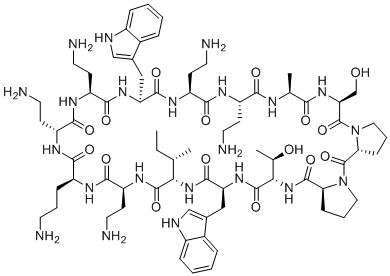
Murepavadin
CAS No. 944252-63-5
Murepavadin( POL7080 | POL 7080 )
Catalog No. M16763 CAS No. 944252-63-5
Murepavadin (POL7080) is a highly potent, specific, macrocycle Pseudomonas antibiotic for the treatment of bacterial infections caused by Pseudomonas aeruginosa.
Purity : >98% (HPLC)
 COA
Datasheet
HNMR
HPLC
MSDS
Handing Instructions
COA
Datasheet
HNMR
HPLC
MSDS
Handing Instructions
| Size | Price / USD | Stock | Quantity |
| 100MG | Get Quote | Get Quote |


|
| 200MG | Get Quote | Get Quote |
|
| 500MG | Get Quote | Get Quote |
|
| 1G | Get Quote | Get Quote |
|
Biological Information
-
Product NameMurepavadin
-
NoteResearch use only, not for human use.
-
Brief DescriptionMurepavadin (POL7080) is a highly potent, specific, macrocycle Pseudomonas antibiotic for the treatment of bacterial infections caused by Pseudomonas aeruginosa.
-
DescriptionMurepavadin (POL7080) is a highly potent, specific, macrocycle Pseudomonas antibiotic for the treatment of bacterial infections caused by Pseudomonas aeruginosa.Bacterial Infection Phase 3 Clinical.
-
In VitroMurepavadin has activity against P. aeruginosa with MIC50 and MIC90 values both of 0.12 mg/L.Murepavadin inhibits megalin-mediated uptake of gentamicin in vitro with an IC50 value of 5.84 μM.
-
In VivoMurepavadin (s.c.; 0-100 mg/kg) is active in pre-clinical animal models including infections with XDR isolates. Animal Model:murine models of P. aeruginosa infectionDosage:0-100 mg/kg Administration:Subcutaneous, q24h or q12h Result:Resulted in an increase in survival rate to 100% and showed significantly lower CFU levels both in the blood and in the peritoneal fluid at 2 and 10 mg/kg 1 h post-infection.Animal Model:Mouse, rat, rabbit, and monkey Dosage:0-5 mg/kg Administration:Intraperitoneal or subcutaneous, single Result:Followed a two-compartment model following intravenous administration and decline of plasma concentrations.Distributed into the aqueous phase of the body, and systemic plasma clearance (CL) values were similar to the species-specific glomerular filtration rates (GFRs) .Had high bioavailability (67.79%) after subcutaneous (s.c.) administration in rats but had low oral bioavailability (<0.01%).Had a linear relationship between ELF AUC and unbound plasma AUC in mouse.
-
SynonymsPOL7080 | POL 7080
-
PathwayGPCR/G Protein
-
TargetAntibacterial
-
RecptorAntibacterial
-
Research AreaInfection
-
IndicationBacterial Infection
Chemical Information
-
CAS Number944252-63-5
-
Formula Weight1553.837
-
Molecular FormulaC73H112N22O16
-
Purity>98% (HPLC)
-
Solubility——
-
SMILESCCC(C)C1C(=O)NC(C(=O)NC(C(=O)NC(C(=O)NC(C(=O)NC(C(=O)NC(C(=O)NC(C(=O)NC(C(=O)NC(C(=O)N2CCCC2C(=O)N3CCCC3C(=O)NC(C(=O)NC(C(=O)N1)CC4=CNC5=CC=CC=C54)C(C)O)CO)C)CCN)CCN)CC6=CNC7=CC=CC=C76)CCN)CCN)CCCN)CCN
-
Chemical Namecyclo[Ala-Ser-D-Pro-Pro-Thr-Trp-Ile-Dab-Orn-D-Dab-Dab-Trp-Dab-Dab]
Shipping & Storage Information
-
Storage(-20℃)
-
ShippingWith Ice Pack
-
Stability≥ 2 years
Reference
1. Bassetti M, et al. Curr Opin Infect Dis. 2018 Jan 13. doi: 10.1097/QCO.0000000000000438.
molnova catalog



related products
-
LED-209
LED-209 is a bacterial conserved membrane histidine sensor kinase QseC inhibitor.
-
Phenylmercuric aceta...
A phenyl mercury compound used mainly as a fungicide. Has also been used as a herbicide slimicide and bacteriocide.
-
Sodium citrate dihyd...
Sodium citrate dihydrate is an anticoagulant, and also used as a buffer and food preservatives.
