


 Cart
Cart
 sales@molnova.com


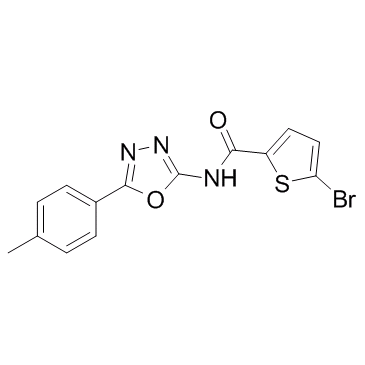
KKL-10
CAS No. 952849-76-2
KKL-10( KKL10 )
Catalog No. M16811 CAS No. 952849-76-2
KKL-10 is a small-molecule inhibitor of bacterial ribosome rescue that exhibits broad-spectrum antimicrobial activity against bacteria grown in liquid culture.
Purity : >98% (HPLC)
 COA
Datasheet
HNMR
HPLC
MSDS
Handing Instructions
COA
Datasheet
HNMR
HPLC
MSDS
Handing Instructions
| Size | Price / USD | Stock | Quantity |
| 2MG | 48 | In Stock |


|
| 5MG | 77 | In Stock |
|
| 10MG | 130 | In Stock |
|
| 25MG | 250 | In Stock |
|
| 50MG | 423 | In Stock |
|
| 100MG | 616 | In Stock |
|
| 200MG | Get Quote | In Stock |
|
| 500MG | Get Quote | In Stock |
|
| 1G | Get Quote | In Stock |
|
Biological Information
-
Product NameKKL-10
-
NoteResearch use only, not for human use.
-
Brief DescriptionKKL-10 is a small-molecule inhibitor of bacterial ribosome rescue that exhibits broad-spectrum antimicrobial activity against bacteria grown in liquid culture.
-
DescriptionKKL-10 is a small-molecule inhibitor of bacterial ribosome rescue that exhibits broad-spectrum antimicrobial activity against bacteria grown in liquid culture; exhibits exceptional antimicrobial activity against both attenuated (LVS) and fully virulent strains of F. tularensis (Schu S4) in vitro with MIC of 0.12 and 0.48 ug/mL, respectively; arrests intracellular growth of F. tularensis during all stages of infection, does not affect macrophage viability or function.
-
In VitroThe ribosome rescue inhibitor KKL-10 exhibits exceptional antimicrobial activity against both attenuated and fully virulent strains of F. tularensis. The minimum inhibitory concentration (MIC) against F. tularensis strain LVS and Schu S4 are 0.12 and 0.48 μg/mL, respectively. KKL-10 arrests intracellular growth of F. tularensis during all stages of infection. KKL-10 does not affect macrophage viability or function. KKL-10 produces cytotoxic effects of less than 5% at concentrations up to 17.5 μg/mL. The combination of IFN-γ stimulation and KKL-10 activity results in a reduction of the bacterial load by >99.9%. KKL-10 is also able to inhibit growth of F. tularensis inside eukaryotic cells and show no toxicity to HepG2 cells.
-
In Vivo——
-
SynonymsKKL10
-
PathwayGPCR/G Protein
-
TargetAntibacterial
-
Recptorribosomerescue
-
Research Area——
-
Indication——
Chemical Information
-
CAS Number952849-76-2
-
Formula Weight364.217
-
Molecular Formula4H10BrN3O2S
-
Purity>98% (HPLC)
-
SolubilityDMSO: Soluble ( < 1 mg/ml refers to the product slightly soluble or insoluble )
-
SMILESO=C(C1=CC=C(Br)S1)NC2=NN=C(C3=CC=C(C)C=C3)O2
-
Chemical Name5-Bromo-N-[5-(4-methylphenyl)-1,3,4-oxadiazol-2-yl]-2-thiophenecarboxamide
Shipping & Storage Information
-
Storage(-20℃)
-
ShippingWith Ice Pack
-
Stability≥ 2 years
Reference
1. Goralski TD, et al. Antimicrob Agents Chemother. 2016 May 23;60(6):3276-82.
molnova catalog



related products
-
Antibacterial agent ...
Antibacterial Agent 125 exhibits potent antimicrobial activity against clinically relevant Gram-positive pathogens, displaying Minimum Inhibitory Concentration (MIC) 50 values ranging from 0.25 to 8 μM. It is suitable for researching antimicrobial resistance.
-
Solithromycin
A novel fluoroketolide with lower MICs than those of telithromycin and macrolides.
-
Ethambutol dihydroch...
Nocodazole is an inhibitor of microtubule polymerization which inhibits insulin-stimulated glucose transport.
