


 Cart
Cart
 sales@molnova.com


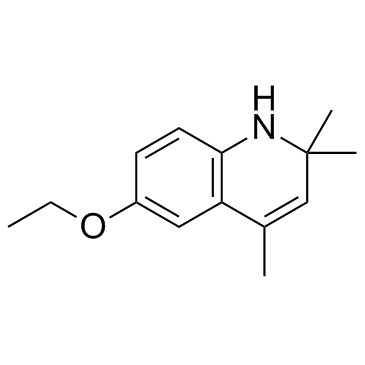
Ethoxyquin
CAS No. 91-53-2
Ethoxyquin( NSC 6795 )
Catalog No. M16574 CAS No. 91-53-2
Antioxidant; also a post-harvest dip to prevent scald on apples and pears.
Purity : >98% (HPLC)
 COA
Datasheet
HNMR
HPLC
MSDS
Handing Instructions
COA
Datasheet
HNMR
HPLC
MSDS
Handing Instructions
| Size | Price / USD | Stock | Quantity |
| 1 mL x 10 mM in DMSO | 41 | In Stock |


|
| 100MG | Get Quote | In Stock |
|
| 200MG | Get Quote | In Stock |
|
| 500MG | Get Quote | In Stock |
|
| 1G | 27 | In Stock |
|
Biological Information
-
Product NameEthoxyquin
-
NoteResearch use only, not for human use.
-
Brief DescriptionAntioxidant; also a post-harvest dip to prevent scald on apples and pears.
-
DescriptionAntioxidant; also a post-harvest dip to prevent scald on apples and pears.(In Vitro):Ethoxyquin (EQ) does not block Paclitaxel’s (PTX’s) ability to induce cell death in 4 different breast cancer cell lines. Results demonstrate that only when Hsp90 level is down regulated is neuroprotec-tion provided by Ethoxyquin (EQ) no longer seen. It is found that Ethoxyquin provides neuroprotection with a best efficacy range from 30 to 300 nM. It is interesting to note that higher (μM) concentrations of Ethoxyquin do not provide further neuroprotection and in fact at these higher concentrations Ethoxyquin loses its neuroprotective effects.(In Vivo):Ethoxyquin (EQ) provides a dose-dependent neuroprotection. Although all 3 doses of Ethoxyquin provide partial neuroprotection against reduction in intraepidermal nerve fiber density, the peak efficacy is with the 75 μg/kg dose. Rats treated with Ethoxyquin (EQ) alone or control vehicle treated rats gain weight as expected under normal physiological conditions.
-
In VitroEthoxyquin (EQ) does not block Paclitaxel’s (PTX’s) ability to induce cell death in 4 different breast cancer cell lines. Results demonstrate that only when Hsp90 level is down regulated is neuroprotec-tion provided by Ethoxyquin (EQ) no longer seen. It is found that Ethoxyquin provides neuroprotection with a best efficacy range from 30 to 300?nM. It is interesting to note that higher (μM) concentrations of Ethoxyquin do not provide further neuroprotection and in fact at these higher concentrations Ethoxyquin loses its neuroprotective effects.
-
In VivoEthoxyquin (EQ) provides a dose-dependent neuroprotection. Although all 3 doses of Ethoxyquin provide partial neuroprotection against reduction in intraepidermal nerve fiber density, the peak efficacy is with the 75 μg/kg dose. Rats treated with Ethoxyquin (EQ) alone or control vehicle treated rats gain weight as expected under normal physiological conditions.
-
SynonymsNSC 6795
-
PathwayOthers
-
TargetOther Targets
-
RecptorOthers
-
Research Area——
-
Indication——
Chemical Information
-
CAS Number91-53-2
-
Formula Weight217.31
-
Molecular FormulaC14H19NO
-
Purity>98% (HPLC)
-
SolubilityDMSO: 10 mM
-
SMILESCC1=CC(C)(C)NC2=C1C=C(OCC)C=C2
-
Chemical Name6-ethoxy-2,2,4-trimethyl-1,2-dihydroquinoline
Shipping & Storage Information
-
Storage(-20℃)
-
ShippingWith Ice Pack
-
Stability≥ 2 years
Reference
1. Rubel DM, Freeman S. Australas J Dermatol. 1998 May;39(2):89-9
molnova catalog



related products
-
LL - 37, reverse seq...
LL - 37, reverse sequence
-
lorvotuzumab
Lorvotuzumab (Anti-NCAM1/CD56 Reference Antibody (lorvotuzumab)) is a humanized monoclonal antibody that binds to CD56 (NCAM1) and can be used to synthesize the antibody-drug conjugate Lorvotuzumab mertansine.
-
Genistein 8-c-glucos...
Genistein 8-c-glucoside (G8CG), a natural glucoside isolated from the flowers of Lupinus luteus L., induces mitochondrial membrane depolarization and apoptosis.
